Welcome to Massage Educator, a resource created exclusively for massage schools and instructors. Each newsletter is filled with classroom tools and activities, important industry information, and links to ABMP resources created for schools and instructors.
Want to know more about how ABMP supports schools, educators, and students? Contact us at education@abmp.com.
Current Issue
2025 Issue 3
- How Massage Educators Can Use GenAI
- ABMP Massage School Survey
- Training New Massage Instructors
- Philanthropy at The Healing Arts Center
- Meet the ABMP Team

How Massage Educators Can Use Gen AI
By Amanda Baskwill, PhD
Running a massage therapy program means wearing many hats: educator, administrator, mentor, and often, problem-solver-in-chief. Between building lesson plans, hiring instructors, completing performance reviews, and supporting recruitment efforts, the administrative load is substantial. Generative artificial intelligence (GenAI) offers new possibilities to lighten that load.
Tools like ChatGPT, Gemini, and Microsoft Copilot respond to natural language prompts to generate text, images, or code. While not a replacement for human expertise, GenAI tools can assist behind the scenes, especially where dreaming (big-picture thinking), drudgery (repetitive tasks), and designing (creative planning) are required.1 With thoughtful use, GenAI can free up time and mental energy so you can focus more on what matters: students, learning, and leadership.
Here are some practical ways you and your school can use GenAI to reduce workload and improve workflow in people management, academic planning, and program operations.
Read more
Streamline Human Resource Responsibilities
Hiring, onboarding, and staff support are critical parts of leading an educational program, but they also come with recurring administrative tasks. GenAI can assist with job postings, onboarding materials, and even performance reviews.
For example, GenAI can revise existing job descriptions to be more student-centered or inclusive, write strengths-based review comments for staff, or suggest professional development goals aligned with a team member’s interests. It can also help format or draft onboarding checklists, welcome letters, or internal memos to keep things moving smoothly when new staff join your team.
Use GenAI to Support Academic Planning
Massage educators are expert practitioners, but not everyone has formal training in curriculum design. Whether you’re revising an old lesson plan or building a new course from scratch, GenAI can offer inspiration, structure, and formatting support.
Need a lesson plan that aligns with a specific competency? GenAI can generate a draft outline you can then refine and adapt. Working on a practical exam? These tools can offer scenarios and evaluation criteria to start your thinking. They’re especially helpful when time is tight, or when you’re facing a bit of curriculum writer’s block.
Even small tasks, like drafting email reminders or building rubrics, can take a surprising amount of time. GenAI won’t do the teaching for you, but it can reduce the time that academic planning and content development require.
Get Behind-the-Scenes Support
Beyond teaching, school leaders are often responsible for a wide range of operational and administrative work. From faculty meetings to policy creation, the to-do list is long. This is another area where GenAI can assist. Whether it’s helping you brainstorm clinic rotations, draft respectful communication guidelines for student clinicians, or outline a faculty meeting agenda, these tools can provide a structured starting point for your work.
Of course, GenAI outputs should always be reviewed for accuracy, professionalism, and alignment with regulatory requirements. But the time savings comes from starting with a draft rather than a blank page and from shifting your role from content creator to thoughtful editor.
Final Thoughts: Using GenAI Wisely
Generative AI is not a magic fix or a one-size-fits-all solution, but it is a powerful support tool. Whether you’re hiring, planning lessons, managing the clinic, or communicating with students, GenAI can help reduce the mental load and give you back time and energy.
Used thoughtfully, GenAI can support the dreaming, drudgery, and designing that are part of program leadership and teaching.2 It allows you to think bigger, move faster, and communicate more clearly—especially when you’re juggling competing priorities.
In the end, it’s not about doing less. It’s about making space to do more of what matters: connecting with students, leading your team, and shaping meaningful learning experiences.
Try some of these prompts to explore how GenAI might help you:
“Revise this job posting to highlight inclusive practices and student-centered teaching.”
“Create a lesson plan for a two-hour class on the ethical considerations of touch in massage therapy.”
“Draft a grading rubric for assessing student technique during a Swedish massage practical exam.”
“Outline a weekly clinic schedule for 12 students and two supervisors that maximizes client diversity.”
“Write a respectful communication guideline for students working with the public in the massage clinic.”
Notes
1. Stanford Teaching Commons, “Exploring Pedagogical Uses of AI Chatbots,” Stanford University (2023), https://teachingcommons.stanford.edu/teaching-guides/artificial-intelligence-teaching-guide/exploring-pedagogical-uses-ai-chatbots
2. Stanford Teaching Commons, “Exploring Pedagogical Uses of AI Chatbots,” Stanford University.
Amanda Baskwill, PhD, was a presenter at the 2025 ABMP School Forum in Denver.
Numbers of Schools and Graduates Show Slight Increase
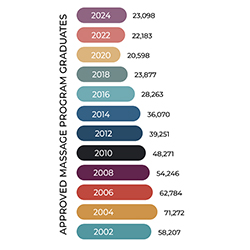
ABMP completed its biennial school graduate census for massage programs and the results show massage school graduations increased slightly in the past two years.
Between reported answers ABMP gathered, US Department of Education graduate data, and projections for those programs that failed to participate, it is estimated that 23,098 people graduated from 914 massage programs in 2024. This compares to the estimate of 22,183 from 872 programs in 2022. The average number of graduates per program is 25.3, compared to 25.4 in 2022.
To get to these numbers, we started with 946 programs in our database, and initiated email solicitations, followed by 5–6 calls (for schools that didn’t respond) over a period of six weeks. Through diligent efforts by the survey team, 74 percent of programs in our system participated. As usual, our estimate takes the responses and extrapolates a number for the non-participating programs at a slight discount to the average from the responding programs.
The number of graduates has increased for the second survey in a row—even if slightly. While the total graduate number reached its low point in 2020 during COVID, there have been modest increases since then.
As noted, the number of programs increased 4.8 percent, from 872 to 914. This was the first time the total number of massage programs increased in the biennial period between surveys since the period from 2006–2008.
Training New Instructors
By Jimmy Gialelis, LMT, BCTMB
As a former entry-level instructor at three separate massage therapy schools, I learned many lessons on “how to teach” on my own accord. But there were several things I wish school management would have helped prepare me for. Let’s see if any of these resonate with you and your school.
Read more
Encourage Self-Awareness and Professionalism
My introduction to teaching was daunting. Within my third month as a teaching assistant, the anatomy teacher quit. My campus director brought me out of one classroom and informed me I would be teaching in another. She handed me an anatomy textbook and said “good luck, kid” as she walked me into a room of 50 adults awaiting their lesson. Admittedly, this was not my finest teaching performance.
The experience, however, did not curtail me from pursuing a teaching career. As the years progressed, I began honing my crafts, as both a massage therapist and teaching assistant. I recognized the areas of growth I would need to become an instructor. Awareness of myself was my first major lesson. I learned I needed to embody the attributes of a successful massage therapist. Being an example of success in the field would be an asset in the classroom.
As I continued to mature as a massage therapist, I learned how to embody hallmark traits of massage including exemplifying honesty, awareness, and compassion. I practiced interacting with students as a teaching assistant in the same manner as I would converse with my massage clientele. Employing active listening, using reflective language, and asking open-ended questions allowed me to interact with students in a respectful, positive manner. When training new instructors, especially those you pull from your recent graduate pool, it is wise to recognize there are attributes that can make a successful massage therapist also be a successful instructor.
Offer True Training
Ensure you’re providing new instructors with an actual training program. I have seen some new instructors simply be told to meet with an established veteran instructor “whenever you can to review course content.” This approach rarely succeeds and places undue pressure on the veteran instructor who already has a full load. This veteran most likely will not have the time or energy to devote the level of attention required for an impactful training process. I advise either having the director of education conduct the training or schedule a formal training session with appropriate trainers that is planned and set well ahead of the new hire’s start date.
Dial In Student Communication
A new hire’s training needs to entail aspects of communication with students of all types. An entry-level classroom is a microcosm of society in many ways, with people from all walks of life and backgrounds present. Role-playing scenarios can be a wonderful training tactic to prepare for expected and unexpected student encounters.
When I began teaching, I was told that my job in the classroom was “50 percent managing course content, 50 percent managing people.” I understood it was my responsibility to ensure I comprehend course content, and I appreciated my education director providing me with a lighter schedule in my first quarter of teaching to ensure sufficient time preparing content.
Managing people was the more difficult aspect for me. Some situations to prepare new teachers for include:
- The uninspired student who insists they do not want to complete homework because there is no value in the assignments.
- The exceptional student who is frustrated the class is moving at a slower pace than they desire.
- The challenging student acting out behaviorally, not following classroom policies, and blatantly disrespecting the teacher and fellow students.
- The dishonest student who lies about classroom actions.
- The cohort which consistently talks during lectures and will not stop talking no matter how much requesting or admonishing is done by the instructor.
These students can challenge a teacher to a breaking point, resulting in teachers losing their passion for teaching and “their cool” in the classroom.
Preparing new teachers with a well-planned training plan ahead of time (rather than baptism by fire) and helping them work through communication skills will yield more successful entry-level massage instructors in your classrooms.
Pro Tip: All ABMP Premier School members have access to Cornerstones: The ABMP Instructor Development Program. This 25-hour online teacher training program covers everything from handling difficult classroom behaviors to building lesson plans to getting the most learning out of your student clinic experience. Learn more at abmp.com/cornerstones.
Check Out the Good Work of The Healing Arts Center
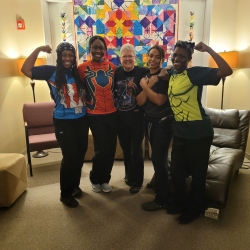
We are excited to share the philanthropic work of the team at The Healing Arts Center in St. Louis, Missouri—a school that exemplifies what ABMP’s Massage Is for EveryBody mission is about.
Meet Your ABMP Team
Is your school part of the ABMP family? ABMP School membership includes a variety of resources for students, and lesson plans, tools, and presentations to help your faculty and students succeed. Learn more at abmp.com/educators or email our school liaisons at education@abmp.com with your questions and to request a 15-minute virtual school resource tour today!

Jessica Cooke
ABMP School Engagement Specialist
jessicac@abmp.com
800-458-2267, ext. 1687
"My role at ABMP allows me to pull from life experiences and apply them when speaking with schools and students about our multifaceted programs and comprehensive insurance. I cannot wait to connect with each of you!"

Amber Edwards
ABMP School Liaison
AmberE@abmp.com
800-458-2267, ext. 1613
"My favorite resource to share with schools is Five-Minute Muscles. I would’ve given my eye teeth as a student to have the palpation, muscle-skeleton overlay, and dissection videos!"
Areas Covered: Alaska, Arizona, California, Colorado, Connecticut, Delaware, D.C., Hawaii, Idaho, Kentucky, Maine, Maryland, Massachusetts, Montana, Nebraska, Nevada, New Hampshire, New Jersey, New Mexico, New York, North Carolina, North Dakota, Ohio, Oregon, Pennsylvania, Rhode Island, South Dakota, Utah, Vermont, Virginia, Washington, West Virginia, Wyoming

Brian Sinclair
ABMP School Liaison
Brian@abmp.com
800-458-2267, ext. 1633
"My favorite thing about working with schools is being at the beginning of a student's journey to becoming a massage practitioner, and helping schools send amazing professionals into the world."
Areas Covered: Alabama, Arkansas, Florida, Georgia, Illinois, Indiana, Iowa, Kansas, Louisiana, Michigan, Minnesota, Mississippi, Missouri, Oklahoma, Puerto Rico, South Carolina, Tennessee, Texas, US Virgin Islands, Wisconsin