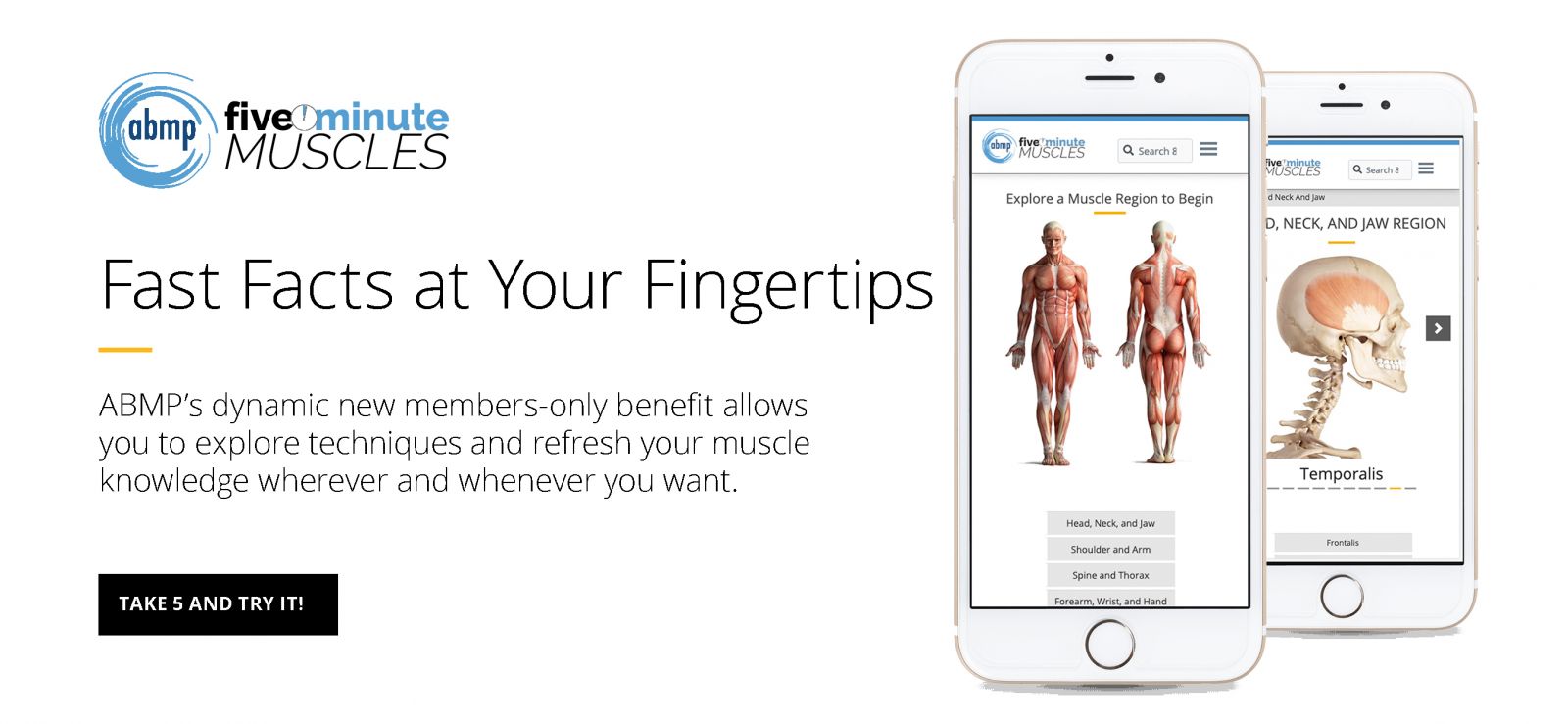
This quick reference program puts key information for 83 muscles at your fingertips.
- Do you have a client with shoulder pain and need a speedy review? Look up the origins, insertions, and actions of shoulder muscles in seconds, or explore a quick animated illustration.
- Practicing advanced bodywork techniques and want a reminder of the primary muscles that extend the hip? Log in on your phone, tablet, or laptop and find them fast!
- Want some new ideas for hands-on techniques to address the deltoid muscle, or a refresher on palpation of the scalenes? We’ve got video for that!
- Have more time and want a deep dive into the levator scapulae? Explore the dissection videos, or check out the “More Information” section on each muscle where you’ll find muscle-related ABMP webinars and Massage & Bodywork articles from the top educators in our field.
Contact ABMP
Want to share your thoughts and feedback about ABMP Five-Minute Muscles? We want to hear from you. Send your comments to fiveminutemuscles@abmp.com.
Caution First
The techniques shown by master practitioner Clint Chandler in the palpation and technique videos may be advanced for some massage therapists. Please work cautiously and adhere to professional standards by obtaining a health intake and ruling out contraindications before providing massage therapy to clients.
Why 83 Muscles?
ABMP Five-Minute Muscles launched with the muscles that are specified by the Entry-Level Analysis Project (ELAP) as being necessary for foundational massage education. We are always open to expanding content, so please email fiveminutemuscles@abmp.com if you feel there are specific muscles we should add.
Why Are There Discrepancies in Anatomy Terms and Teachings?
The purpose of anatomical terminology is to communicate precise information on position of and relationships among individual structures of the human body. Whether charting findings from a session with a patient/client or communicating with another health-care provider, the use of a common anatomical language is imperative for clear understanding, which ultimately provides accuracy and patient safety.
In some cases, however, you will see discrepancies in the anatomical terms themselves, as well as descriptions of specific structures. This occurs for a couple of reasons:
- Anatomical language continues to evolve as clinicians find more precise and accurate ways to describe position of and relationships between structures. It’s a good thing, as it enhances communication among practitioners.
- Because anatomical terminology is considered a language, there will naturally be variances in pronunciations, just as there are variances in accents and inflections among people from different countries and regions.
- No two bodies are alike. While anatomy is often seen as a precise study, it cannot be . . . due to the dynamic nature of the human body. When cadavers are dissected, variations and anomalies are naturally discovered.
We do our best to uphold a common language while also honoring the dynamic nature of the human body. In an effort to provide you with the most current anatomical terminology and structural descriptions, we have fact-checked all content among a minimum of three sources (including the Terminologia Anatomica, which is considered the international standard for human anatomical terminology).
Acknowledgements
Thank you to these subject-matter experts and fact-checkers for developing the content for ABMP Five-Minute Muscles: Clint Chandler, Brian Halterman, Dr. Joe Muscolino, Karrie Osborn, Cindy Williams, and Anne Williams.
Thank you to master practitioner Clint Chandler for demonstrations of muscle-specific palpation and soft-tissue manipulation videos and to Dr. Joe Muscolino for animated muscle illustrations and dissection videos..
Thank you to all of the ABMP staff who supported this project. A special thanks to Matt Barnes (video production), Lara Bracciante (project management, concept), Eric Esquibel (programming support), Stephen Harris (programming), Jed Heneberry (project management, concept), Karrie Osborn (editing, concept), Amy Kline (design), and Anne Williams (concept).
About Clint Chandler, B.S., C.N.M.T., L.M.T.
Clint Chandler’s professional career over the past 36 years has been dedicated to and focused on physical rehabilitation, pain management, and enhancing athletic performance. Chandler is a nationally recognized educator and research contributor who has participated in several innovative educational initiatives. He has also created digital educational tools in the form of DVDs and mobile applications directed at the treatment of tension-type headaches and palpatory anatomy instruction. His strong work ethic and belief in the therapeutic value of massage and bodywork is unprecedented. As full-time owner and operator of Corrective & Restorative Massage Therapy Services in Boulder, Colorado, Chandler is fully engaged in the advancement of the art and science of massage therapy and in bringing health and well-being to his clients.
About Dr. Joe Muscolino, D.C.
Dr. Joe Muscolino has been a manual and movement therapy educator for more than 35 years. He is a global educator and author of multiple textbooks, including The Muscle and Bone Palpation Manual and the Musculoskeletal Anatomy Coloring Book, as well as a longtime contributor to Massage & Bodywork magazine. Muscolino is the owner of LearnMuscles Continuing Education (LMCE), which is home to more than 3,000 video lessons and 300 hours of CE. He has been in private practice since 1985.
Works Consulted
- Berryman-Reese, N. Muscle and Sensory Testing. 3rd ed. St. Louis, Missouri: Elsevier Sanders, 2012.
- Gilroy, A., et al. Atlas of Anatomy. 3rd ed. New York, New York: Thieme Medical Publishers, 2016.
- Hamill, J., K. Knutzen, and T. Derrick. Biomechanical Basis of Human Movement. 4th ed. Baltimore, Maryland: Lippincott, Williams & Wilkins, 2015.
- Houglum, P. A., and D. B. Bertoti. Brunnstrom’s Clinical Kinesiology. 6th ed. Philadelphia, Pennsylvania: F.A. Davis Company, 2011.
- Klavora, P. Foundations of Kinesiology: Studying Human Movement and Health. 3rd ed. Toronto, California: Kinesiology Books Publisher, 2017.
- Lippert, L. S. Clinical Kinesiology and Anatomy. 6th ed. Philadelphia, Pennsylvania: F.A. Davis Company, 2017.
- Masaracchio, M., and C. Frommer. Clinical Guide to Musculoskeletal Palpation. Champaign, Illinois: Human Kinetics, 2014.
- McMillan, I. and G. Carin-Levy. Tyldesley and Grieve’s Muscles, Nerves and Movement in Human Occupation. 4th ed. Oxford: Wiley-Blackwell, 2012.
- Moore, K. L. and A. F. Dalley. Essential Clinical Anatomy. 5th ed. Baltimore, Maryland: Lippincott, Williams & Wilkins, 2015.
- Neumann, D. Kinesiology of the Musculoskeletal System: Foundations for Rehabilitation. 3rd ed. St. Louis, Missouri: Elsevier Sanders, 2017.
- Oatis, C. A. Kinesiology: The Mechanics and Pathomechanics of Human Movement. 3rd ed. Baltimore, Maryland: Lippincott, Williams & Wilkins, 2016.