


Pricing Is an Identity Issue, Not a Math Issue
By
Elicia Crook
Give yourself the credit you deserve when considering a price increase.
We're all on board with the idea that it's more efficient to keep the clients we already have coming back than it is to be constantly working to gain new clients, right? And that return clients offer many other benefits like new client referrals? Fantastic!
So, what's your current client retention rate (CRR)? Is it where you want it to be, or do you need to put a little more time and attention into your client retention strategies?
If you're like the majority of therapists I coach, you probably have a general sense of the number of clients who come back regularly, but you've never calculated your actual CRR before (and aren't sure how to get started). It's worth taking the time to calculate and track your rate because when you know the accurate percentage of clients who came back within a certain time frame, you can evaluate your current strategies and set measurable goals for growth. Or, as I like to say: know so you can grow.
Before we go through the steps to calculate your CRR, test your knowledge of your practice. Take a guess at what you think your rate is and we'll see how close you come to the actual figure. Now, let's do some math.
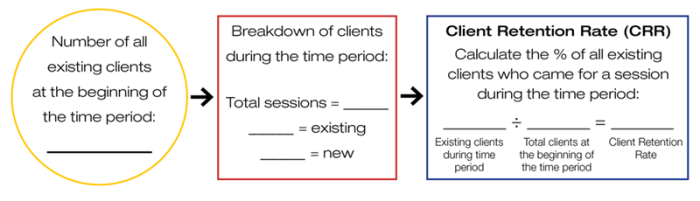
Follow these steps to calculate your CRR:
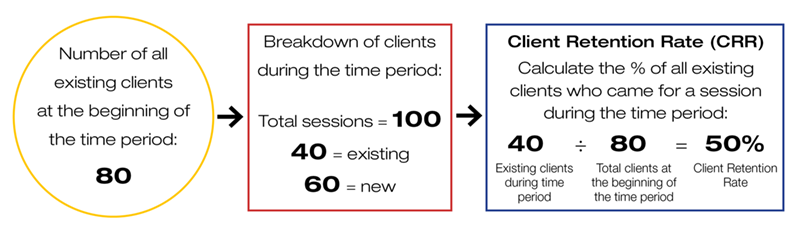
You've got your CRR for that time period! Now what? Let's look at some examples using figures from Mable's Massage Practice to show how you can use this formula to evaluate what's happening in your practice and set goals to make change. Here are Mable's initial figures.
With a CRR of 50 percent, Mable had to attract 60 new clients to get a total of 100 clients during the time period. That's a lot of marketing and sales work to gain those new clients, especially if she has to do that over and over each time period.
Let's look at an example with the same figures, but with a 75 percent CRR. How many new clients does Mable need to attract to make her goal of 100 sessions during the time period? The numbers show that if she increases her client retention efforts and is able to raise her CRR from 50 percent to 75 percent, she only needs to gain 40 new clients to make her goal of 100 sessions.
Going forward, working to maintain a CRR of 75 percent or higher will benefit Mable: if she wants to maintain her client session number at 100 during the time period, she will need to gain fewer new clients over time. As shown in the example below, she'll start the next time period with 120 clients: the 80 she started the initial time period with, plus the additional 40 new clients she worked to gain during the time period. A 75 percent CRR means she only needs 10 new clients during the next time period to meet her goal of 100 sessions.
I know, I know, that's a lot of math! But I hope these examples help you see how a high CRR will help you minimize the time, money, and effort you need to put into gaining new clients—especially if you're growing your practice. Once you calculate your own CRR, play with the numbers to see how increasing your CRR impacts your figures.
Now that you know your rate and understand its impact on your practice, use it to set goals. Are you maximizing your client retention strategies to meet your CRR goal? Have you set goals for the number of sessions you want to give within a certain time frame? How can increasing your CRR help you achieve those goals?
Give yourself the credit you deserve when considering a price increase.
Selling products can help support client outcomes even after they leave your treatment room and can provide a profit boost for your practice.
Through ABMP, members now have access to a streamlined, modern solution designed to help clients find and choose you more easily.
Receiving bodywork provides an important reminder of what to do (and what not to do) in your practice.