

Fascia: The Pericardium-Diaphragm Connection
Understanding how the pericardium relates to breathing can in turn help clients relax into their massage session.
The rhomboids are comprised of two separate muscles, the rhomboid major and rhomboid minor. Both are named for their shape and then differentiated by size. Located immediately deep to the trapezius on the upper back, the minor lies superior to the major. Additionally, the rhomboid minor has a cylindrical shape, while the rhomboid major is more quadrangular.
Together, the two rhomboid muscles span the distance between the last cervical and upper thoracic spinous processes and medial border of each scapula. Rhomboid minor begins on the ligamentum nuchae and spinous processes of C7 and T1, and then inserts on the medial border of the scapula near the base, or root, of its spine. Rhomboid major has broader attachments connecting the spinous processes of T2–5 to the medial border of the scapula, from the root of the spine to the inferior angle. The downward-angled fiber direction allows the rhomboids to elevate and downwardly rotate the scapula, as well as perform strong scapular retraction.
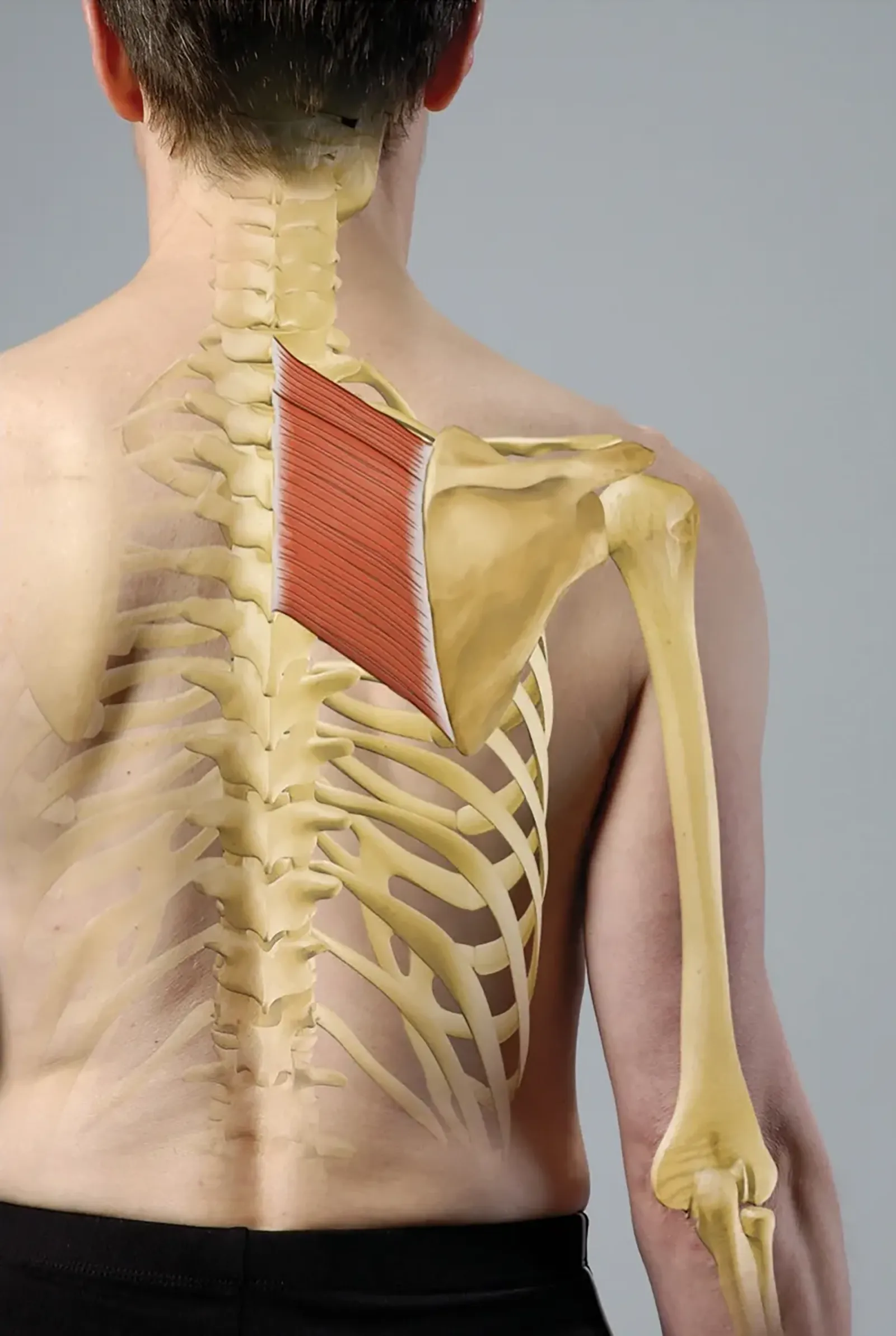
The rhomboids are part of the shoulder girdle musculature along with the pectoralis major and minor, levator scapulae, trapezius, latissimus dorsi, and serratus anterior. They serve as scapular stabilizers and also contribute to upper limb movement. The rhomboid muscles work with the trapezius, levator scapulae, and serratus anterior to stabilize the scapula on the rib cage during weight-bearing movements.
There is a clear antagonistic relationship between the rhomboids and the serratus anterior in particular, as both muscles attach to the medial border of the scapula, but their fibers extend in opposite directions. The serratus anterior is positioned to protract and depress the scapula, while the rhomboids retract and elevate that same structure. Co-contraction of these two powerful muscles helps stabilize the scapula against the rib cage, preventing movement away from the rib cage known as winging of the scapula. The rhomboids, levator scapula, and serratus anterior also steer the glenoid fossa in downward rotation. This scapular motion enhances the range of motion of the glenohumeral joint, allowing for greater range in shoulder adduction. Pulling motions, such as rowing, are the result of the rhomboids and trapezius working together to retract the scapula.
Along with the middle trapezius, the rhomboids are commonly underdeveloped and elongated. This can contribute to a rounded-shoulder posture and is commonly seen in clients who work at computers or otherwise maintain forward-arm positions for long periods. When the scapula is held in a protracted and depressed position, the rhomboids elongate and the serratus anterior shortens. This creates muscle tension and decreased mobility in the shoulder girdle and cervical spine that clients perceive as neck and shoulder pain or stiffness. Maintaining optimal length and strength in the muscles of the shoulder girdle contributes to healthy alignment and mobility in the upper body.
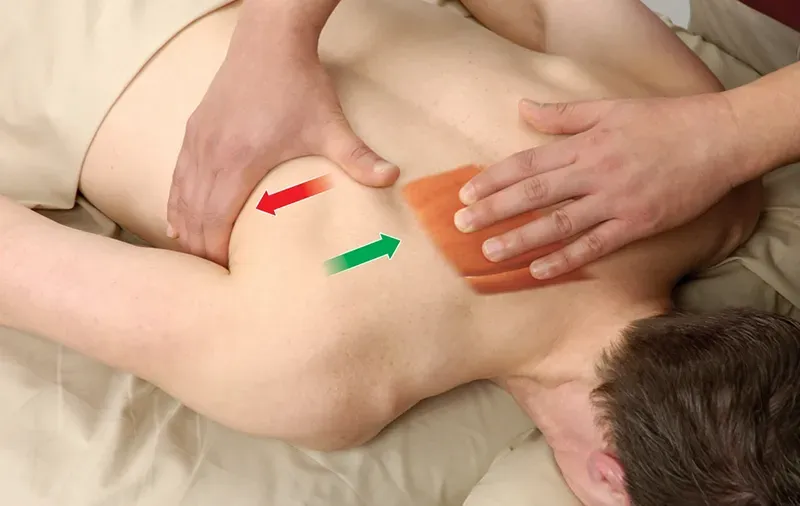
Positioning: client prone with arm at side.
Understanding how the pericardium relates to breathing can in turn help clients relax into their massage session.
Superficial fascia may not get the same attention as deep fascia, but it plays an extremely important role in the organization of tissues and the structure of the body.
Understanding tendons—their shapes, lengths, and organization—improves an MT’s touch vocabulary and facilitates a more skilled touch.
While the neck is a bridge, a pathway, the position of the neck and head can also indicate a multitude of other things happening beneath the surface.