
Fascia: The Pericardium-Diaphragm Connection
Understanding how the pericardium relates to breathing can in turn help clients relax into their massage session.
What do you picture when you think of a tendon? A thick cord like a rope? Or perhaps a shiny, satin ribbon on a birthday present? We can palpate tendons, and we massage them every day in our sessions, but they may fall beneath our radar most of the time. Unless we are treating a specific tendon injury, we may never really think about them or say to ourselves, “Yes, that’s a tendon,” as we glide past them.
But tendons deserve our attention because they are a big part of the tissues we touch. Knowing where they live, what they look like, what they feel like, and how they function heightens our awareness of them in our bodywork sessions. Tendons have specific organizations, lengths, shapes, and sizes that have developed to suit their functions in the body. They are a vital part of our locomotor system and of the collagen-based fascial network.
The outline of many tendons can be seen through the skin. Take off your socks and wiggle your toes. Strong ribbons of tendon can be easily distinguished on the tops of your feet, even though the motivating muscles live deep in your leg (Image 2). Make a fist and then curl your wrist: The cord-shaped tendons of your flexor muscles will pop into view. I (Rachelle) can even see the long tendons of my finger extensor muscles bounce up and down on the backs of my hands as my fingers type away this paragraph.
The tendons that move the bones of my fingers connect to the contracting muscle bellies in my forearms—a smart arrangement when you think about it. If the muscle bellies were actually in my fingers instead of my forearms, the keys on my keyboard would need to be much more spread out to accommodate my huge hands!
In the dissection lab, tendons never fail to evoke a sense of awe and wonder when we see them for the first time. “Oohs” and “ahhs” are commonly heard as they come
into view.
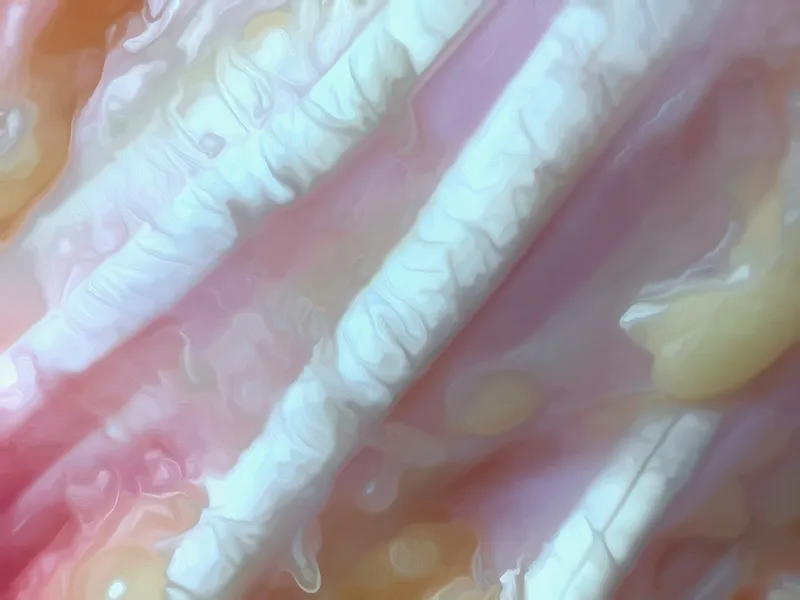
They’re gorgeous. Silvery structures that weave throughout our bodies, tendons are tough, smooth, silky, and slippery. They also reflect light, making them easily recognizable to the naked eye by their unmistakable collagen fiber iridescence.
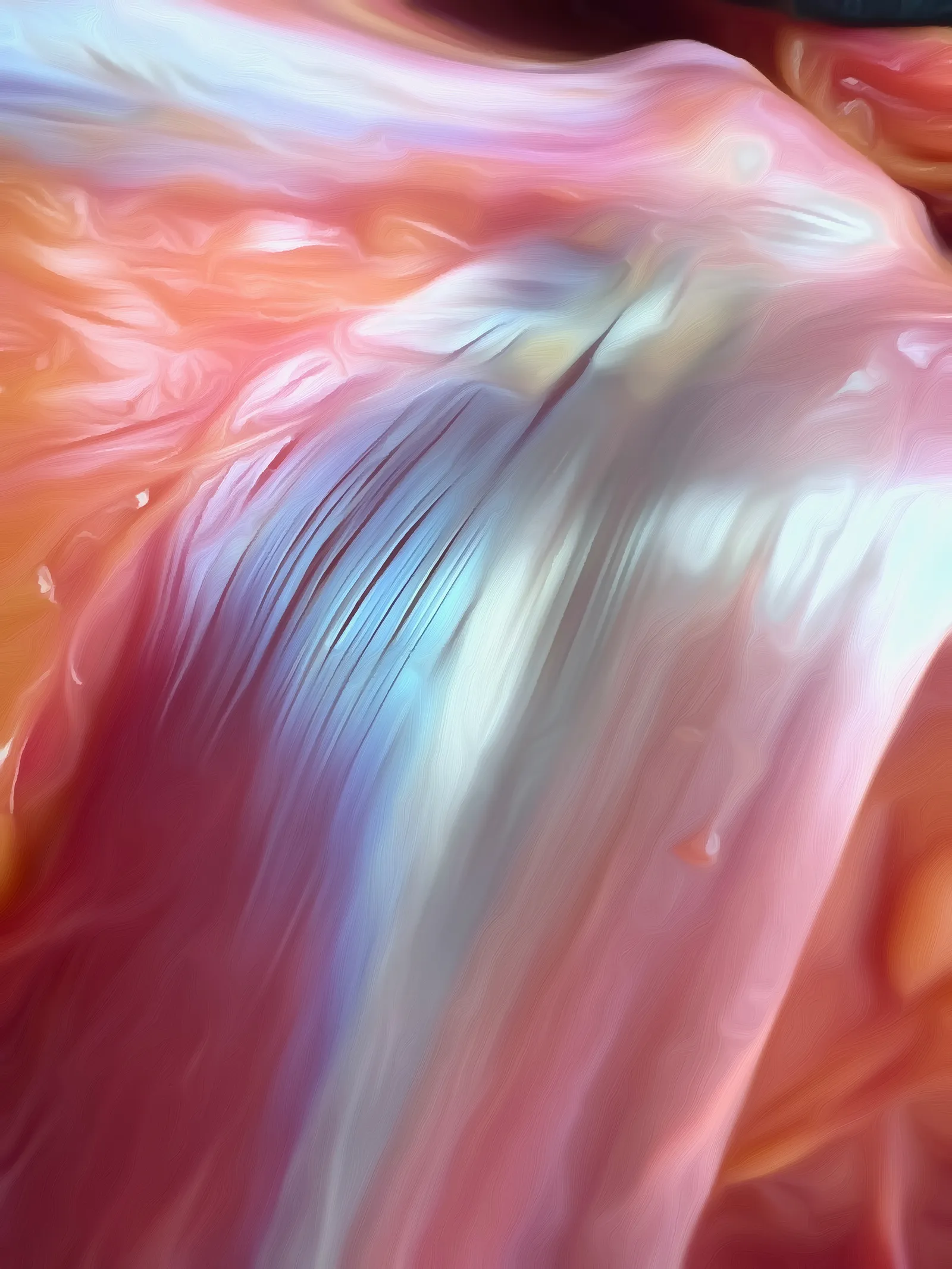
While tendons of the hand and forearm run relatively parallel to each other, we see a totally different arrangement further up the limb. The shoulder and upper arm tendons form a labyrinth of collagen ribbons, like intersecting highways, overlapping, diving underneath, or hovering over each other (Image 3). From their flat anchors into the humerus, latissimus dorsi, teres major, and pectoralis major, tendons expand toward their respective muscles, with the thin cord of the long head of the biceps tendon snuggled in between. This assembly of tendons connects the upper arm to a wide variety of destinations, including the spine, scapula, sternum, and forearm, respectively.

Nearby on the coracoid process (the scapula’s bony prominence that hooks under the clavicle), the short head of the biceps shares a tendon with the coracobrachialis, giving two muscles a single, conjoint tendon (Image 1). Adjacent to this conjoint tendon, another tendon emerges: the tendon of the pectoralis minor as it heads toward the third, fourth, and fifth ribs. When the muscles contract, they stretch the stiff tendons in different combinations, creating the complex choreography of our shoulder and arm movements.
Muscles would accomplish little without their collagen-rich collaborators, the tendons. In simple terms, tendons are the structures that connect the soft, contractile muscle tissue with the hard bones that make up our skeleton (and sometimes to other fasciae). They do not generate force but rather transmit it.
When muscles contract, tendons provide the bridge our muscles require to make movement (concentric contraction), provide stability (isometric contraction), or absorb impact (eccentric contraction). How do tendons make it happen? The answer lies in their anatomy, from their macrolevel diversity of shapes and muscle-tendon arrangements down to their microscopic collagen structure.
Tendons can be short or super long, flat or round, thick or thin. They can follow straight pathways or wrap around corners. Why is there so much diversity? Each muscle’s tendon is shaped to meet that muscle’s specific force-transmission needs and to navigate the local terrain.
Muscles would accomplish little without their collagen-rich collaborators, the tendons.
But tendon shape is only part of the story. Muscle fibers are organized in relationship to tendons in unique ways too. There are two main muscle fiber-tendon relationships: parallel or pennate. Parallel muscles have tendons that are parallel with the fibers of the muscle. Typically, the muscles insert into the tendons at the ends and can be (1) thick in the middle and narrow at the ends (fusiform); (2) long and thin (strap); (3) flat and rectangular (rhomboidal or quadrate); or (4) broad at one and narrow at the other (convergent). Pennate muscles, on the other hand, are feather-shaped. The tendons root deeply into the muscle like a central stem with the muscle fibers inserting obliquely on one side (uni-pennate) or both sides (bi-pennate).
These two different organizations of muscle fiber to tendon influence the muscle’s range of motion and force-generating capacity. The parallel fiber arrangement provides greater range of motion and more flexibility, while the pennate fiber arrangement allows for a greater number of muscle fibers to be packed into a smaller space, giving it more power but a smaller range of motion. Whether because of its shape or muscle fiber arrangement, each tendon is optimized for the work that needs to be done.
Made mostly of collagen type I, tendons have enormous tensile strength. The densely packed parallel fibers always reveal the path of force transmission and can often be seen with the naked eye. But this collagen fiber arrangement isn’t just at the macro level.
Collagen molecules are bundled into tiny fibrils, which are bundled into groups to form collagen fibers, which group into fascicles, which bundle to form the whole tendon (molecule → fibril → fiber → fascicle → tendon). If this sounds familiar, it’s because it’s similar to the organization of how muscle fibers are bundled. In tendons, this hierarchical arrangement creates an immensely strong structure with a high level of resistance to longitudinal stretch, which is what you want from a tendon in order for it to transmit force and maximize function.
Studying tendon anatomy deepens our work as massage therapists by helping us understand their organization and function. With a clearer picture of the many presentations of tendons in our minds—where they live, what they look like, how they are arranged, and how they function—our touch vocabulary increases.
Our hands understand what they feel, and we grow more confident with our work no matter the techniques we use. Most importantly, the more skilled our touch becomes, the more our clients benefit.
Benjamin, M., E. Kaiser, and S. Milz. “Structure-Function Relationships in Tendons: A Review.” Journal of Anatomy 212, no. 3 (March 2008): 211–28.
Koryak, Yu. A. “Functional and Clinical Significance of the Architecture of Human Skeletal Muscles.” Human Physiology 34, no. 4 (July 2008): 482–92.
Lieber, R. L., and J. Fridén. “Functional and Clinical Significance of Skeletal Muscle Architecture.” Muscle & Nerve 23, no. 11 (November 2000): 1647–66.
Stecco, C. Functional Atlas of the Human Fascial System. Elsevier, 2014.
Zhang, S. et al. “Hierarchical Ultrastructure: An Overview of What Is Known About Tendons and Future Perspective for Tendon Engineering.” Bioactive Materials 8 (February 2022): 124–39.
Understanding how the pericardium relates to breathing can in turn help clients relax into their massage session.
Superficial fascia may not get the same attention as deep fascia, but it plays an extremely important role in the organization of tissues and the structure of the body.
While the neck is a bridge, a pathway, the position of the neck and head can also indicate a multitude of other things happening beneath the surface.
Understanding fibroblasts and the extracellular matrix changes how we think about the tissue we touch.