


Fascia: The Pericardium-Diaphragm Connection
Understanding how the pericardium relates to breathing can in turn help clients relax into their massage session.
In massage therapy, muscle is often the center of attention. Skin and fat? Not so much. But what if the superficial tissues we work through to get to the muscle are doing more than we ever imagined? In the past few years, researchers have been shining the spotlight on the layer between the skin and muscles: the superficial fascia.
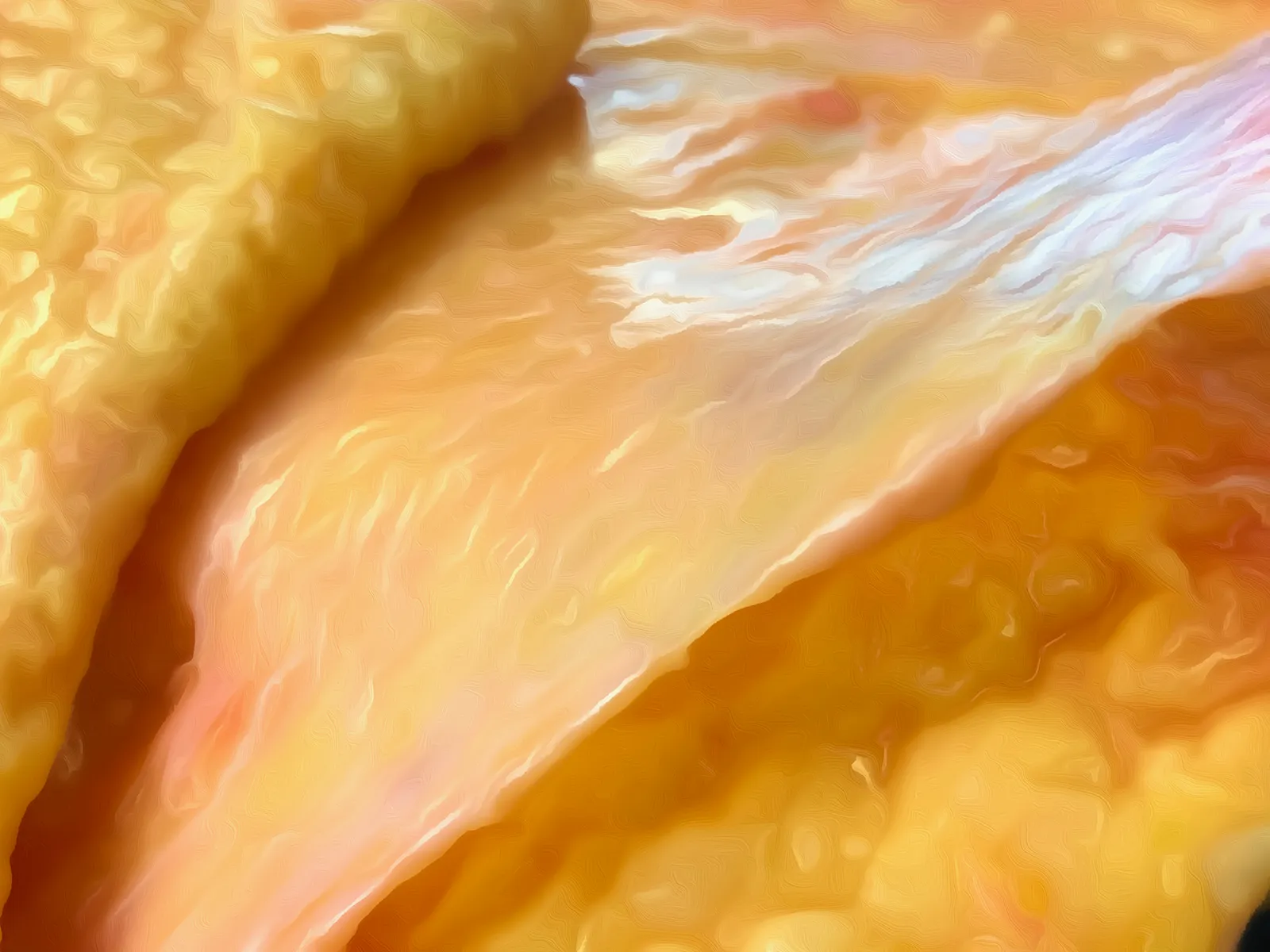
Firmly rooted in the dermis, the superficial fascia runs parallel to the skin and is continuous over the entire body. Wherever there is skin, superficial fascia is just below. It turns out the superficial fascia is highly sensitive, plays a major structural and functional role for fat and lymph, and is involved with healing and scar tissue formation.
The truth is, you’ve been massaging the superficial fascia all along. Effleurage, petrissage, compression, or skin rolling? Superficial fascia always comes along for the ride. So how would your touch change if you knew as much about it as you know about muscles?
Just beneath the skin, there is a sea of bright yellow (Image 2). This tissue has always had several names, including the subcutis, subcutaneous fat, hypodermis, and panniculus, which is Latin for cloth.
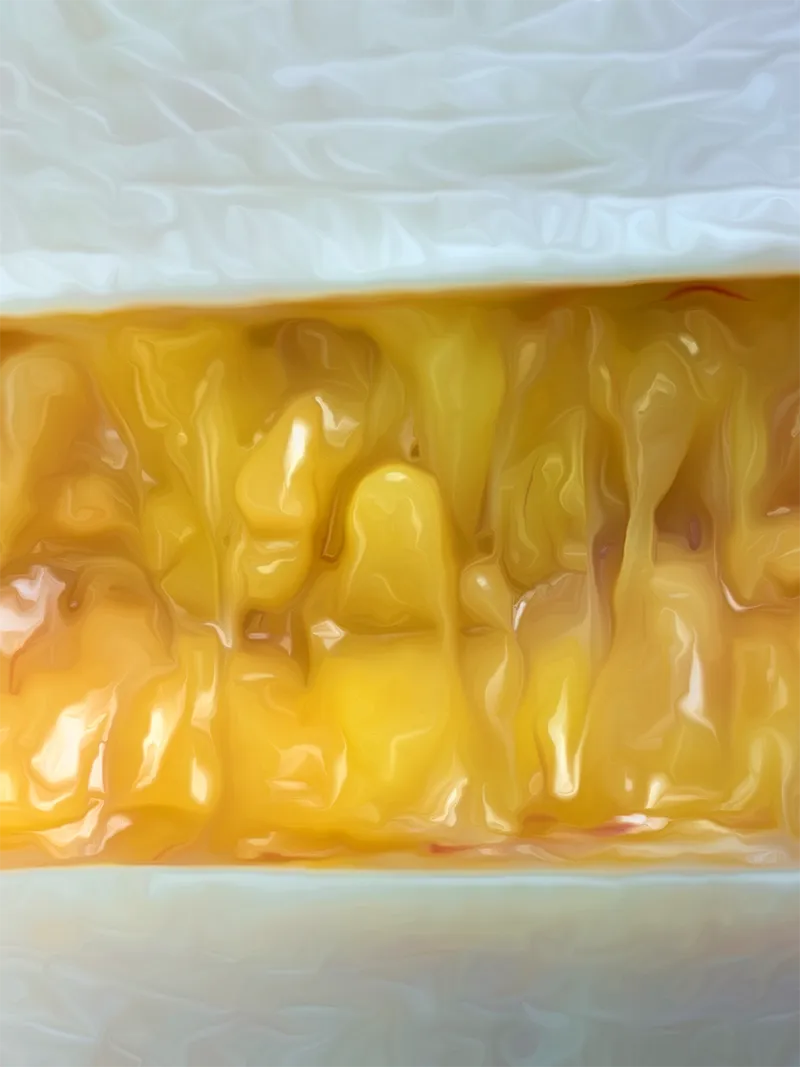
You’re likely familiar with this zone as a storage depot for extra calories or as the site of hypodermic injections. In the past, scientists dismissed it as a loose, lumpy, amorphous blanket of fat floating under the skin. More recently, researchers turned ultrasound imaging toward this layer and found a clearly visible, collagen-based fascial network hiding in the fat throughout the body.1 Fortunately for all of us, our fat is not free-floating. This network of collagen, called the superficial fascia, provides the structure that holds every fat lobule in place, giving the entire layer its stability. This is good news, because without it, the simple act of standing up in gravity, or even a gentle effleurage, would dramatically reorganize our fat into haphazard piles.
Once scientists could see the collagen among the bright yellow fat lobules, they could decipher its architecture and role (Image 3).
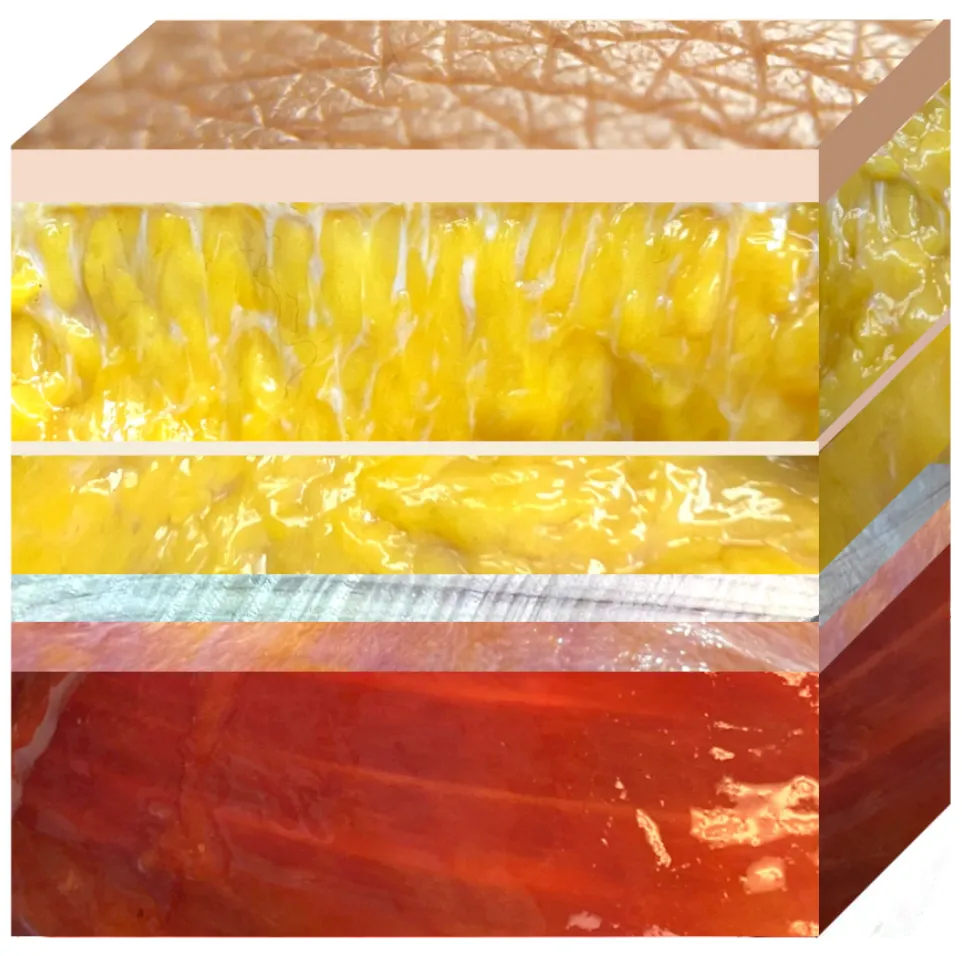
They identified three distinctions within this subcutaneous layer:
1. The superficial adipose tissue (SAT) is distinguished by its densely packed skin ligaments (retinacula cutis) that extend upward to anchor firmly into the dermis.
2. The deep adipose tissue (DAT) is identified by its thinner and more obliquely angled skin ligaments that extend downward to connect with the deep fascia.
3. The flat, thin, fibrous, stretchy membrane lives in the middle.
While the word “membrane” might imply that it can slip and slide freely between the two fat layers, that’s not the case. The skin ligaments are interconnected with the fascia membrane the way a tree’s roots and branches are continuous with its trunk—branching upward into the dermis, rooting downward toward the deep fascia, and inseparable from the membrane between them.
Like all fascia, the superficial fascia is rich in type I collagen. But it has a secret sauce: elastin! With 10 times more elastic fibers than the deep fascia of our muscles,2 the superficial fascia is stretchy. This fibroelasticity makes it remarkably adaptive and resilient and enables it to manage much of the tissue tension in the layer. The stretch comes with stability as the trunk, branches, and roots (the membrane and its skin ligaments) provide stable pathways for blood vessels, nerves, and lymph to travel, making the health of the superficial fascia critical for fluid drainage and circulation.
Because of the differences in the organization of the SAT and DAT, they can move with some independence. This organization is immensely consequential for our massage strokes. Because of the strong tethering of skin ligaments in the SAT, moving the skin always pulls on the SAT and the middle membrane. That same movement, however, may have less of an effect on the deep fascia and muscles.
Depending on how loose the organization of the DAT is in that location, the middle membrane may have more of a gliding relationship with the deep fascia and muscle layers. Looking at it from the inside out, contracting muscles often have very little movement effect on the skin because the DAT acts as a sliding buffer that prevents movement from being transmitted to the skin. There’s more, but for now, just consider that superficial fascia provides a dynamic and flexible anchor for the skin to the underlying tissues.
The collagen-rich tissue that was dismissed as “just a blanket of fat” for so long turns out to be remarkably sensitive. Researchers have found that the superficial fascia is the second-most innervated tissue in the body—surpassed only by the skin.3 The surface unit of skin, fat, and superficial fascia under our hands in every massage stroke is immensely sensitive, supporting our sensory perception of the world. But the nerve fibers found in the superficial fascia aren’t only sensory. Perhaps the most provocative research finding about the superficial fascia is the significant presence of sympathetic nerve fibers.
Sympathetic nerves regulate autonomic processes, including the stress response. Researchers are curious about these sympathetic nerve fibers, asking if chronic stress creates fibrotic changes in the superficial fascia.4 That’s a big question, and the answers would have direct implications for how we understand the effects of chronic stress on the tissues we touch.
Understanding the superficial fascia architecture is helpful, particularly when there are disruptions. Research shows that the superficial fascia plays an unexpected role in scar tissue formation. Previously, it was assumed that skin fibroblasts were responsible for producing scar tissue, but the story is widening. With new tools, scientists have documented fibroblasts from the superficial fascia migrating into cutaneous wounds, including surgical incisions, carrying with them an extracellular matrix rich in blood supply and immune cells. This migrating matrix arrives at the wound site as a ready-made patch, the body’s first responder to injury.
For those of us working with scars, this is not a peripheral detail. It forms the basis of our work, supporting the body in making big changes with surprisingly superficial touch.
We have a lot to learn from the very first tissues we touch. As we draw our attention to the superficial fascia, we begin to appreciate just how sensitive and responsive this surface layer really is. We may think deep impact requires going deep into the tissues. But when it comes to the superficial fascia, “deep” work happens rather near the surface.
1. M. F. Abu-Hijleh et al., “The Membranous Layer of Superficial Fascia: Evidence for Its Widespread Distribution in the Body,” Surgical and Radiologic Anatomy 28, no. 6 (December 2006): 606–19.
2. Caterina Fede et al., “The Human Superficial Fascia: A Narrative Review,” International Journal of Molecular Sciences 26, no. 3 (February 2025): 1289.
3. Caterina Fede et al., “Innervation of Human Superficial Fascia,” Frontiers in Neuroanatomy 16 (August 2022): 981426.
4. Fede et al., “The Human Superficial Fascia: A Narrative Review.”
Stecco, C., et al. Functional Atlas of the Human Fascial System. Churchill Livingstone Elsevier, 2015.
Stecco, C., et al. “Towards a Comprehensive Definition of the Human Fascial System.” Journal of Anatomy 246, no. 6 (January 2025): 1084–98.
Understanding how the pericardium relates to breathing can in turn help clients relax into their massage session.
Understanding tendons—their shapes, lengths, and organization—improves an MT’s touch vocabulary and facilitates a more skilled touch.
While the neck is a bridge, a pathway, the position of the neck and head can also indicate a multitude of other things happening beneath the surface.
Understanding fibroblasts and the extracellular matrix changes how we think about the tissue we touch.