We’ve all encountered the client who reports a persistent “knot” in the mid-back near the scapula. Their pain is chronic and disruptive. The widespread occurrence of upper back and neck pain is well-known and often results from the modern lifestyle, involving repetitive movements, poor posture, or injury.
As massage therapists, our initial instinct is often to focus on the painful areas. We notice hypertonicity in the rhomboids or middle trapezius, and we respond accordingly. Indeed, using deep compression, trigger-point release, cross-fiber friction, and stretching can reduce the client’s pain. Usually, the client feels great afterward—for about 48 hours. Then the tension returns, the knot reappears, and the cycle starts over.
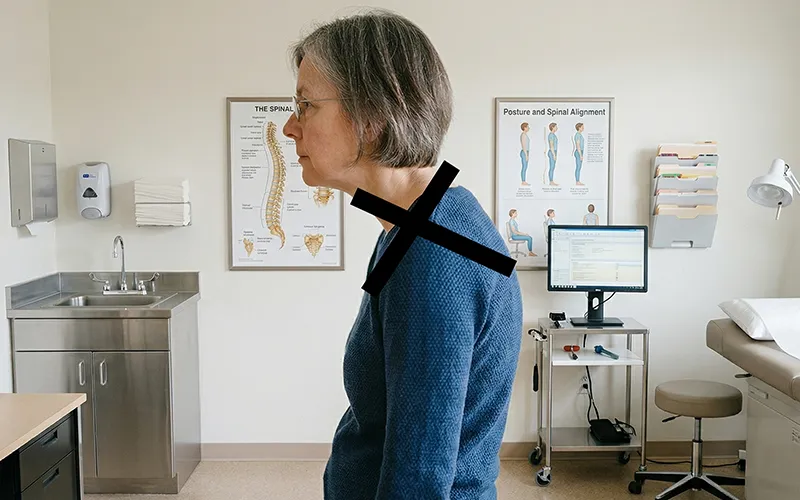
For many years, we relied on Vladimir Janda’s idea of upper-crossed syndrome (UCS) to help us understand chronic pain and postural stress in the upper back and neck. UCS describes a pattern (shaped like an X) in which the pectorals, upper trapezius, and levator scapulae are tight or overactive, while their opposing muscles—the deep neck flexors, middle and lower trapezius, and serratus anterior—become weak or underactive. Forward-head posture, rounded shoulders, and upper back tightness characterize UCS (Image 1).
Image 1. An example of forward-head posture of upper-crossed syndrome. Image courtesy Whitney Lowe.
While we know that UCS is a major contributor to upper back and neck pain, today we also understand that there are critical mechanical causes that should be integrated into our treatment protocol.
In current clinical practice, dysfunctional scapular mechanics—called scapular dyskinesis (SD)—should be viewed as more than just a “downstream effect” of forward-head posture and muscle tightness. Instead, it can be the primary contributor to chronic upper back and neck pain. In fact, the incidence of SD is statistically higher than that of UCS. And SD can be caused not only by posture or muscle tightness but also by injury. To effectively address these issues, we need to broaden our approach and enhance our understanding of scapular instability. As I often say in workshops, “If you change the scapula’s job, you change the neck’s workload.” Let’s explore why.
Core Anatomy and Biomechanics
To understand upper back pain, we first need to recognize that the scapula acts as a bridge between the spine (axial skeleton) and the upper extremity. Its main role is to provide a stable yet mobile base for the humerus. If this base is unstable, every arm movement can become a source of strain for the neck and back. Scapular dysfunction can also cause other issues like subacromial impingement, rotator cuff problems, subacromial bursitis, and tendinosis. Several core anatomical and biomechanical factors can contribute to scapular dysfunction and lead to upper back and neck pain: alterations in the scapulohumeral rhythm, force couple and muscle dysfunction, cervical spine involvement, and shoulder instability.
The Scapulohumeral Rhythm
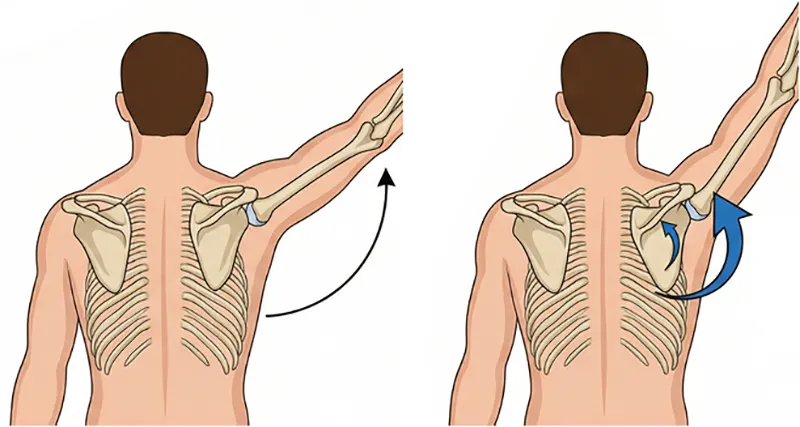
The core concept in shoulder mechanics is the scapulohumeral rhythm (Image 2). This is the coordinated movement of the glenohumeral (humerus and scapula) and the scapulothoracic (scapula and rib cage) joints. For a healthy shoulder to achieve full flexion or abduction (180 degrees), the scapula must contribute significantly.
Image 2. Glenohumeral abduction and scapular upward rotation in the scapulohumeral rhythm. Image courtesy Whitney Lowe.
For every two degrees of humeral elevation, the scapula should upwardly rotate by one degree. However, it’s not just about rotation. Effective arm movement relies on several scapular motions:
• Posterior tilt—The top of the scapula moves backward, keeping it flush against the rib cage.
• Protraction—The scapula wraps around the rib cage.
• Upward rotation—The inferior angle moves laterally and superiorly.
SD occurs when there is dysfunction with any or all these motions.
Force Couples: Coordination
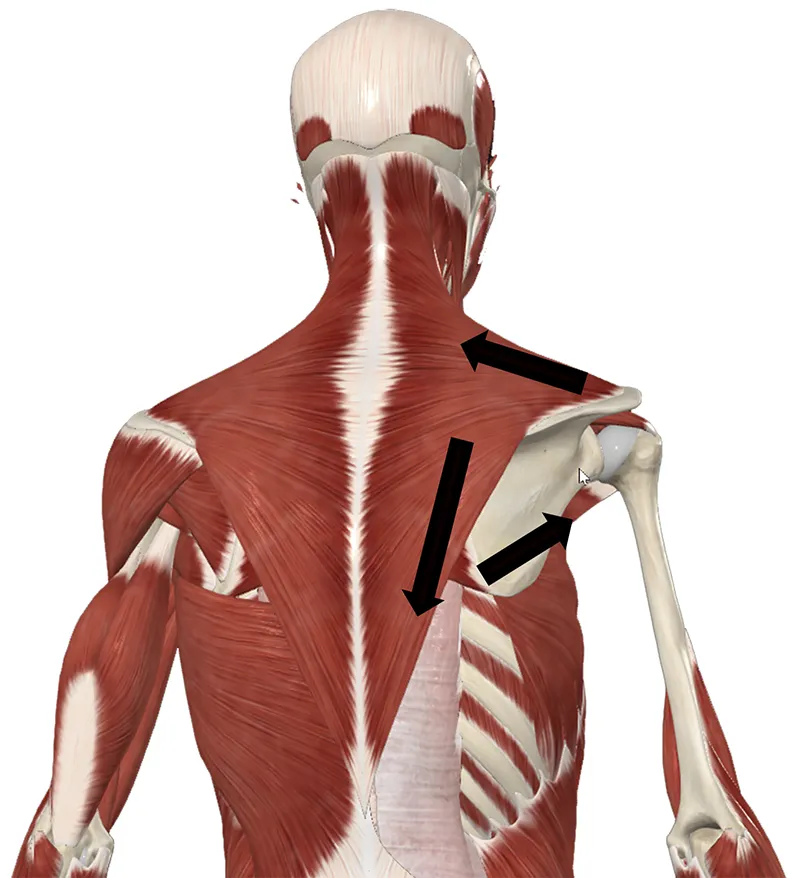
Muscles rarely work in isolation; they act as force couples, in which two or more muscles pull in opposite directions to produce rotation about an axis. The primary force couple for scapular upward rotation involves the serratus anterior (the lower portion), the upper trapezius, and the lower trapezius (Image 3).
Image 3. The combined force couple of upper trapezius, lower trapezius, and serratus anterior for scapular upward rotation. Image courtesy Complete Anatomy.
In SD, we often see the serratus anterior and lower trapezius become inhibited or underactive. To compensate, the nervous system over-recruits the upper trapezius and the levator scapulae. This compensation results in a hitching or hiking of the shoulder. Instead of rotating smoothly upward, the scapula is yanked toward the ear. This hitching pattern is a primary driver of chronic tension clients may feel in their shoulders (specifically in their upper trapezius).
Cervico-Scapular Coupling
The most overlooked aspect of SD is its impact on the cervical spine. The levator scapulae elevates the scapula and laterally flexes the neck. Its attachments are on the cervical transverse processes and the upper corner (superior angle) of the scapula. The upper trapezius aids in upper rotation, scapular elevation, and cervical lateral flexion. It attaches to the occiput and the dense fibrous band down the neck (the nuchal ligament), and the distal clavicle. A scapula that sits in a forward position (protracted), downwardly rotated, or forwardly tilted (anterior) position creates a constant pull on the cervical region.
The brain recognizes this instability and responds by recruiting the posterior cervical extensors—the suboccipitals, splenius capitis, and semispinalis—to act as stabilizers. These muscles are designed for fine-tuned movement and posture, not for supporting the weight of the shoulder girdle all day. This constant, low-level isometric contraction leads to myofascial fatigue, ischemia, and eventually, the development of persistent trigger points.
Neurophysiology
SD comprises several physiological challenges of the neuromuscular system. For example, an altered scapular position generates a significant amount of confusing and incorrect proprioceptive signals to the central nervous system. As a result, the brain struggles to identify the scapula’s location and movement accurately. This is known as cortical smudging.
Myofascial trigger points also often play a core role in SD. When scapular movement is altered, some muscles are overloaded while others underperform, creating an uneven distribution of force across the shoulder girdle. This persistent overload can contribute to the development of myofascial trigger points, especially in muscles such as the upper trapezius, levator scapulae, pectoralis minor, infraspinatus, and rhomboids. These trigger points may increase local tenderness, restrict normal muscle length, and further disrupt scapular motion.
Trigger points refer pain to the shoulder, upper back, or arm, making the problem seem more diffuse than it is. In many cases, they are not the primary cause of SD but are instead caused by faulty movement patterns and chronic tissue overload. As a result, treatment should focus not only on deactivating trigger points but also on correcting underlying movement dysfunction, improving muscular balance, and restoring scapular control.
Trigger-Point Suspects
• Infraspinatus and teres minor—These muscles of the posterior rotator cuff often become irritated when the scapula does not tilt backward properly. Their referral pattern is interesting because it frequently mimics deep shoulder joint pain or radiates down the lateral arm, leading therapists to mistakenly treat the deltoid.
• Levator scapulae—When the scapula tilts forward, often due to a tight pectoralis minor, the levator scapulae muscle becomes overstressed. This pattern can lead to pain along the upper, inner border of the scapula and may cause stiffness or a jammed sensation when turning the head.
• Rhomboids and middle trapezius—These muscles are eccentrically overloaded and develop trigger points. Our treatment goals are mainly pain management and improved tissue mobility. Usecompression and stripping to help neutralize trigger points.
• Suboccipitals—These muscles serve as the last line of defense against a forward-head posture caused by a collapsing scapular base. They refer pain in a headband pattern and are major contributors to dizziness and eye strain.
• Upper trapezius—When the scapula doesn’t rotate upward properly, the upper trapezius overworks. This leads to pain along the side of the neck, extending to the temple and jaw angle, often resulting in a tension headache.
Assessment
SD assessment should focus on symptom patterns, movement quality, and tissue compensation rather than pain location alone. Ask the client about any activities that provoke pain, such as prolonged sitting, overhead movement, or reaching behind the body. Ask whether the symptoms begin immediately or only after repetition or ongoing use. Observe the scapula during arm movement, watching the client as they lift and lower their arm(s). If the condition is only on one side, observe how the movement occurs on the healthy side to see if the mechanics appear altered.
Key signs include an early shrug, winging, shuddering, or a loss of smooth control, especially during lowering, when dysfunction is often most apparent. It’s also important to assess the thoracic spine, since limited extension can create a poor base that restricts normal scapular motion. Finally, watch for compensation patterns such as forward-head posture or excessive shrugging at the clavicle.
Clinical Application
Once you solve some of the mechanical puzzles, you can develop a treatment plan. For massage therapists, addressing SD involves shifting from just treating local “knots” to a more integrated, biomechanically informed approach. Since the scapula relies on nearly 20 muscles for stability and movement, manual therapy is most effective when it targets the muscles causing disruption in the client’s scapular mechanics.
Massage therapy serves as a critical entry point for rehabilitation by targeting the following physiological mechanisms:
• Better body awareness—Massage improves the brain’s ability to sense where the joints are, leading to smoother and more coordinated movement.
• Pain relief—Stimulating the sensory nerves with manual therapy can block pain signals, helping to calm the nervous system.
• Physical reset—Directly targeted massage work helps stretch tight connective tissue, allowing muscles to return to their natural length and reducing forward pull on the scapula.
• Starting point—In many cases, massage is a wise approach before strengthening exercises.
Primary Soft-Tissue Targets
The primary aim is to restore normal function to tissues that force the scapula into abnormal positions. A key part of this clinical goal is to regain flexibility in hypertonic cervical and shoulder muscles, enabling the scapula to rotate upward and tilt posteriorly without limitation. Massage can also deactivate trigger points in opposing muscles, potentially improving neuromuscular control during functional movement.
Initial treatment techniques focus on reducing hypertonicity and enhancing tissue mechanics. Effective methods include static compression, targeted deep gliding, and broad myofascial therapy to facilitate sliding between fascial layers. Begin with broad contact techniques, then progress to more specific and smaller contact methods. Be careful with pressure levels to avoid causing bracing or splinting. Monitor the client’s pain levels closely.
Active engagement techniques (AET) are especially effective because they help reduce pain by increasing proprioceptive input that overrides pain signals and improve tissue mobility through muscle engagement with compression or stripping techniques. AET are massage techniques performed with active or passive movement. A variety of techniques can be used.
The Pectoralis Minor
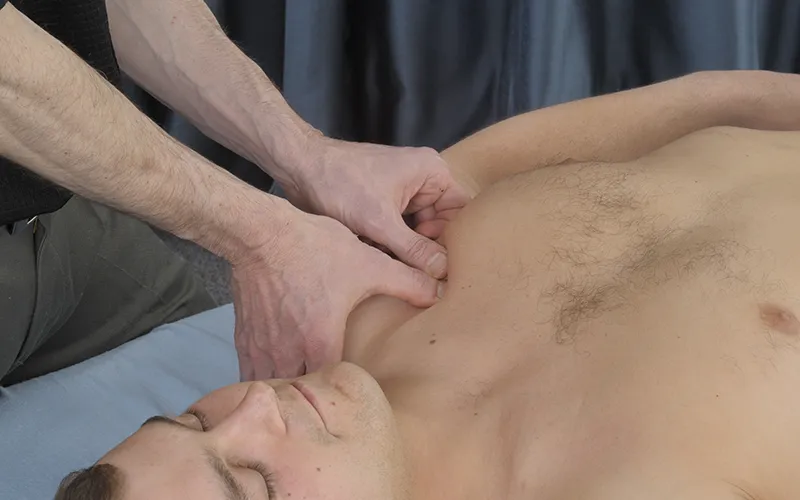
Tenderness at the coracoid process strongly suggests pectoralis minor involvement. Tightness in this area causes a noticeable inferior and anterior pull, directly contributing to the anterior tilt seen in SD (Image 4). Accessing the pectoralis minor can be challenging. To approach through the pectoralis major, it’s important to relax the pectoralis major as much as possible before proceeding deeper. Sometimes, it’s easier to access the lateral part of the pectoralis minor by going underneath the pectoralis major with the client in a supine or sidelying position.
Image 4. Specific small contact surface treatment of pectoralis minor. Image courtesy Whitney Lowe.
Posterior Cervical and Scapular Stabilizers
While the pectoralis minor is often the primary mechanical cause of scapular tilt, an effective treatment plan should also address the muscles that attach to the scapula and affect its position relative to the ribs. Treating the posterior cervical area and the secondary stabilizers is essential for relieving referred pain and restoring the scapulohumeral rhythm.
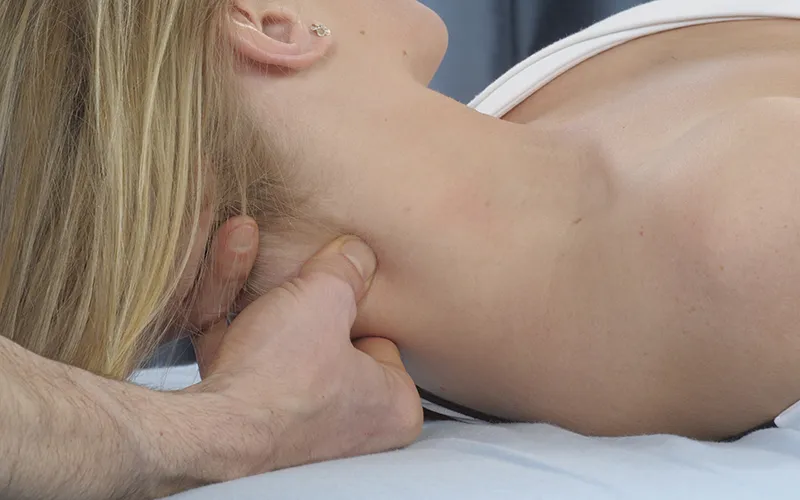
Compensatory shrugging often results from overreliance on the upper trapezius and levator scapulae to compensate for a weak or inhibited serratus anterior. AET targeting the posterior cervical region, specifically the levator scapulae and upper trapezius, are especially effective in correcting dysfunctional scapular movement (Image 5). Deep, focused stretching promotes lengthening of the sarcomeres, while the active movement also benefits gate control mechanisms and helps to restore proper muscular mechanics.
Image 5. Stripping massage with active engagement of the posterior cervical muscles. Image courtesy Whitney Lowe.
In SD, the rhomboids can become chronically held in a lengthened position, leading to trigger points. Clients often present with burning or aching sensations along the medial border of the scapula. Longitudinal stripping techniques along the muscle fiber direction should be part of the treatment protocol; they do not further lengthen the rhomboid muscles. Deactivating trigger points in the rhomboids and middle trapezius can alleviate referred pain and encourage proper movement. Addressing trigger points and hypertonicity in the lower trapezius is also critical to restoring proper scapular mechanics.
Stop Chasing Knots, Start Changing Load
SD is primarily a problem involving the entire upper-body kinetic chain and can even influence the fascial connections into the lower extremities. It affects more than just the shoulders and scapulae. The proper function of the upper body and neck depends on coordinated support from the trunk, spine, neck, and rib cage. When dysfunction occurs, it can trigger a chain of effects that make this condition complex and involved.
Upper back pain is rarely a local problem. It’s a symptom of a larger mechanical story—a story of how the scapulae move, how the neck stabilizes, and how the nervous system compensates for fatigue. When we restore proper scapular mechanics, we take the workload off other muscles and tissues. Pain and dysfunction can then start to resolve because the reason for their existence has been removed.
To understand tissue-tension barriers, MTs must be constantly present and mindful. Too light and we will not become efficient at creating the healing change that is needed.