After winning two gold medals in figure skating at the 2026 Winter Olympics, Alysa Liu explained to an incredulous Today crew that winning had not actually been her goal. “I just really like what I do,” she said.1
It’s the same for Chris Curry and his gold medals (the most recent obtained in sports massage at the Colorado Massage Championships) and the reason behind his drive. “Honestly, I love what I do,” Curry says, and it’s easy to believe him based on the accomplishment he values far more than his medals. “My favorite thing about massage is getting one. I received 60 60-minute massages last year, and I’m trying to beat it this year.”
A Spirit of Self-Improvement
A massage therapist, educator, and ABMP member, it’s clear that Curry can’t get enough bodywork. This has been the case, he says, since some of his earliest memories of receiving massage in sibling massage trains with his brother and sister.
After pivoting from a career path in physics, he was inspired to make bodywork his career. “I thought space was my final frontier,” Curry says, “but I learned it’s actually the human body.”
Driven by his belief that everybody deserves to feel good, Curry constantly sought new knowledge and skills to help his clients. This curiosity led him to become a massage instructor, and in class he found a new way to deepen his understanding of bodywork. “I was showing videos of a massage competition to my students, and it just hit me,” he says. “I thought, ‘Oh, I want to do this as well!’”
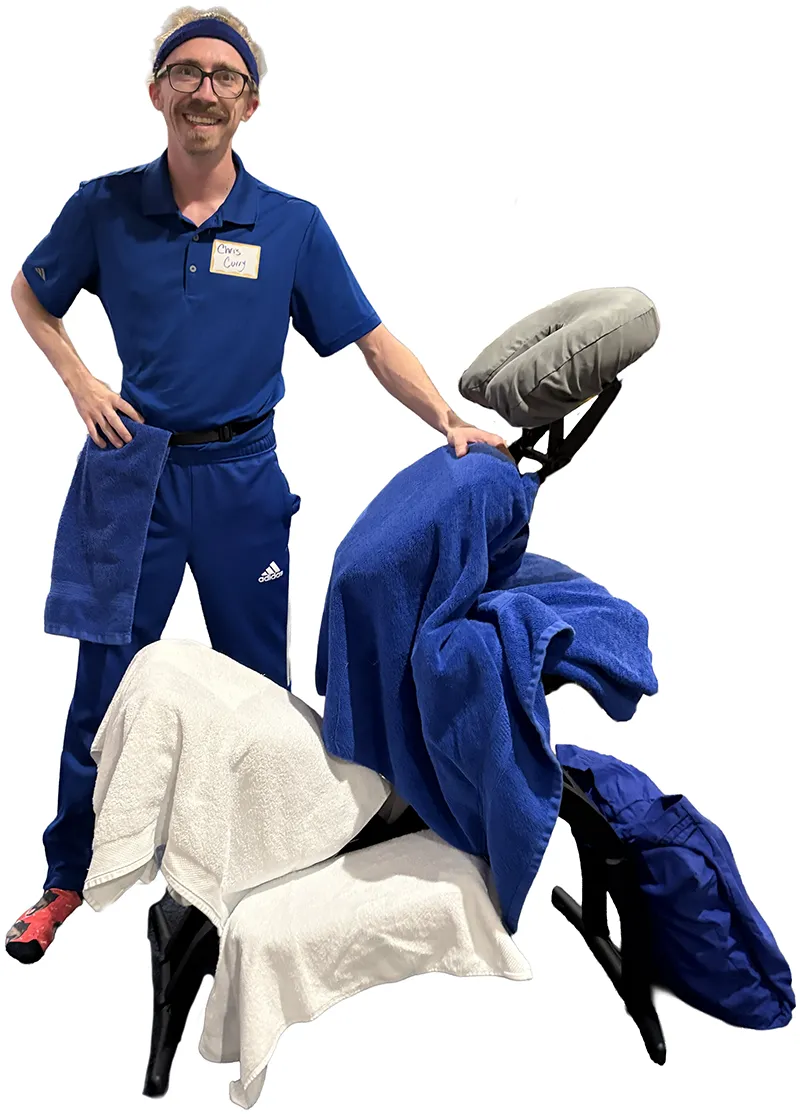
ABMP member Chris Curry won gold at the 2026 Colorado Massage Championships in sports massage. Massage & Bodywork staff.
Curry’s first massage competition was in Denmark, coincidentally, where the 9th World Championship of Massage will be held in July 2026. His most recent competition was the Colorado Massage Championships, where he earned gold in sports massage and silver in chair massage. In competition, massage therapists provide bodywork to other therapists and are scored by judges on categories such as technique, ergonomics, flow, innovation, and client contact.
Curry sees it as an opportunity to demonstrate the work and attention he has spent on each of these aspects of his practice. “I think of it like an exhibition in some capacity,” Curry says. “I work on the techniques and parts of practice that I want to become more masterful at as I prepare. By the time I get to the competition, I feel like I’ve already won.”
The Lessons of Competition
The best part of the competition experience for Curry is connecting with other massage therapists who share his passion for learning and who are usually very willing to share their best tips and techniques. “I learn just as much from the receiving process,” Curry says. “I’ll be receiving a technique and think, ‘I have to do this.’ I don’t think there’s a technique like that from a competition that I haven’t then used with a client. And I’ve been lucky enough to receive a massage that eventually won gold.”
The following are five of the most important lessons Curry has learned from participating in massage competitions.
1. Use Both Hands for Strategic Flow
Competition preparation has helped Curry develop his two-handed skills. “Every move I could do with one hand I wanted to be able to do with the other,” he says. “It helps me create that flow I’m looking for.”
To add stability while elevating your bodywork, Curry recommends focusing on using both hands. “Whether it’s stabilizing, preparing my flow, or tractioning, I’ve found that it elevates my practice,” he says. Part of his inspiration for this was watching one of his students keep multiple points of contact during a stretch session, because it’s something he notices so frequently on the competition floor.
2. Explore with Supported Movements
Most competition massages begin with just a five-minute intake in a more stressful setting than a typical massage session, so any information that can help session planning is precious, which is why he makes sure to start sessions with supported movements that allow him to gain information about his client.
“Supporting joints as I move them is a great investigative tool,” Curry says. “By facilitating safety, I can focus on the nervous system and find out about any muscle guarding so I can help facilitate recovery. I can tell what’s holding, what’s not moving so well. Plus, I’ve found that the more I can support my clients’ joints while I move them, the more they can relax.”
3. New Positions, New Possibilities
“There are so many creative positions and techniques that can be applied,” Curry says, but they require knowledge of what works (built from experience) combined with strong client communication skills.
One aspect of competition that he doesn’t enjoy is the way some practitioners use showy techniques for style points but not for their clients’ strategic benefit. To try something different, Curry suggests the frog-leg position, one of his clients’ favorites. “Don’t feel like you have to keep someone supine or prone with just a bolster under their knees or ankles,” he says. An innovative way to do this is to use the fitted sheet to support a client’s arm.
4. Professionalism Is More Than Draping
Witnessing all the creative competition techniques has given Curry an interesting perspective: “I think massage is less than half technique,” he says. Communication is where it starts for Curry, who believes his role as a bodyworker is to listen to the client and give them the massage they want. “It doesn’t matter what situation you’re in,” he says. “You should be communicating to make sure the client is getting what they need and that they feel heard.”
Beyond that, it’s about being present in the session and giving your best. “I still have days when I doubt myself,” he says. “But I try and think about what I’m doing in the moment, what I want to do, and how I make the transition seamless between the two.”
Stay Curious, Stay Playful
Curry’s passion for massage grows with doing more of it, teaching more of it, and receiving more of it. “For me, I want to enjoy what I do,” he says. “We can keep it fresh for us and our clients.”
One of the clearest ways his curiosity has paid off in his practice is his setup, which has benefited from competition upgrades that allow him to move efficiently among his tools. And while a lot of shiny new hardware goes into that setup, the intangibles of experience, community, and perspective he’s gained from competition far outweigh the benefits of winning. “Leave your ego at the door and have some fun in your massage,” he says. “Your client will notice.”
Returning to the Treatment Room
The unique environment of competition has also sharpened Curry’s attention to the aspects of his practice that he finds far more important than techniques. Recently, a chair massage class asked Curry to demonstrate the real “power moves” that helped him earn a gold medal. Curry thought about what to show them, then came to class the next day and told them this instead: “The real power move is to listen to your client and give them what they want.”
“It doesn’t matter what situation you’re in. You should be communicating to make sure the client is getting what they need and that they feel heard.” —Chris Curry
One thing that has helped him keep a level head through all his competition experience is viewing himself as facilitating healing with his clients rather than as a healer. “We’re not just doing massage,” he says. “We’re working with a human. One thing that’s been a big focus for me is keeping everything about the competition client-focused.”
Curry tries to remember this in every massage he gives—and every time he reminds someone that a gold medal massage is not about being perfect. “The best massage you can get,” he says, “is the one you want to receive.”
Chris Curry says if you’re practicing massage, you’re ready to compete, as long as you’re open to learning from the experience and keep these tips in mind.
Be Open to Feedback
The massage therapy profession can be a feedback desert, but a competition provides lots of visibility and opportunities to hear from other therapists. Being proactive and asking for feedback is your best bet to ensure you get ideas for growth, and being discerning about what feels right for you will help you navigate.
Make Preparation Your Focus
Working on areas you want to improve or on new aspects of bodywork and using them at the competition will ensure you’re a winner—even if you don’t place on the podium.
Practice Being Present
In every massage, you need to meet the person where they are, which Curry says is more difficult in a busy competition environment. He starts every massage by asking clients, “How are you today?” and leaves plenty of time for an answer before moving on to more detailed intake questions, which helps him stay in the moment.
To understand tissue-tension barriers, MTs must be constantly present and mindful. Too light and we will not become efficient at creating the healing change that is needed.