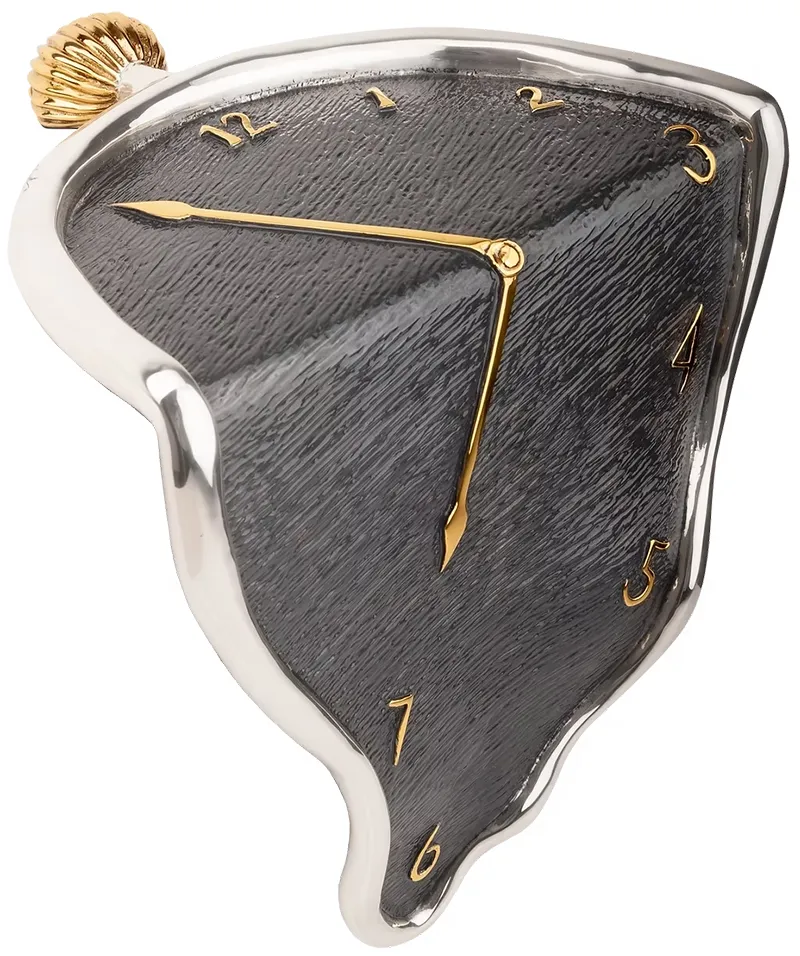
There’s a moment, maybe 20 minutes into a session, when the clock on the wall stops mattering. My client’s breathing has deepened, my hands have found a rhythm that doesn’t need thinking about, and then something shifts—not in the tissue, not in the technique, but in time itself. We’ve both slipped into a place where minutes have no edges and seconds are no longer ticks. Later, blinking back into clock-time, my client will say something like, “I have no idea how long that was.” Neither do I. And that timelessness, I’ve come to believe, is not a side effect of good work. It might be one of the most important things we offer (Image 1).
Image 1. A D’Argenta sculpture inspired by Salvador Dalí’s The Persistence of Memory. Dalí’s melting clocks have become an iconic image of time’s subjective, elastic nature—an apt metaphor for the timelessness hands-on therapists can cultivate in their sessions.
Think about what we’re really after when we go on vacation, sleep in on a weekend, or have one of those rare “nothing days” that feels so luxurious. We’re not just looking for rest, we’re looking for a particular quality of time—unhurried, open, unmetered—and a state where we stop measuring and start being. That timeless feeling is delicious, restorative, even magical. It may also be therapeutic.
Its opposite is equally familiar: watching the clock during a tedious session, counting the minutes until the end of the day, or staring at the ceiling at 3:00 a.m. when sleep won’t come. When we’re stuck in clock-watching mode, time drags and so does everything else—our mood, our pain, our sense of possibility. The contrast is telling. How we experience time is intrinsically linked with how we feel.
It’s worth remembering that this relationship with precise clock-time is surprisingly new. Until the 17th century, clocks had no minute hand—just an hour hand or sometimes only a bell. For most of human history, time was shaped by days, moons, and seasons. The relentless minute-by-minute accounting we now take for granted came later, tightening its grip with commerce and industrialization.1 Our ancestors lived on very different timescales.
How Do We Perceive Time?
Here’s the strange thing: Unlike sight, hearing, or touch, we have no dedicated sensory organ for time. There’s no “time receptor” in the body, no temporal cortex the way we have a visual cortex. And yet our experience of duration is vivid, undeniable, and deeply personal. No one fully knows how the brain creates our sense of time.
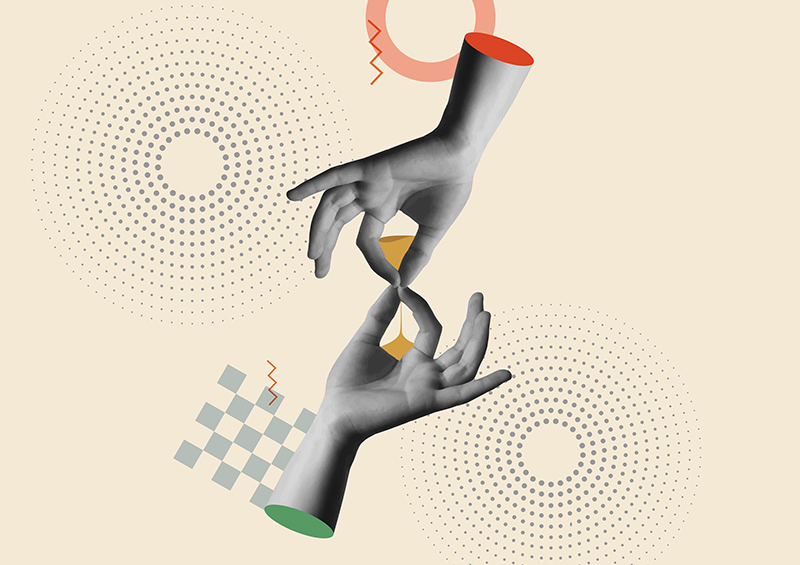
Getty Images.
What we do know is that time perception is remarkably elastic. It stretches and compresses depending on attention, novelty, emotional state, age, and—this is the part that matters most for us—body state. Neuroscientist Marc Wittmann’s research argues that our sense of duration is deeply entangled with interoception, the brain’s awareness of the body’s internal signals. He proposes the insular cortex—which processes information from the viscera, heartbeat, and breath—as a key player in how we encode the passage of time.2 This would mean our experience of time is not just in the head in some abstract sense but braided into how we feel in our bodies.
That’s especially relevant for bodyworkers. If time perception is linked to interoceptive state, and if our hands-on work directly influences that state—calming the autonomic nervous system, shifting attention inward, changing the felt quality of the body—then we are, in a real sense, already bending time for our clients. The question is whether we can do it more intentionally.
Slowing Time by Being, Not Doing
The paradox of therapeutic timelessness is that you can’t chase it. You don’t create it by trying harder or adding more technique. You create it by slowing down—by being present rather than performing, by connecting with your client, and then slowing your own nervous system.
This is where mindfulness and present-moment awareness enter the picture—not as a philosophical overlay, but as a practical tool. When I find myself rushing, thinking about the next technique or the next client, I notice that I’m the one in clock-time mode. So I pause. I take a breath. I let my attention drop into my own body, into the universe of sensation that opens when I’m deeply attuned to my own physical experience, including what’s under my fingers. It’s a kind of time warp, and I go into it first.
Then, something happens. My client’s nervous system responds to the quality of my attention. When I’m unhurried, they can be unhurried. When I get somatically curious, they do too. The room gets quieter, breathing synchronizes, and the whole interaction drops into a different register. The clock hasn’t stopped, but it has stopped being as relevant.
Time Out of Time
Many spiritual traditions have long recognized this elastic quality of time. In contemplative Christianity, there is a distinction between chronos—measured, sequential clock-time—and kairos—the sense of a ripe or sacred moment when something significant becomes possible. In prayer, it is kairos that matters: the quality of presence, not the number of minutes elapsed.
What we can offer is a temporary reprieve from the tyranny of the clock; a place where the body’s own sense of time, slow and spacious, gets to be in charge for a while.
Buddhist practice makes a similar point from a different direction, treating time as largely constructed by the mind, with present-moment awareness revealing that our deepest experience happens not across duration but in immediacy—in this breath, this moment of contact.
For bodyworkers, these aren’t just philosophical ideas. They’re descriptions of something we already know in our hands: that the most potent moments in our work often have very little to do with the clock.
The Paradox of Less
There’s a beautiful paradox here. When we work slowly, lingering with a waiting or listening hand rather than hurrying on to the next area, the session often seems to fly by. My client gets off the table surprised that an hour has passed. I’m surprised too. We went slow, yet it felt like no time at all. And most surprisingly, both of us have the feeling the session is complete.
Compare that with the session where I’m trying to cover too much ground or checking off a mental list. Those sessions can feel long to both of us, even if we “got a lot done.” The busyness keeps both practitioner and client pinned to clock-time, to a mode of consciousness that may be exactly what our clients came to us to get a break from.
This is not an argument against skill, planning, or on-time endings. It’s an argument for recognizing that the quality of our presence—the pace and depth of our attention—is itself a therapeutic intervention. Our clients come to us living in a world that treats time as a commodity. Because of this, many are in pain, anxious, stressed—and all of those states make time feel rigid and more pressing.
It’s too easy for practitioners to also stay time-bound, thinking only about what needs to be done, and therefore, reinforcing a stressful relationship with time. What we can offer, alongside everything else we do with our hands, is a temporary reprieve from the tyranny of the clock; a place where the body’s own sense of time, slow and spacious, gets to be in charge for a while.
That means we might need to plan differently. If our clients come with a long list of complaints, we might ask them something like, “If we were to get to just one of those today, which would be the most important?” It’s surprising how often we find that when one issue is thoroughly addressed, others become much less pressing.
Timelessness isn’t an escape from reality. It’s a different, and arguably deeper, way of being in it. And it’s something we’re already doing every time we slow down, tune in, and let the session breathe. The invitation is simply to do it on purpose, knowing that when we bend time for our clients, we create conditions for something genuinely powerful to happen.
To understand tissue-tension barriers, MTs must be constantly present and mindful. Too light and we will not become efficient at creating the healing change that is needed.