
Fascia: The Pericardium-Diaphragm Connection
Understanding how the pericardium relates to breathing can in turn help clients relax into their massage session.
The splenius cervicis muscle is located on the posterior neck and upper back and lies deep to the trapezius and rhomboids and superficial to the splenius capitis and levator scapulae. It connects the spinous processes of the upper thoracic vertebrae to the transverse processes of the upper cervical vertebrae. The splenius cervicis shares its attachments on the cervical transverse processes with the levator scapula posteriorly and the scalenes anteriorly.
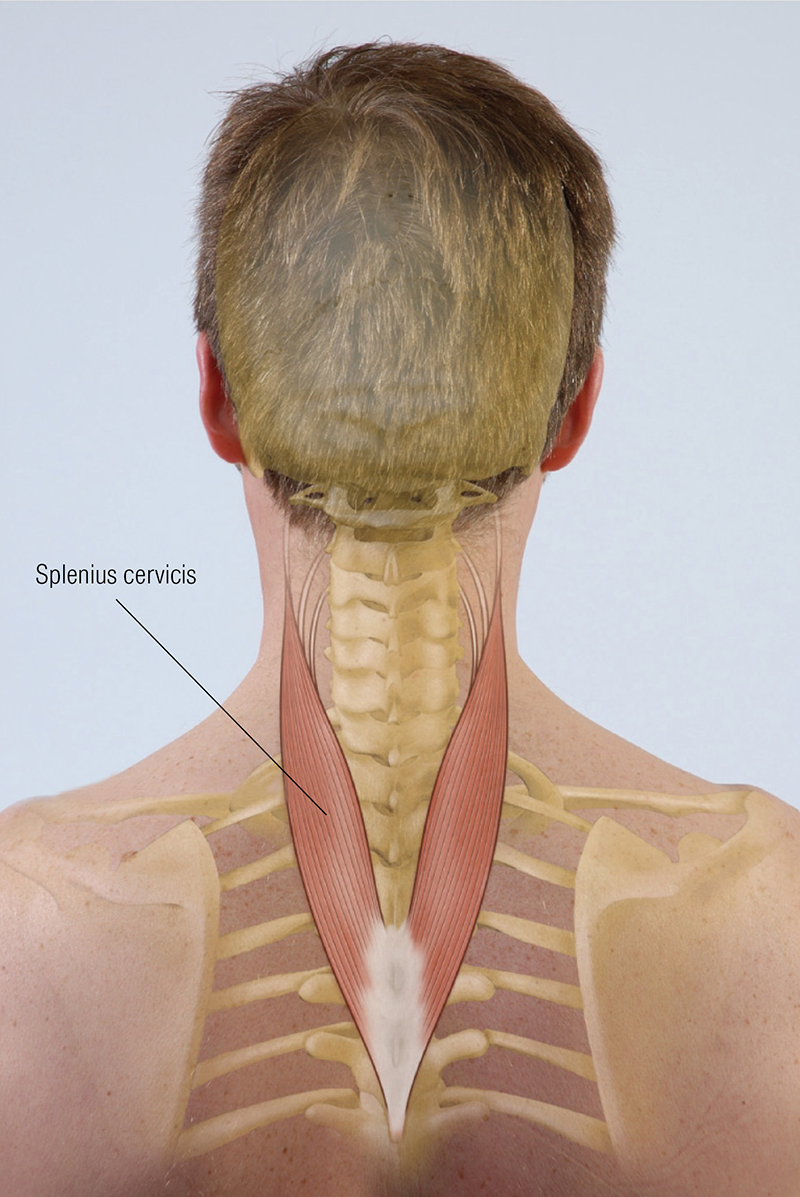
The fiber orientation of the splenius cervicis—vertical and slightly oblique—makes it a powerful extensor and weak rotator of the cervical spine. It is a direct synergist to the splenius capitis in cervical extension and lateral flexion but has less leverage for rotation than its more obliquely oriented counterpart. The splenius cervicis muscle is part of a complex system of stabilizers and prime movers of the posterior cervical spine.
Both the splenius cervicis and splenius capitis are part of a larger system of intrinsic back muscles that span the entire posterior trunk from the pelvis to the head. These muscles vary in size and span, functionally providing stabilization and movement of the vertebral column. Muscles are divided into a medial tract that includes the spinalis, interspinales, semispinalis, rotatores, and multifidi muscles, and a lateral tract that includes the longissimus, iliocostalis, splenius capitis, splenius cervicis, intertransversarii, and levatores costarum muscles. Where the muscles of the medial tract lie deep and close to the midline, those of the lateral tract, including the splenius cervicis, lie more superficially and insert more laterally. The two splenii muscles form the spinotransverse system of the lateral tract as both originate on spinous processes and have fibers that run laterocranially to transverse processes.
Since the splenius cervicis is intermediate in size and depth, it functions both in maintaining posture and as a prime mover, particularly for cervical extension. As such, poor endurance or excessive tension in this muscle may contribute to postural deviations in the head and neck as well as chronic pain conditions such as headaches, neck pain, and trigger-point activation. Proper balance of endurance and flexibility in the splenius cervicis relative to other associated muscles maximizes cervical alignment and function.
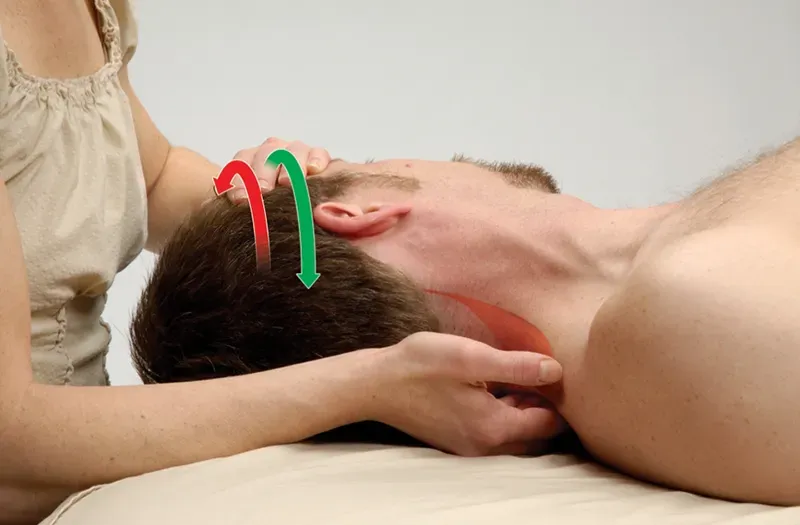
Positioning: client supine.
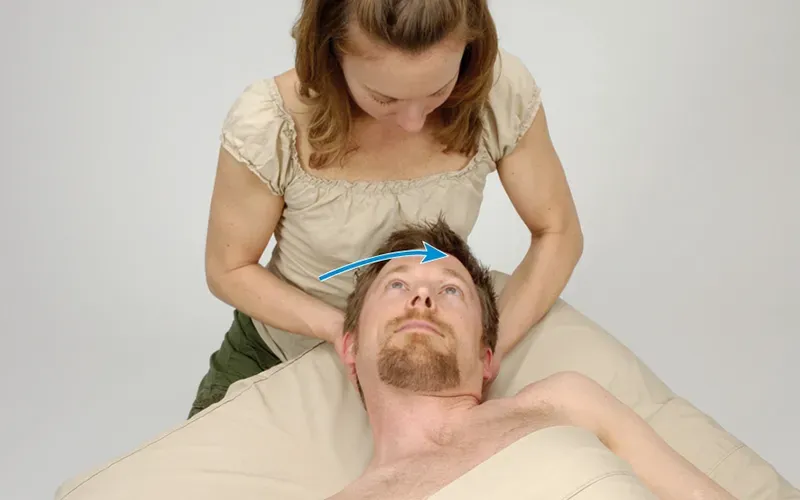
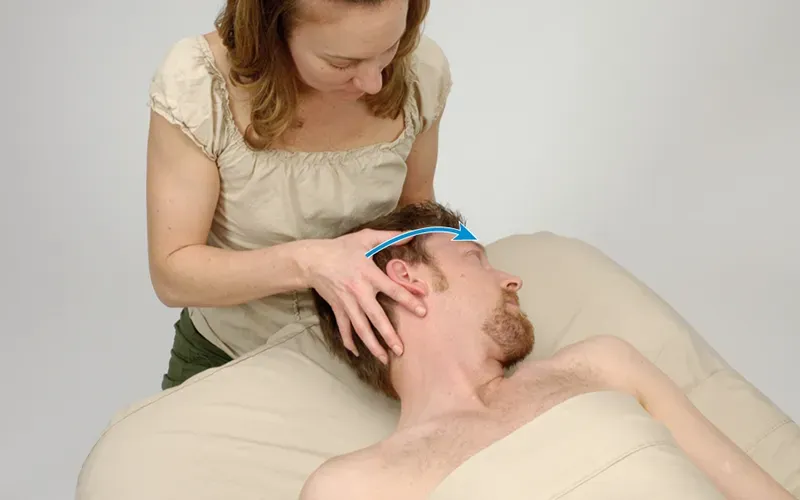
Understanding how the pericardium relates to breathing can in turn help clients relax into their massage session.
Superficial fascia may not get the same attention as deep fascia, but it plays an extremely important role in the organization of tissues and the structure of the body.
Understanding tendons—their shapes, lengths, and organization—improves an MT’s touch vocabulary and facilitates a more skilled touch.
While the neck is a bridge, a pathway, the position of the neck and head can also indicate a multitude of other things happening beneath the surface.