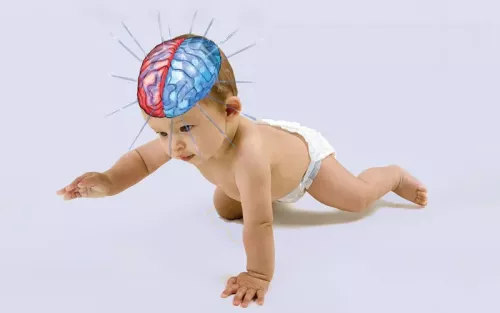
Before infants learn to crawl, they move using homolateral movements, which involve one side of the body, such as the right hand and leg jutting forward simultaneously during reaching and kicking activities. Throughout this primitive developmental stage, the right cerebral hemisphere controls the child's right side, and the left hemisphere controls the left. The resulting uncoordinated movement continues until the child begins to cross-crawl. This new contralateral movement pattern then reorganizes the child's central nervous system so all bodily systems work together as a team (Image 1). Here are some signs cross-patterned movements could use sharpening: poor balance, neck stiffness, lack of coordination, difficulty reading, stuttering, clumsiness, and learning disabilities such as dyslexia.
In certain adults, a smooth cross-patterned gait simply failed to develop, partially due to well-meaning parents who prematurely encouraged the child to move from crawling to walking before a strong neurological bridge through the corpus callosum had been established. In others, things like traumatic injuries, bracing, prolonged inactivity, and lumbar fusion surgeries have shocked the body and jumbled nerve impulses, causing the brain to revert back to a previously mapped homolateral pattern. Clients presenting with remnants of homolateral gait need not only cross-crawling retraining exercises to help strengthen whole-brain neuronal connections, but also good bodywork to correct compensatory muscle imbalance patterns that may have formed.
Image 1. Cross-crawling helps organize the child's central nervous system. Image courtesy Erik Dalton.
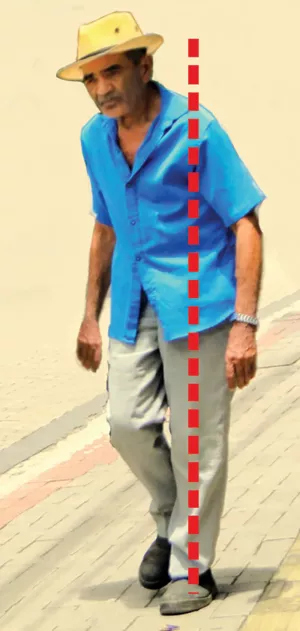
During gait evaluation, we occasionally see clients sporting homolateral remnants that cause them to walk in a block-like fashion, with the shoulder girdle and pelvis rotating as one unit. Notice in Image 2 how this gentleman's homolateral pattern forces him to right sidebend his head as he bears weight on his left leg. This unbalanced position not only unlevels his eyes, but also produces excessive energy expenditure due to altered head-over-leg positioning. The unleveling of his eyes also triggers head-righting reflexes that set the stage for whole-body stress and cervicogenic strain.
Image 2. Homolateral gait unlevels the eyes, initiates head righting reflexes, and distorts balance. Image courtesy Erik Dalton.
Is Balance the Key to Ideal Posture?
One of the evolutionary advantages of erect posture is that it establishes ease of head rotation around the vertical axis, which serves to widen one's horizon. In early man, the need to stabilize this sensory platform to track a target was essential for survival. Optimal head-on-neck positioning should allow easy access in all directions, limited only by skeletal architecture rather than any muscular impediment from protective muscle guarding. A walk that does not land in balance forces the body's posture to compensate via muscular contraction, particularly in the cervical spine. Eventually, as the brain begins to map these compensations, length-strength muscle imbalance patterns develop that may lead to overuse injuries, temporomandibular joint dysfunction, and degenerative conditions.
To test whether you land in balance when you walk, stand with your feet shoulder-width apart and, without moving your head, lift one of your feet to check your one-legged stability. Now, take a few steps, then stop mid-stride and lift one of your legs. Are you able to balance without compensation?
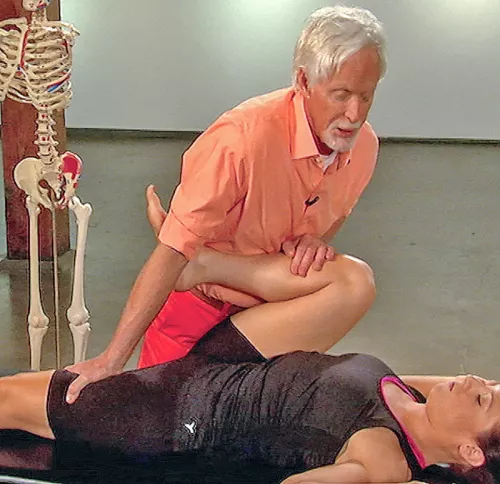
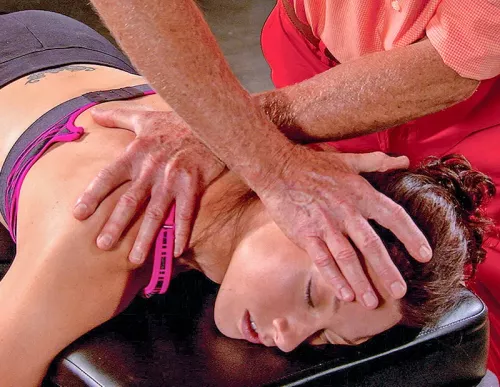
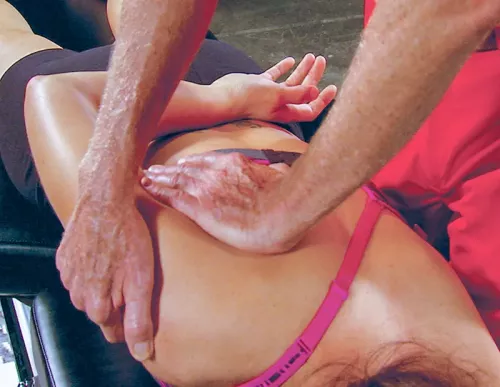
Balance is greatly enhanced when the head is vertically aligned with the stance foot, eyes looking straight ahead. This cervicocranial positioning allows gravitational forces to transmit effortlessly through the body. Before offering cross-patterned home retraining exercises such as the ones outlined below, therapists must first make sure all kinetic-chain kinks are removed, and the neck, thorax, lumbar spine, and pelvis are able to sidebend and rotate symmetrically to encourage a smooth cross-patterned gait. Images 3-5 offer technique suggestions for dealing with the type of protective compensatory spasm I see in many of my homolateral-patterned clients.
Image 3. To assess for contralateral thorax-pelvis rotation, the client's right hip and knee are flexed and the therapist slowly brings their knee toward their left shoulder to the first restrictive barrier. To treat, the client gently extends their hip against the therapist's resistance to a count of five and relaxes. The therapist applies a graded exposure stretch toward the client's left shoulder to reinforce pain-free contralateral movement to the brain. Repeat on opposite side.Image 4. To test and treat head-shoulder girdle contralateral movement restrictions, the therapist right rotates the client's head to barrier, allowing their right shoulder to lift off the therapy table if necessary. The therapist's left hand gently depresses the client's right shoulder to barrier. The client slowly lifts their shoulder against the therapist's resistance to a count of five and relaxes. The therapist applies a pain-free graded exposure stretch to reinforce contralateral "uncoupling" at the cervicothoracic junction. Repeat on opposite side.Image 5. To test and retrain torso-pelvis contralateral rotation, the therapist braces the client's shoulder and adducts the client's arm behind their back. The therapist's hands right rotate the client's shoulder girdle to barrier and the client is asked to slowly lift their left extended leg off the table to a count of five and relax. The maneuver is repeated 3-5 times, with the therapist increasing the counter-rotation stretch as needed. Repeat on opposite side. Images courtesy Erik Dalton.
Summary
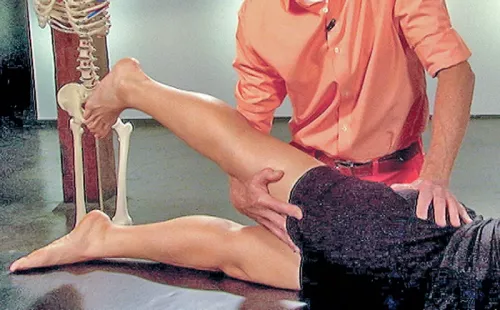
Infancy is characterized by clumsy, nonoptimized homolateral motor behavior and, along these same lines, less integrated cognitive function. As a child grows and develops, mastery of cross-patterned movement allows bodily systems to begin working together as one seamless team. As adults, practicing contralateral movements is a prime way to practice self-care. In fact, cross-lateral exercise can be one of the most fun and effective ways to reboot your nervous system, help discharge stress, and recharge your attention and energy.
Image 6. To test and retrain pelvis-torso contralateral rotation, the therapist's hands create a counterforce by left rotating the client's pelvis while resisting the rotation through the lumbar spine. The client is asked to push their right anterior superior iliac spine toward the therapy table to a count of five and relax, and the therapist slowly brings the pelvis-torso to the new pain-free contralateral restrictive barrier. Repeat on opposite side.
Cross-Lateral Exercise
Try this cross-lateral exercise at work:
Stand with your feet apart and your arms open parallel to the ground.
Shift your weight to your right foot, then lift your left knee and touch it with your right hand.
Step back to both feet, then immediately shift weight to your left foot as you lift your right knee and touch it with your left hand.
Repeat this several times in a comfortable, upbeat, rhythmic way. If the situation allows, get down on the floor and practice cross-crawling.
Such cross-lateral exercise provides a fantastic break from mentally over-focusing, and can serve as a handy neurological tool to help bring both body and mind back online.
To understand tissue-tension barriers, MTs must be constantly present and mindful. Too light and we will not become efficient at creating the healing change that is needed.