


Fascia: The Pericardium-Diaphragm Connection
Understanding how the pericardium relates to breathing can in turn help clients relax into their massage session.
The supraspinatus is a relatively small muscle located deep to the trapezius and deltoid on the shoulder. The muscle belly is located in the supraspinous fossa, just superior to the spine of the scapula. The muscle runs horizontally from the superior angle of the scapula laterally to the acromion process. Here, the tendon drops deep to the acromion process, crosses the glenohumeral joint superiorly, then descends and inserts on the greater tubercle of the humerus.
The supraspinatus is one of four muscles of the shoulder that make up the rotator cuff. The supraspinatus, infraspinatus, teres minor, and subscapularis muscles surround and function as a unit to stabilize the humeral head in the glenoid fossa. Each muscle has a specific role in positioning and steering the head of the humerus as the arm moves into different positions. Without the rotator cuff dynamically stabilizing this highly mobile, ball-and-socket joint, the humeral head would collide with surrounding bony structures such as the acromion process superiorly or coracoid process anteriorly and medially. This may result in compression of adjacent soft tissues and associated damage to bursae, tendons, nerves, and blood vessels critical to the health and function of the upper extremity.
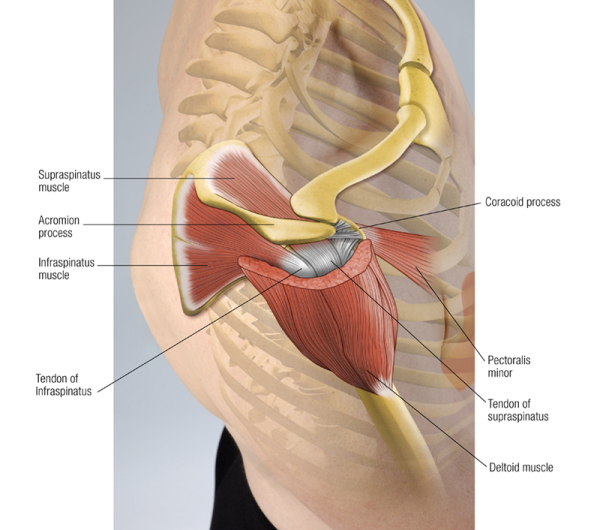
Specifically, the supraspinatus maneuvers the humeral head inferiorly as prime mover muscles such as the deltoid move the shoulder through abduction. When the supraspinatus contracts, it levers the proximal end of the humerus downward as the distal end rises upward. Ideally, this occurs in tandem with activation of the deltoid muscle during shoulder abduction. Subtle depression of the humeral head during shoulder abduction positions the humeral head centrally within the glenoid fossa, preventing contact or impingement on the acromion process. By maintaining adequate space and optimal mechanics throughout the full range of shoulder abduction, the supraspinatus prevents compression and excessive friction that is damaging to surrounding soft tissues.
The location of the supraspinatus tendon deep to the acromion process makes this structure particularly vulnerable to tendinitis, impingement, and tearing. Excessive friction and trauma to this muscle is common and debilitating to the function of the entire shoulder. Additionally, bony anomalies such as an excessively angled or "hooked" acromion, and postural deviations such as a forward head or rounded shoulders, can inhibit activation of the rotator cuff and encourage shoulder impingement syndromes.
Establishing and maintaining proper posture and a strong, healthy supraspinatus in conjunction with the other rotator cuff muscles is essential to optimal shoulder function.
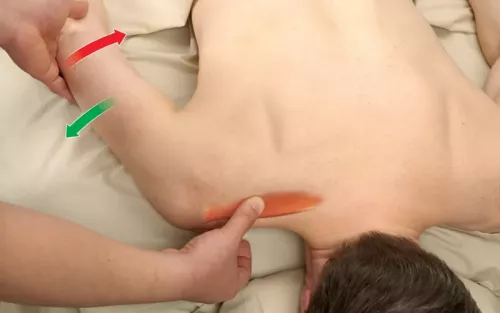
Positioning: client prone with arm at side.

Understanding how the pericardium relates to breathing can in turn help clients relax into their massage session.
Superficial fascia may not get the same attention as deep fascia, but it plays an extremely important role in the organization of tissues and the structure of the body.
Understanding tendons—their shapes, lengths, and organization—improves an MT’s touch vocabulary and facilitates a more skilled touch.
While the neck is a bridge, a pathway, the position of the neck and head can also indicate a multitude of other things happening beneath the surface.