We move by contracting. Muscles fire, causing them to tighten, shorten, and pull. With repetition and habituation, muscles fire quicker, shorten more, and pull harder. When strength or stability are needed, this rapidity, tightening, and pulling are all very good things.
But muscles that get accustomed to firing quickly or strongly can lose refinement and finesse. Powerful movements become jerky and less precise, as muscles "forget" they don't have to bring all their motor units online at once. And when it's time for rest or relaxation, muscles accustomed to fast contraction, strong pulling, and sustained tightening sometimes forget how to simply let go.
That's where hands-on work can help. By leveraging the nervous system's built-in regulatory and control systems, skilled manual therapy can "remind" muscles to lower their resting tone when they aren't working; to let go and relax. And using the same systems, hands-on work can also help muscles learn refined, incremental, and nuanced possibilities for action, instead of lurching into unnecessarily large, all-or-nothing contractions with every movement.
Leveraging the Golgi Tendon Organ Effects
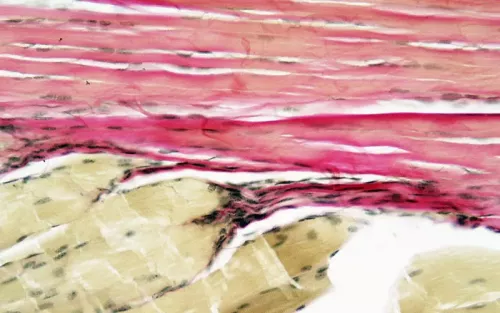
Image 1. Found in dense connective tissues throughout the body, Golgi tendon organs (GTOs) are concentrated around the myotendinous junctions, where the fascial wrappings of muscle cells (red) blend with the collagen fibers of tendons (tan), shown here at 40x magnification. Image copyright Lutz Slomianka, used by permission.
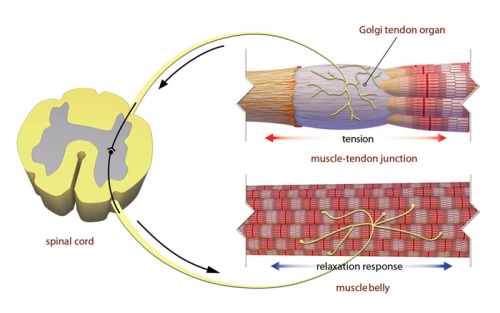
One of these built-in systems for moving with refinement, relaxation, and efficiency is the Golgi-based stretch reflexes. Golgi mechanoreceptors are common in many of the body's dense connective tissues, such as joint capsules, ligaments (where they are known as Golgi end organs), and Golgi tendon organs (GTOs), which are concentrated around the myotendinous junctions, where muscle cells end and tendons begin (Image 1).1 Intimately involved in tension perception, protective reflexes, and movement coordination, with the right kinds of mechanical stimuli, GTOs can lower the firing rate (i.e., relax) of their associated muscles (Image 2). Interestingly, they can also facilitate (increase the firing rate, or excite) a muscle's synergists and antagonists, and thereby play a key role in de-emphasizing prime-mover dominance and increasing global movement coordination and refinement.2
Image 2. When stimulated, Golgi tendon organs can provoke a relaxation response in their associated muscles via inhibitory interneurons in the spinal cord. Image courtesy www.bandhayoga.com, used by permission.
Many types of manual and movement therapies, including structural integration, proprioceptive neuromuscular facilitation, Hatha yoga, and others, use GTO responses (along with other kinds of mechanoreceptors) to explain their effects. Though such theories about the GTOs' manual therapy applications were first proposed over 30 years ago,3 subsequent research (detailed by authors and researchers such as Robert Schleip4) has clarified several conditional factors relevant to hands-on work. A Golgi response is more likely with sustained and relatively firm local pressure on a muscle's fascial connections, in a direction oblique or perpendicular to the muscle's axis of pull, and in combination with active client movement.
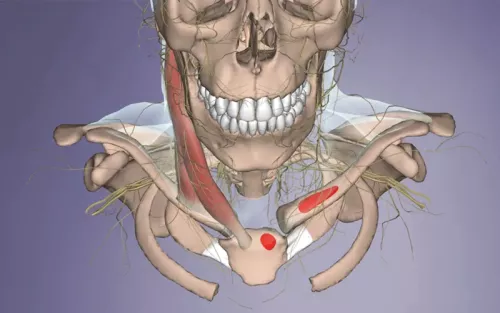
Image 3. The sternocleidomastoid (SCM) and its attachments (red). The superficial and deep cervical fasciae (transparent) and selected nerves (yellow) are also shown. Image courtesy Primal Pictures, used by permission.
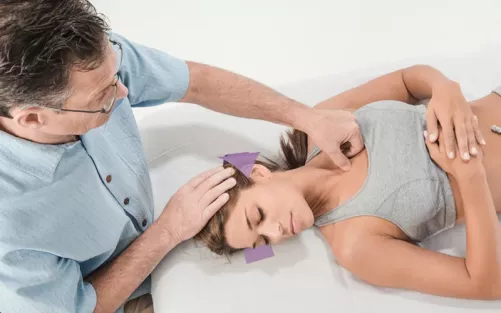
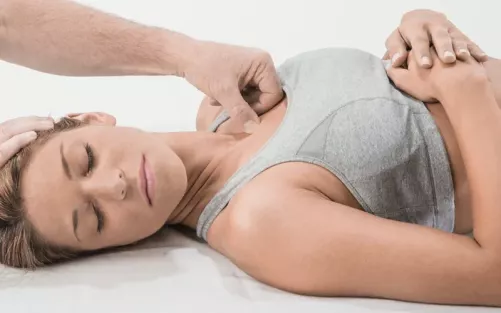
In our Advanced Myofascial Techniques workshops and video courses, we use these three principles to take advantage of the Golgi effects in several situations. Examples include when working with the large, strong, and always-on hip abductors in the Push Broom "A" Technique ("Working with Hip Mobility," Massage & Bodywork, March/April 2012, page 114); when working with the sensitive structures of the jaw in the Posterior Digastric Technique ("The Temporomandibular Joint, Part II," Massage & Bodywork, September/October 2009, page 120), and for reeducation of the often-tight sternocleidomastoids (SCMs, Image 3) in the SCM Attachment Technique (Images 4 and 5).
Images 4 and 5. The SCM Attachment Technique helps the client learn to relax the SCM, even during head/neck movement. Direct pressure on the SCM's sensitive attachments (the site of GTO concentration) amplifies the client's proprioceptive awareness of (and helps relax) any SCM contraction during slow, incremental, active head rotation (arrow). Use verbal cues and feedback to help the client find easier movement, with minimal SCM contraction. Though relatively firm pressure is required to evoke a Golgi response, as always, your pressure should be comfortable for the client. Image courtesy Advanced-Trainings.com.
In many Golgi-based techniques, including the SCM Attachment Technique, in addition to precise, sensitive, firm pressure and active client movement, we use another important tool: our words. Our verbal cues and feedback (described in the Sternocleidomastoid Attachment Technique below) aim to kindle our clients' curiosity, open up new movement possibilities, and foster refined proprioceptive awareness. In practice, for example, this might mean using verbal cues to slow down your client's movements, make them smaller, and direct your client's attention toward the smooth, controlled, and gradual initiation of motion.
Of course, deliberate movements and focused attention have beneficial effects beyond local muscle relaxation and reeducation. Schleip, for example, describes how stimulation of fascial mechanoreceptors has long been shown to increase global, entire-body relaxation, calming of the autonomic nervous system via parasympathetic responses, and other whole-person effects.5 So whether you're working with reeducating one muscle's firing pattern, or with the bigger picture of whole-body activation and relaxation responses, including the Golgi tendon organs in your work can help you utilize the nervous system's built-in mechanisms for movement efficiency, coordination, relaxation, and ease.
The Sternocleidomastoid (SCM) Attachment Technique
Indications
Neck tension, pain, or stiffness
"Cold" whiplash (3-6 weeks or more since injury; no muscular spasms)
Positional or postural issues, such as head-forward position; torticollis
Headaches: both tension-type and migraines
Jaw pain, tension, and temporomandibular joint disorder
Purpose
Refine proprioceptive awareness of SCM's role in neck/head motion.
Reduce and reeducate SCM tonus by refining proprioceptive coordination of SCM engagement in movement initiation.
For More Learning
Watch "Neck, Jaw & Head" and "Whiplash" in the Advanced Myofascial Techniques series of workshops and video courses.
After other preparatory work, use gentle, firm, specific, and static (not sliding) pressure directly on the sternal and clavicular insertions of the SCM (Images 3-5).
Cue active but slow client movements, as described below.
Monitor client's comfort and ability to fully relax, and modulate pressure and pace accordingly.
Movements
While maintaining SCM relaxation, have the client slowly look left and right with just their eyes.
Once the ability to move the eyes with relatively relaxed SCM is established, add slow, gentle neck rotation, looking for ways to move the head without overcontracting the SCM. SCM relaxation while moving may seem difficult at first. Slow, focused, small, active movements will be more effective (and comfortable) than large, fast movements.
Possible cues: "Leave your head heavy, so this place [SMC attachments] stays relaxed. Slowly, begin to look right." "Go slow enough that you leave this place soft." "Let it go; start again; let this stay relaxed." "Let the back of your head turn as much as the front." "Use your eyes instead of your muscles to start the movement," etc.
Repeat with the client sitting or standing.
Client Homework
While pressing into SCM attachments, practice head rotation with a relaxed SCM when lying, seated, and standing, with special attention to slow initiation of movement, without over-contraction of the SCM.
Notes
1. M. H. Ross and P. Pawlina, Histology: A Text and Atlas: With Correlated Cell and Molecular Biology, 6th ed. (Baltimore: Wolters Kluwer/Lippincott Williams & Wilkins, 2011): 158-217.
2. A. Prochazka and M. Gorassini, "Ensemble Firing of Muscle Afferents Recorded During Normal Locomotion in Cats," The Journal of Physiology 507, no. 1 (March 1998): 293-304, https://doi.org/10.1111/j.1469-7793.1998.293bu.x; J. Moore, "The Golgi Tendon Organ: A Review and Update (Neuromuscular Receptors; Proprioceptors; Sensory Receptors)," The American Journal of Occupational Therapy 38, no. 4 (April 1984): 227-36. https://pubmed.ncbi.nlm.nih.gov/6375383/.
3. J. T. Cottingham, Healing Through Touch: A History and Review of the Physiological Evidence (Boulder: Rolf Institute Publications, 1985).
4. R. Schleip, "Fascia as a Sensory Organ: A Target of Myofascial Manipulation," in Dynamic Body, ed. Erik Dalton (Oklahoma City: Freedom From Pain Institute, 2012), 127-36.
5. R. Schleip, "Fascia as a Sensory Organ: A Target of Myofascial Manipulation."
To understand tissue-tension barriers, MTs must be constantly present and mindful. Too light and we will not become efficient at creating the healing change that is needed.