Beauty, they say, is in the eye of the beholder. In other words, not everyone thinks the same things are attractive. "Value" is similar: the worth we assign something (for example, the price we're willing to pay for it, or how much effort we'll put into getting it), varies from person to person and from situation to situation. This perception of value can help (or hinder) your hands-on work in more ways than might first meet the eye, and it pays to be interested in how the value of your work is perceived.
The idea of value gets even more interesting in value exchanges, such as a client paying you for a session. In this case, the overall value of that session is now in the eyes of at least two beholders—you and your client, each with your own perspectives about its worth. These two views influence each other: if you know your client doesn't think your session was very good, your own sense of its value likely goes down. Most importantly, this is also true the other way around: if you don't value what you offer, chances are very good that your client won't think it's worth much either.
And then there are results—the benefits or changes your clients attribute to your work. Results have a complex, two-way interrelationship with value. It might seem obvious that the results your clients get would determine whether your work seemed valuable to them. If your clients feel better, have less pain, or are less stressed after your work, they're more likely to think it was worth their investment. But, like many chicken-and-egg relationships, if your clients have doubts about the value of your work to begin with, the results they want will be much harder to get. And, if (for whatever reason) clients are predisposed to think that their sessions' results will be good, they're much more likely to get real benefit and satisfaction.
What Influences Value
Signs of Poor Client-Perceived Value
How can you tell when clients might not value your work? Signs could include:
Frequent appointment changing, canceling, or lateness
No rescheduling or referring others
Low participation or motivation; passivity
Poor results (possibly related to self-fulfilling low expectations)
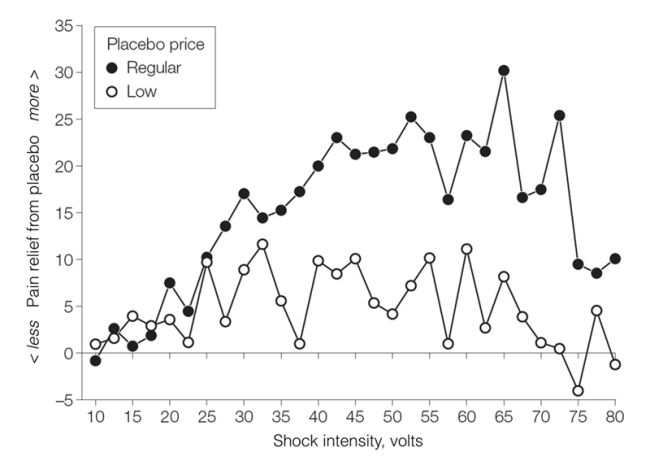
Placebo research reveals that, among other things, price can play a key role in self-fulfilling expectations of effective results (Chart 1).1 And, as many practitioners' discounting or Groupon experiments have shown, discount-motivated customers are much less likely to become regular customers, or to refer others.2 But price is just one measure of perceived value, and not a very reliable one, since incomes and attitudes about money vary widely. Your work does not have to be expensive to be well-appreciated and effective.
Results, effectiveness, and price are just some of the many things that influence your clients' perception of value. Other important factors include:
whether they enjoy their visits
the rapport and trust they feel with you
the authority or credibility you have in their eyes
whether they see what you offer as something special
Clients take some of their strongest value cues from you, their practitioner. If they see that you value what you offer, they're much more likely to see it as worthwhile too. If you have doubts about your abilities or methods, those would be the first things to get help with (see "The Value of Confidence," Massage & Bodywork, March/April 2018). But if you already believe in the value of your work, there are many ways to communicate this (see "Signs of Poor Client-Perceived Value" above).
Chart 1. Pain relief by placebo price. Mean difference in pain ratings (vertical scale), before vs. after placebo, by voltage intensity. Volunteers recruited to test a "new analgesic" pill were instead given a placebo. In response to calibrated electric shocks to the wrist, those who were told they had received a "regularly priced" pill (valued at $2.50) rated their pain as significantly less after taking the placebo than those who were told they were given a "discounted" pill ($0.10). Regularly priced placebos reduced pain in over 85 percent of subjects, while discounted placebos (which were otherwise identical) reduced pain in just 61 percent. Adapted from Waber et al., 2008.
Two more interesting facts about value:
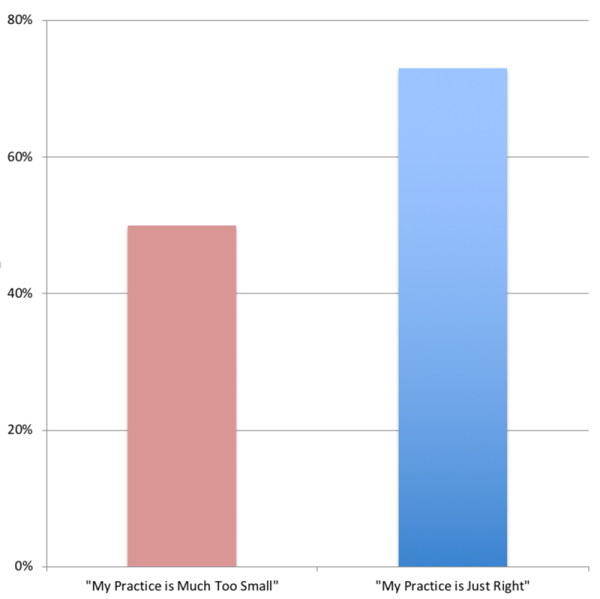
1. The 2014 Psychology of a Full Practice large-scale survey of more than 2,000 massage and bodywork practitioners revealed a strong relationship between how valuable we think our work is to our clients, and how happy we are with the size of our practice (Chart 2).
Chart 2. Clients "see my work as valuable," by satisfaction with practice size. One large-scale survey revealed that the more practitioners thought clients valued their work, the more likely they were to be satisfied with the size of their own practice. Vertical scale: percent of practitioners in each group strongly agreeing that "I think my clients see my work as valuable." From the 2014 Psychology of a Full Practice survey, courtesy Advanced-Trainings.com.
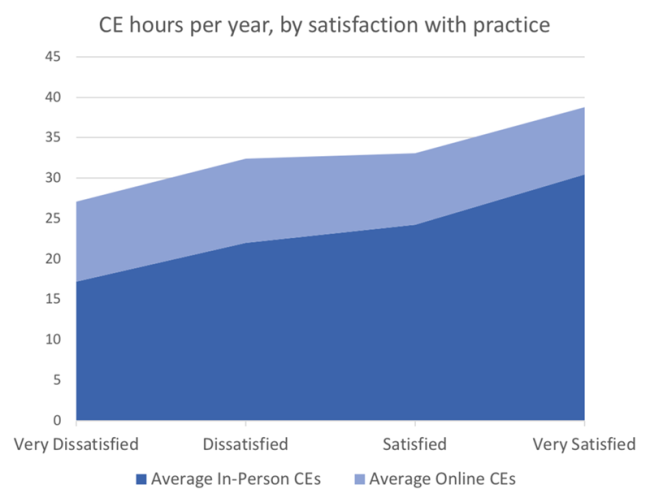
2. The survey also showed that we are more likely to be satisfied with our practice the more hours of continuing education we do (Chart 3), and the more often we receive the work we do; both are signs of valuing and being willing to invest in the work we do. The perception of value may be in the eye of the beholder, but it can have a fundamental impact on the results people get from your work, their likelihood to refer new people to you, and whether they come back. Though we can't directly control how other people think or feel, we have a surprising amount of influence on the value our clients see in our work. The best way is to value it ourselves.
Chart 3. The more hours of professional continuing education (CE) that survey participants completed, the more likely they were to be satisfied with the nature or quality of their practices. This was particularly true for in-person CE (dark green). Conversely, more hours of online CE correlated with less average satisfaction with one's practice. From the 2014 Psychology of a Full Practice survey, courtesy Advanced-Trainings.com.
9 Ways to Communicate Value
Communication: Treat each communication as important. Get back to clients promptly and professionally.
Logistics and details: Pay attention to the quality and condition of your office, décor, linens, attire, paperwork, website, etc.
Professionalism: Practice attentiveness, presence, boundaries, etc.
Keep time agreements: Going over your appointed time can communicate that your time isn't valuable.
Prepare for each session: Research your client's condition before they come, arrive rested and ready, quiet yourself in advance, etc.
Ask your client to "invest" some effort in their work with you. For example, you might have them articulate their desires and goals, work within your scheduling parameters, actively participate (e.g., active movement, simple homework), etc.
Charge a price that implies worth. Avoid discount addiction.
Show that others value your work. Include testimonials or reviews on your website, ask for recommendations, point clients toward review sites, frame your thank-you notes, etc.
Show evidence of ongoing learning and professional development. Tell your clients about your CE studies and share them on your site and social media. Hang your CE certificates in your office.
Notes
1. Rebecca L. Waber et al., "Commercial Features of Placebo and Therapeutic Efficacy," Journal of the American Medical Association 299, no. 9 (2008): 1016-17.
To understand tissue-tension barriers, MTs must be constantly present and mindful. Too light and we will not become efficient at creating the healing change that is needed.