
Fascia: The Pericardium-Diaphragm Connection
Understanding how the pericardium relates to breathing can in turn help clients relax into their massage session.
The focus of this Science of Movement series is educational, to promote the study and personal embodiment of kinesiology. Practitioners and students can practice these techniques with each other for self-study, but to use them with a client, practitioners should have advanced degrees in somatics and certification as Registered Somatic Movement Educators (RSME) or Registered Somatic Movement Therapists (RSMT). For more information about somatic trainings and certifications, go to www.ismeta.org, the International Somatic Movement Education and Therapy Association’s website.
Because massage therapists assess posture and movement in order to work effectively with muscle patterns, understanding kinesiology—the science of human movement—can help MTs get better results in their practice. Efficient movement begins from a position of optimal posture, with the head, thorax, and pelvis stacked along the vertical axis.
Optimal posture allows us to carry the weight of the spine as close to midline as possible. It aligns the skeletal system in a position of mechanical advantage, which equalizes gravity’s downward pull on the bones with the upward counter-support of the axial skeleton. This, in turn, allows the muscles to rest at optimal lengths and minimizes compressive stresses on the weight-bearing joints.
The human body is literally anchored to the earth by gravity. The gravitational pull is so constant that we don’t notice it until a change of dynamics catches our attention. For example, when we lose our grip and drop something heavy or inadvertently step off a short ledge, gravity’s downward force can be startling.
Weight is relative to gravity; that is, gravity gives mass its weight. Without gravity, all bodies would become weightless and float, and the human body would not need an axial, bony framework to counter gravity’s pull.
The narrower and more vertical a structure, the less muscular energy it takes to hold it up. As the most vertical of all animal skeletons, the human skeleton is the most efficient design on the planet for standing. In an upright position, our three bony masses—head, rib cage, and pelvis—stack one on top of another, and all three align over the feet.
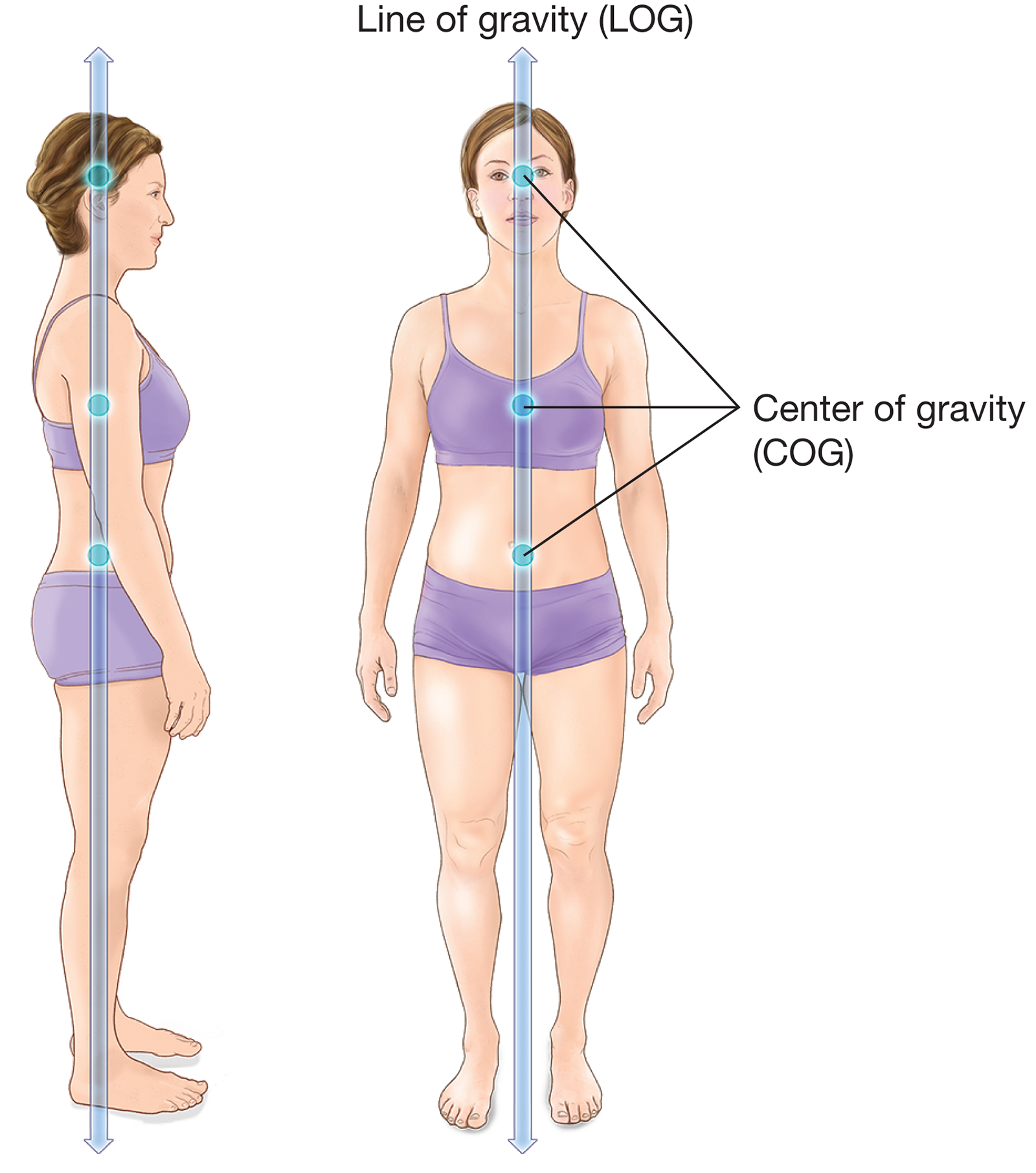
The center of gravity (COG) of a mass is that point around which all parts are exactly balanced: it is the same as the center of weight. The line of gravity (LOG) is the direction of gravity’s force; it is, basically, a plumb line. Our uniquely upright skeleton aligns the body along a single vertical axis.
The COG in the skull lies several inches behind the “third eye” on the forehead, slightly above, and between, the eyebrows.
The COG in the chest lies several inches above the diaphragm, anterior to the 10th thoracic vertebra, midway between front and back, below the heart.
The COG in the pelvis lies behind and below the navel, directly in front of the sacrum. It is usually lower on women, because of greater width and weight in the pelvic girdle.
In optimal posture, the COG of each weight-bearing body part aligns as closely to the LOG as possible (Image 1). This allows gravity to flow through the center of a standing body. When a person demonstrates optimal posture, all the weight-bearing joints of the spine and lower limbs extend. Joints in the extended position are “joint neutral” because they are straight, neither bent nor twisted. Joint neutral serves as a reference point for optimal skeletal alignment and muscular balance.
Caution: Do not perform this test on anyone who has pain and/or a spinal disk problem. Make sure to press down only for an instant. Do not hold sustained pressure.
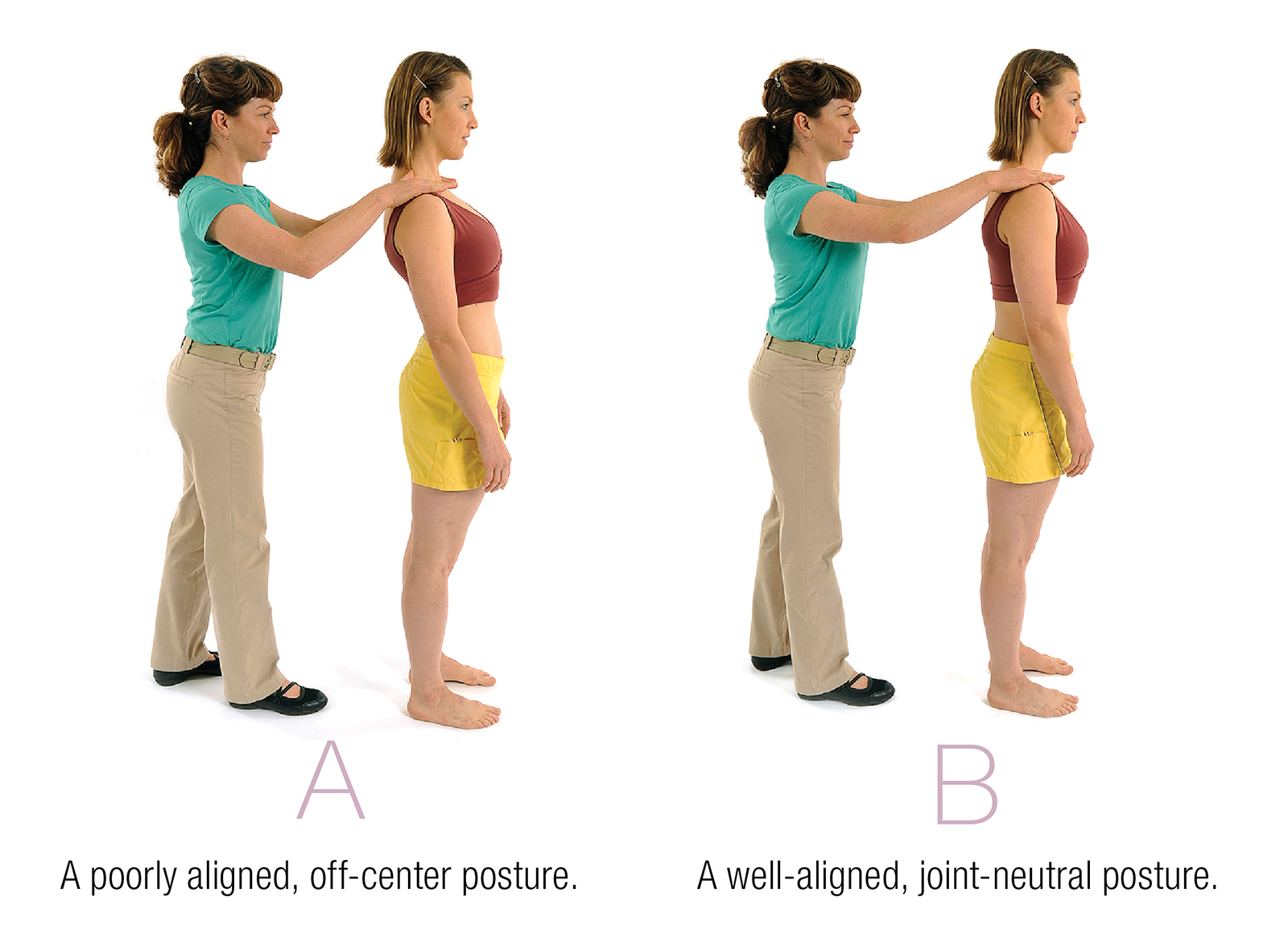
Use this simple compression test to assess the alignment of the thorax over the pelvis and legs. It will help your partner feel how compression translates through the joints from the shoulders to the feet, and feel when the upper body balances over the lower body and the base of support.
Understanding how the pericardium relates to breathing can in turn help clients relax into their massage session.
Superficial fascia may not get the same attention as deep fascia, but it plays an extremely important role in the organization of tissues and the structure of the body.
Understanding tendons—their shapes, lengths, and organization—improves an MT’s touch vocabulary and facilitates a more skilled touch.
While the neck is a bridge, a pathway, the position of the neck and head can also indicate a multitude of other things happening beneath the surface.