No matter a client's presenting symptoms, in the end, bodywork is all about stress reduction and recovery. And one of the major causes of, and antidotes for, stress-related disorders is food.
Under stress, we naturally crave high-carbohydrate, fatty, sugary foods. These provide extra fuel and replenish the reserves used during a crisis. Unfortunately, chronic stress acts like a permanent "on" switch, causing continual yearnings for unhealthy foods. This is a setup for the toxicity, allergies, and addictions that lead to stress-induced reactions, including inflammation, pain, autoimmune disorders, allergies, addictions, and more.1
For quick and effective problem solving, I'd suggest approaching the subject through an energetic lens rather than a textbook lens. I introduced this topic in my last column ("The Energy of Food," Massage & Bodywork, May/June 2018). In this article, I'll expand on the points already made and add to them.
Chakras and Food
iStock.
Chakras are subtle energy centers that manage all aspects of life. Subtle organs are similar to physical organs, except they operate on higher or lower frequencies of light and sound than their bodily counterparts. Even better, chakras are able to convert physical energy into subtle energy, and vice versa. Because of this, interacting with the chakras is an ideal way to evaluate for healthy versus unhealthy consumables and reprogram the negative energies associated with a substance.
Key to understanding the significance of chakra-based food management is knowing that each of the seven in-body chakras operates on a different band of frequencies, measurable as light and sound. In turn, each chakra, which governs a specific set of physical, psychological, and spiritual functions, interrelates to the foods and substances that match its frequency. Negative food programs will cause a chakra to crave the unhealthy consumables linked with that chakra. Positive food programs will do the opposite, enabling us to make healthy choices and reap the benefits from our food.
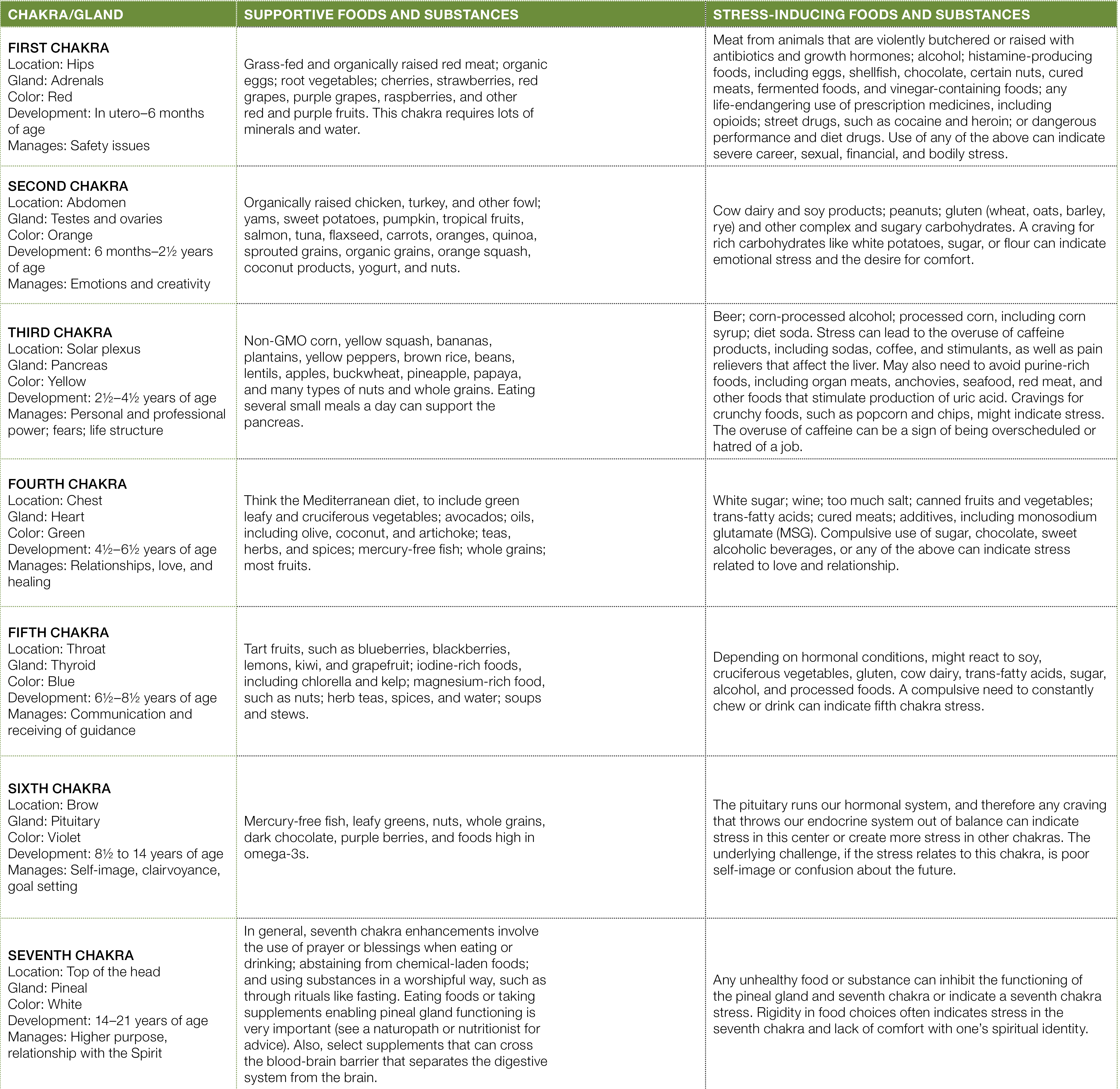
I've provided the chart on page 99 to help you understand the in-body chakras and their relationship with food and other substances. The chart labels each chakra, its bodily location, related hormone gland, frequency described as a color, and the issues it manages. The age of development indicates when this chakra activates most fully during childhood. Food issues incurred during that time period are more apt to stick and affect the client for the rest of their lives.
Each chakra, which governs a specific set of physical, psychological, and spiritual functions, interrelates to the foods and substances that match its frequency.
In order to best utilize this chart, consider the following steps.
Embrace the craving. Encourage a client to embrace a craving and figure out why they have it. The food or substance might have been originally provided as a substitute for what was really needed, in which case the immune system will attack the substance, causing sensitivities, allergies, inflammation, and autoimmune dysfunctions, but the inner self will think it still needs that food to get its needs met. The food might also be perceived in a negative light, and there will be a reason why. Help your client track the food to the correlated chakra and seek the storyline setting up the craving.
Concentrate on the developmental time period. For further clarification in relation to the above first, the client can hone in on events occurring in the chakra's activation period to figure out why the craving or food issue arose.
Release others' energies. If the client believes they might have absorbed another's food issues, or been contaminated by another's feelings or beliefs, ask them to release these subtle energies. Their Higher Power can best dispose of them in a way that is healthy for everyone.
Look up the organ. You can figure out which chakra to focus on if there is a particular organ in distress. If a client is diabetic, they will work with the third chakra, which is associated with the metabolism. If they are under constant survival stress, they will examine the foods related to the first chakra, which manages the adrenals. In general, they should eat healthy foods associated with the affected chakra and abstain from negative substances.
Assess with the hands. If unclear about which chakra needs to be focused on, hold your hand over a chakra area. Then, ask if this chakra holds the key to making healthy food choices. If the answer is yes, your hand will feel light. If it is no, your hand will feel heavy. You can test each chakra this way. If there are multiple yesses, select the one that seems the strongest or easiest to address first.
Heal with light. Once you've selected a focus chakra, when performing bodywork, ask your Higher Power to send the affiliated chakra color into that bodily area. A client can do the same.
Send them to a professional. It's always OK to encourage a client to get professional assistance.
To understand tissue-tension barriers, MTs must be constantly present and mindful. Too light and we will not become efficient at creating the healing change that is needed.