

Fascia: The Pericardium-Diaphragm Connection
Understanding how the pericardium relates to breathing can in turn help clients relax into their massage session.
For the past few years, I’ve grown used to virtually every food product—from high-fructose beverages to bacon—proudly proclaiming, “Gluten Free.” However, I never thought the day would come when the relatively new phenomenon of “Glute-Free Massage” would be an accepted practice, and I find it disturbing. Simply put, I feel that neglecting to work on an area as important as the gluteals is a great disservice to our clients.
Working on the gluteals should not be confined to just clinical therapeutic work; it should also be included in any full-body massage as a way to integrate the important connection, energetically and structurally, between the client’s lower and upper body. Let’s look at some of the kinesiology, anatomy, and therapeutic issues of the gluteals to understand why practicing a glute-free massage can be a detriment to your client.
Not only is strengthening the gluteal muscles important, relaxing and aligning these muscles through bodywork is also crucial and should be part of any session. Any strong, functional muscle has the potential to be tight and restrictive. It seems worse than unwise to shy away from working on such an important group of muscles as the gluteals because of misplaced concern and unsubstantiated projection over client modesty. Good client education and proper languaging (see But How Do I Talk About It? page 68) can help you jump that hurdle.
Quite simply, the gluteal muscles should not be ignored. Let me list a few things that demonstrate the importance of this area and why, as therapists, we need to relax, align, and provide left and right balance to the posterior pelvis.
So, we understand that glute work is important. The good news is that working on the gluteal area isn’t rocket science. Yes, there are many specific techniques for more advanced bodywork to remove sacral dysfunction and to balance the pelvis, but important therapeutic work can also be accomplished in a short time and as part of a primarily relaxation-based massage. Think of the different stresses put on the gluteals and rotators for such asymmetrical activities as skateboarding, tennis, golf, baseball, or even running in a counterclockwise direction around a track. As with many parts of the body, simply assessing tightness and working to achieve left-to-right balance is extremely effective. (Note: while it is beyond the scope of this article, once you balance the posterior pelvis, it is important to also create some front-to-back balance with the anterior pelvis, particularly the psoas, iliacus, abdominal muscles, and rectus femoris.)
The gluteus maximus seems to have the rockstar status of Mick Jagger, while I call the equally important deeper gluteal muscles the Rodney (“I don’t get no respect”) Dangerfields of the posterior pelvis. It is important to also consider the depth of restrictions and be able to work deeply through the superficial gluteus maximus to address deeper tension in the rotators and gluteus medius, and, in turn, work through the gluteus medius to work on the gluteus minimus.
Basic Swedish kneading strokes to the gluteus maximus are not only effective for easing tension and increasing circulation, but also feel great to the client even if you can only spend a minute or two applying them. For more detailed work, a precise focus of depth is crucial so you are not indiscriminately dissipating your energy into too many layers and working too hard. Visualize how the gluteus maximus must be free to slide over the deeper muscles as it lengthens and shortens when the femur moves from flexion to extension during running. Sink vertically through tissue until you feel the resistance of the deeper muscles.
Then, apply force in all directions at an oblique angle to free “stickiness” between the deeper layers so the gluteus maximus can easily slide over the rotators, gluteus medius, and gluteus minimus with a shearing motion.
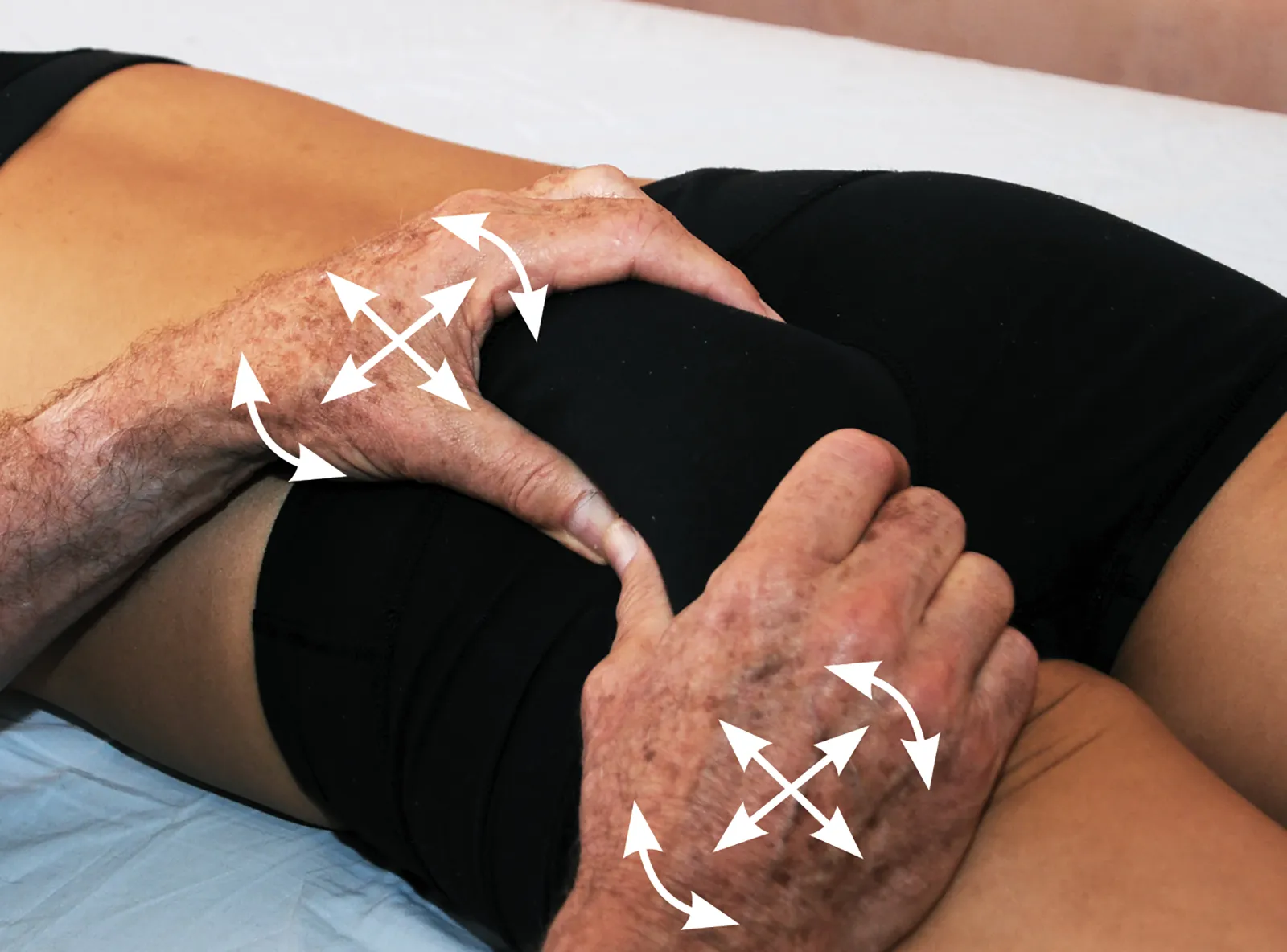
Although this is most easily accomplished by actually grabbing skin and deeper tissue directly, you can also work through a drape or through a client’s underclothes. Keep your fingers relaxed and soft while keeping your entire palms in contact with the surface and applying the majority of your force by pushing with the heel of your hand, rather than pinching with the fingers.
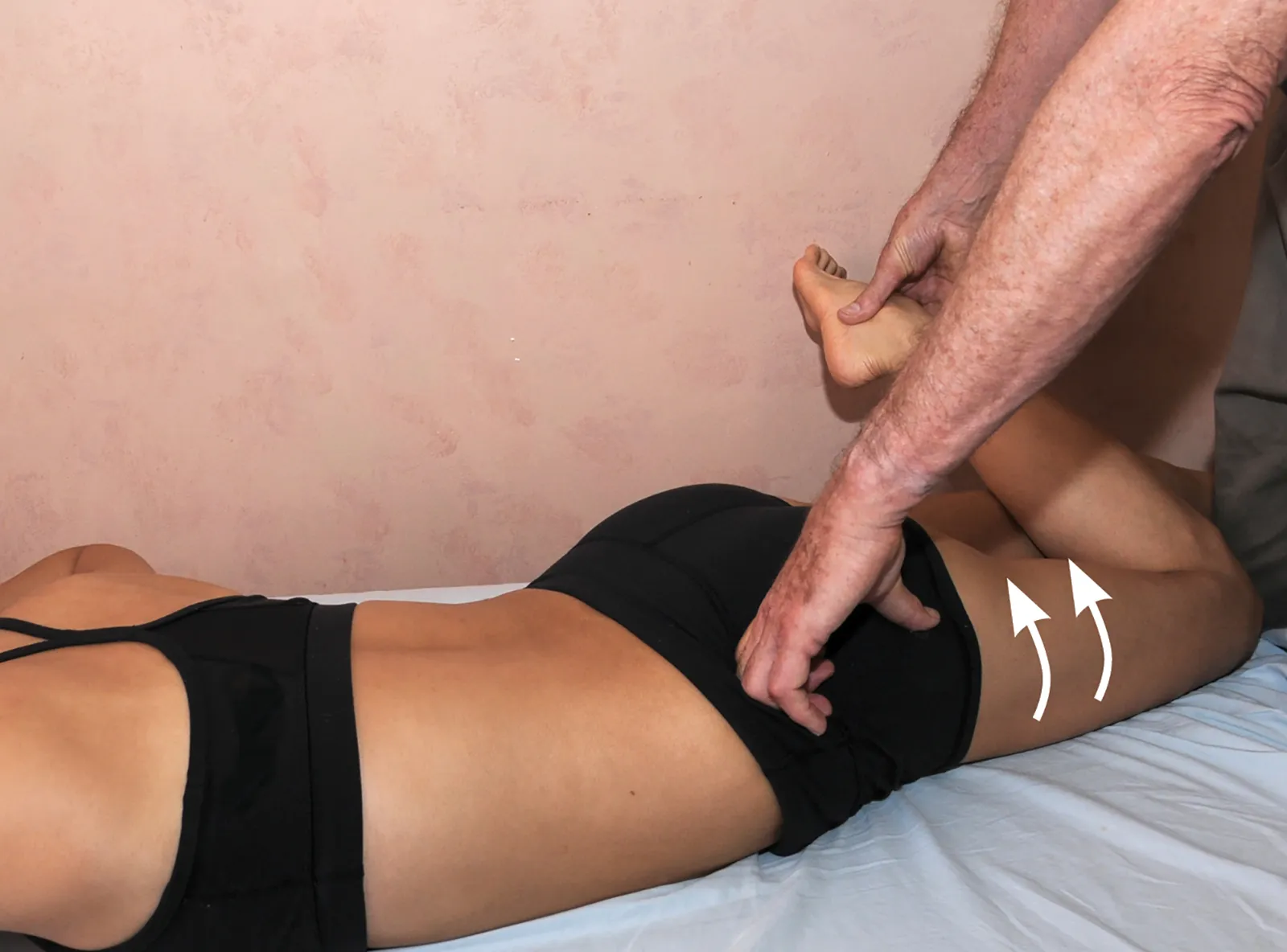
Grab and lift portions of the gluteus maximus and feel for restrictions between it and deeper layers, taking care not to venture too far toward the gluteal cleft; then, lift and push in all directions, including a circular motion (Image 1). The move may look a bit unusual, but try it on friends for practice; you will find that most clients will not have experienced this technique and often comment on how good it feels. Move slowly rather than bouncing; when you reach the end range of restriction, wait for the melt.
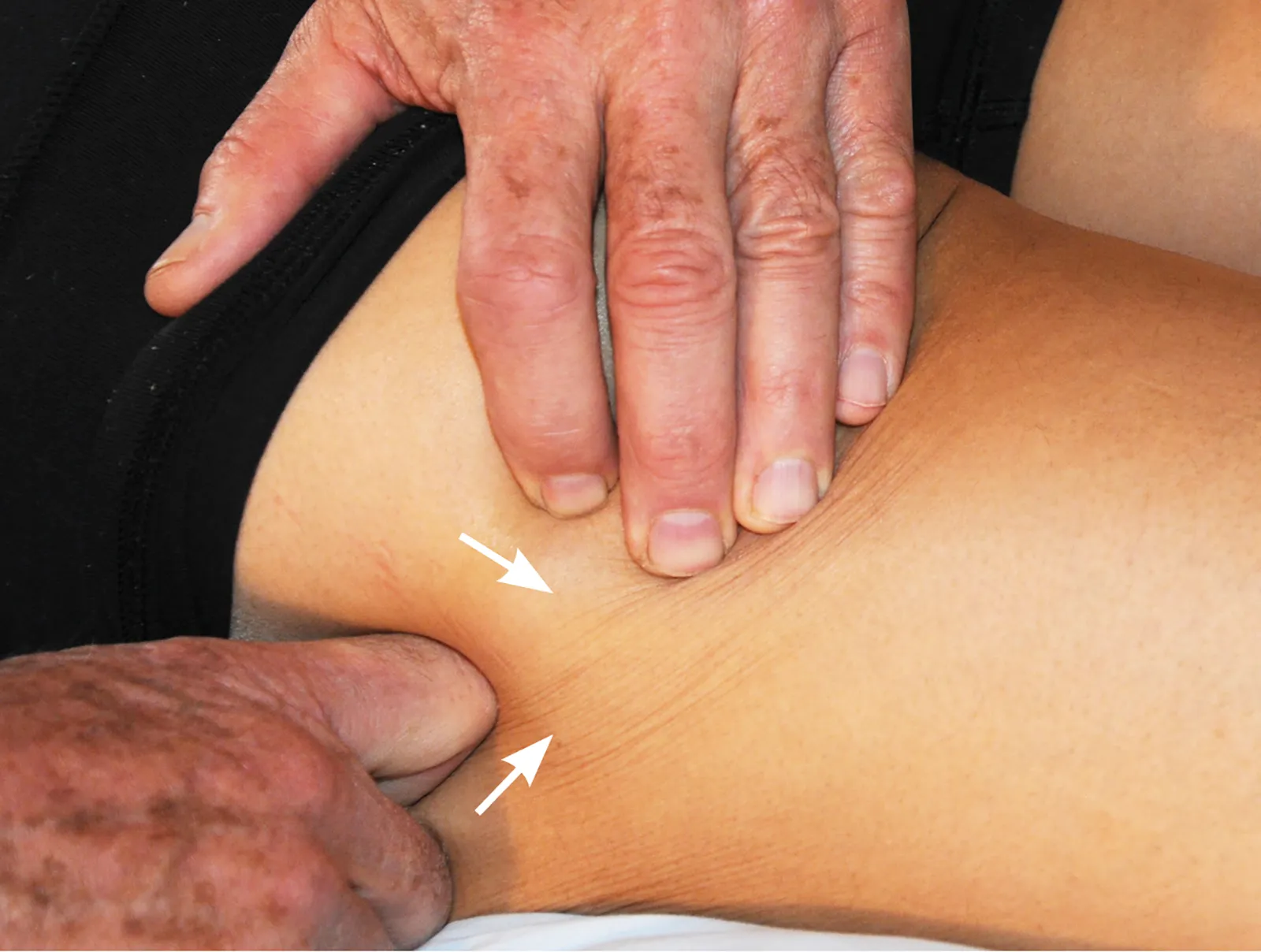
Another goal should be to soften, lengthen, and release adhesions at the attachment of the gluteus maximus to the iliotibial band. Use precise force with fingers or knuckles to follow the fibrous attachment at each anterior and posterior border (Image 2) and visualize that you are allowing the attachment to roll from adjacent and deeper tissue so it is free to adjust to different joint positions during flexion/extension and rotation.
These muscles are often overlooked when addressing pelvic balance, hip pain, and rotational concerns. Their attachments at the upper ilium blend with the quadratus lumborum, gluteus maximus, and latissimus dorsi and influence the body from above the pelvis down to the trochanter. The primary skill here is to work through the superficial tissue for focused work on insertions and muscle bellies, paying attention to the fiber direction to lengthen, but also roll from side to side. While work with the client in a neutral leg position is fine, it is often an added benefit for release and lengthening to work from different positioning of the femur.
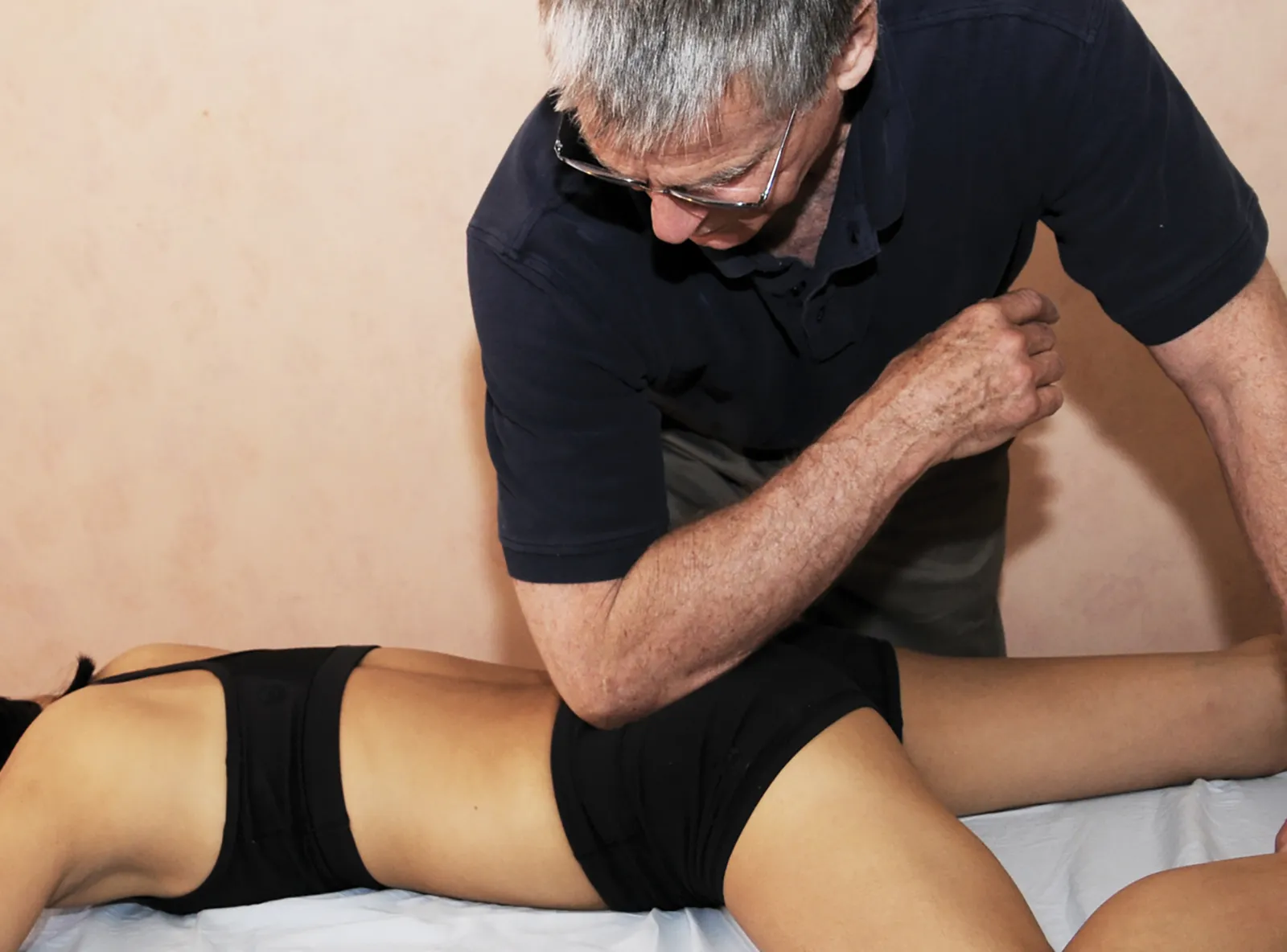
Bringing the leg up into this position (Image 3) shortens and softens these muscles into abduction while at the same time internally rotating the femur. Use any tool you want—from precise finger or knuckle work to broad forearm or elbow work. This is a good position to just hang out, with steady pressure, and wait for the melt.
Functionally, the gluteus medius and gluteus minimus are important abductors of the femur, with the previously mentioned crucial role in pelvic stabilization during gait. Depending on hip flexion or extension, these muscles also are involved with both active movement and stabilization of hip rotation. Since they are internal rotators, positioning the leg into strong external rotation places these muscles into a nice stretch for release. Notice in Image 4 that the torso and pelvic girdle are side-bent to the right; this is essentially placing the leg into adduction (and is also an effective way to release the quadratus lumborum), further stretching these abductor muscles to lengthen and release.
Excellent posterior pelvic work should always address the deep rotators and requires the skill of sinking directly through the gluteus maximus, for precision of force, directly on whichever muscle you are addressing. To save your own body and for your clients’ comfort, do not use too broad a tool, because that will require too much pressure to sink through superficial layers; fingers, knuckles, and a relatively precise elbow are your best options.
I usually refrain from hard and fast rules, but I do feel the problems with external rotators are almost always caused by short and fibrous muscles that need to be coaxed (not intimidated) to relax and lengthen. So, it seems a good idea to work from a medial origin to the distal insertion on the trochanter to allow the muscles to release. Learn the medial origin of all rotators, with special attention to the piriformis’ attachment midway up the medial border of the sacrum. Use caution to not apply force too vertically; this not only can cause discomfort to your client, but can compress and irritate the sciatic nerve against the pelvis, especially as it surfaces below the piriformis.
Using the leg as a lever is an excellent way to both assess rotational restrictions and to place the rotators into a stretch to offer a release and lengthening. Your clients will also know how effective your work is as they can easily feel the leg loosening into internal rotation. Of course, you will always check with them for knee stability, but a right angle at the knee is quite stable and safe. I do like to have my hand on the knee itself to provide support and have the client feel safe as I use the lower leg as a rotational lever. Be precise in focusing your intention through the gluteus muscles to the rotators.
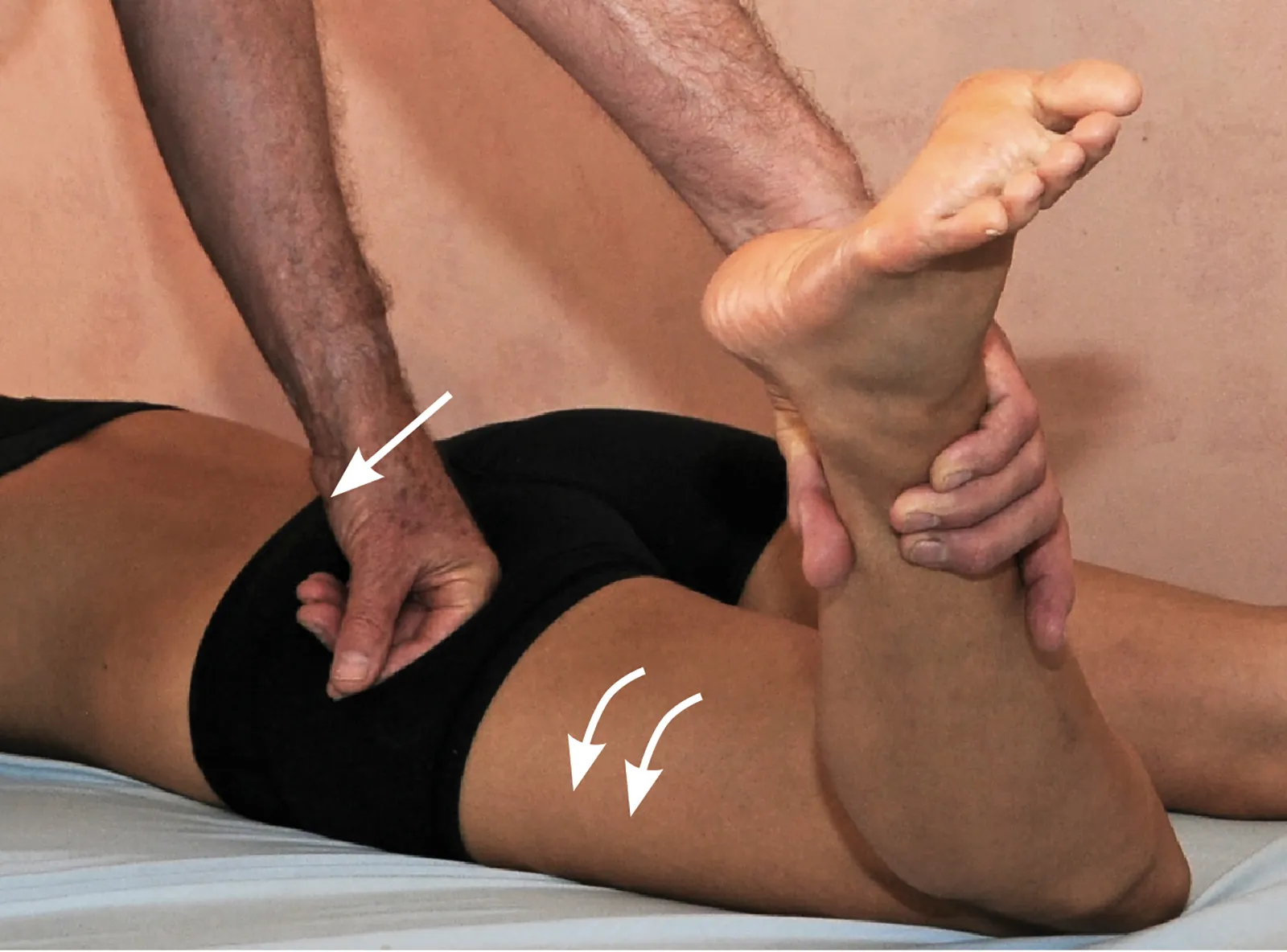
Moving the foot out to move the femur into internal rotation stretches all the external rotators. Gently sink through the gluteus maximus and “grab” the individual rotator where you feel short and fibrous tissue with your elbow or knuckle (Image 5). Gently exert pressure to further rotate the femur while exerting force with your elbow—from a proximal to distal direction—and wait for the muscle to soften. This technique not only softens the muscle, but also reprograms the stretch receptors for lasting release. Cross-fiber strokes are also effective, but don’t just slide over the individual muscles. Picture sliding the muscles perpendicular to their fiber direction and rolling them rather than just rolling over them.
This technique is excellent to stretch and lengthen the piriformis, especially for sciatic problems associated with piriformis syndrome. As with other rotators, I usually prefer facilitated lengthening strokes—medial to lateral—following the muscle belly down to the trochanter, as this direction educates the muscle to relax and lengthen. Of course, you must exercise caution to not impart force too vertically to ensure you don’t irritate the sciatic nerve. A lot of therapists work too intensely in this area, because they push too hard to sink through the gluteus maximus. You only need as much force as is necessary to grab the muscle and then work obliquely to stretch or move in a cross-fiber direction to roll the muscles and free stickiness to deeper tissue. With your stroke, follow all of the muscles that attach to the trochanter over to the thick fibrous sheath of their tendons at the trochanter.
The side-lying position offers many functional advantages for work on the posterior pelvis, especially for stretching the lower fibers of the gluteus maximus and for putting the deeper rotators into a stretch. Hip flexion stretches the lower fibers of the gluteus maximus that extend the hip. Work distally in the direction of lengthening, or perform anchor-and-stretch strokes proximally, while moving the knee up either passively or by asking for active movement from the client to further flex the hip (Image 6).
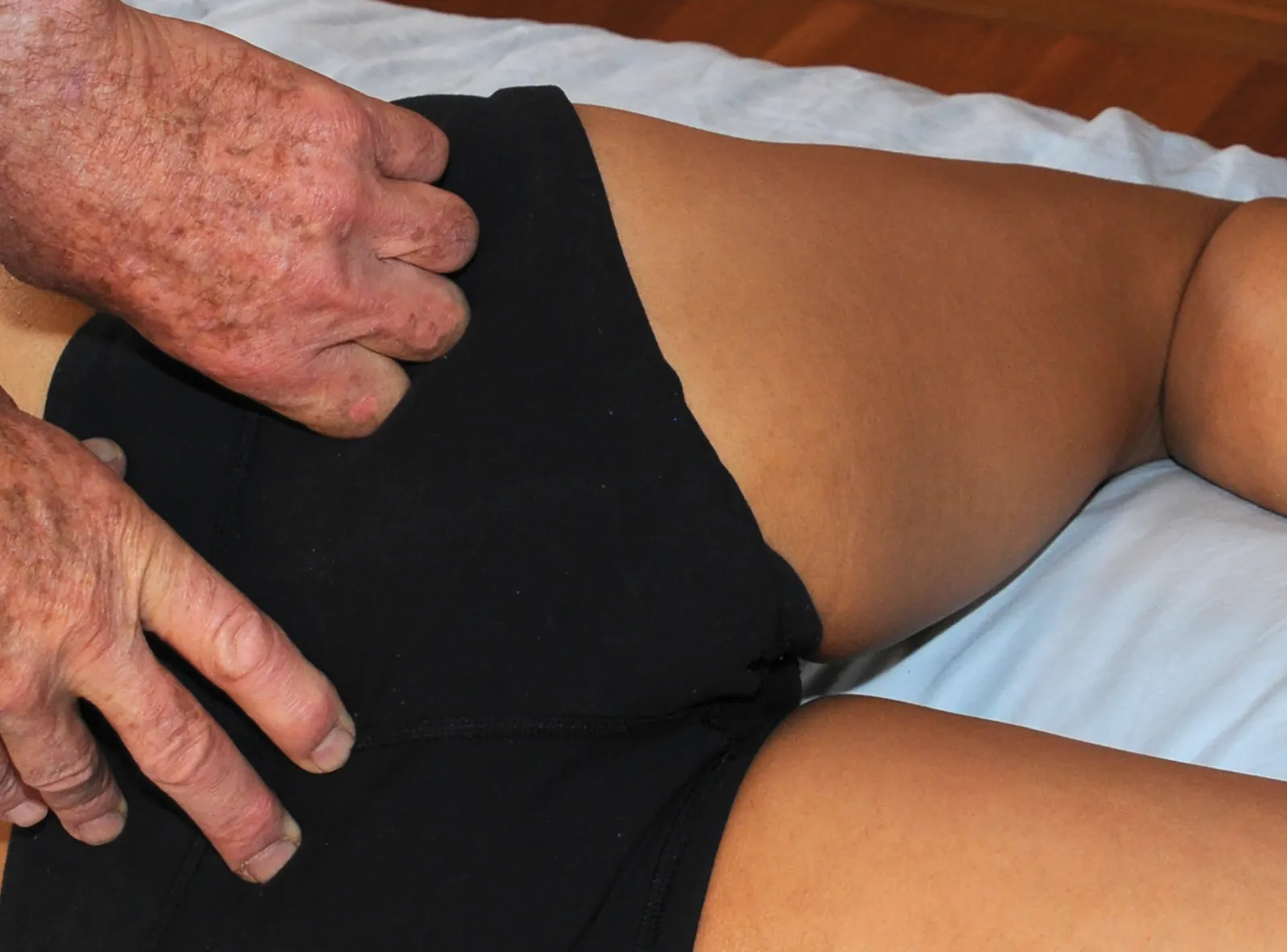
This position is excellent for the deep rotators because hip flexion stretches the lower rotators (both gemellus muscles, the obturator internus, and the quadratus femoris), while at the same time moving the leg into internal rotation to further the stretch. Precision of depth is paramount, so use fairly precise tools so you can sink through the gluteus maximus. You can work in either direction, but I feel you get more mileage by facilitating lengthening by applying force from the proximal origin in a direction toward the trochanter, thus teaching these important muscles to relax and lengthen. For specific pockets of tension, of course, you can perform anchor-and-stretch strokes by working in the opposite direction and asking for active movement by bringing the knee toward the head.
Although not generally considered a posterior pelvic muscle, the tensor fasciae latae is important in this muscle group and is often overlooked because it is considered an abductor of the hip. But, like the gluteus medius and gluteus minimus, it has significant effects on hip rotation and the iliotibial band. In addition to distal lengthening strokes, freeing it from lateral and medial border restrictions will allow proper tracking of the iliotibial band. Use nonspecific relaxation strokes working distally, or just “hang out” at the crest waiting for softening. It is also important to free the iliotibial band’s anterior and posterior borders with precise muscle compartment separation strokes.
When all is said and done, I can’t stress enough the importance of providing bodywork to the client’s gluteal area. This one particular area has ramifications of deeper philosophical and practical import in areas of scope of practice, ethics, liability, and ultimately, the quality of work we perform and the respect we earn for our profession. Failure to teach techniques that address the posterior pelvis, and the resultant failure of individual therapists to perform the work, is a great disservice to the public. I will go so far as to say that it is not only depriving our clients from excellent work, it can actually be harmful and leave bodies more disorganized.
The phenomenal rise of massage in the last 20 years has come from skilled teachers laying the groundwork for countless thousands of skilled individual therapists who, in turn, have educated the public on the value of massage. The remedy to gluteal "prohibition" lies in grassroots efforts to educate not only the public about this important work, but also the owners of schools so that they continue to provide training in gluteal techniques, draping, and communication skills to educate the public.
I empathize with the problems of dealing with a litigious public, both for spas and for therapists in private practice, when it comes to the glutes. The solution to the misguided prohibition of gluteal work and increasing numbers of “no-fly zones” on a client’s body will not be simple, but it is worth fighting for. The more we therapists educate the public by performing excellent bodywork, the more the public will demand the work they deserve.
Maybe it’s not the work itself that has you uncomfortable when addressing a client’s gluteal muscles, but the conversation that goes with the work. Try these suggestions from three of ABMP’s practitioners.
In the initial intake, I tell clients they can completely disrobe or leave their underwear on. I tell them I have better access to their gluteal muscles (related directly to low-back pain) if they completely disrobe, but it is whatever they are most comfortable with, and even with their underwear on, I can still work the glutes, or I can skip them altogether. I make it not a big deal, and then it doesn’t become one.
—Cindy Williams, LMT
I stress the importance of the glutes: “These muscles are often tight, which can affect not only the gluteal area, but the low back and lower body. Because clients have varying levels of comfort receiving bodywork in this area, I wanted to talk about it with you beforehand so we can create a plan together. I can work this area over the sheet or directly on the skin like the rest of your session. What do you think?”
—Kristin Coverly, LMT, ABMP Manager of Professional Development
For new clients with low-back pain I say: “Have you ever had your gluteal muscles massaged? If they are overly tight, they may be contributing to your low-back pain. Would you be willing to have these muscles massaged? I will only undrape one side of your buttocks at a time, or I can work through the drape. I’ll be careful to maintain your modesty at all times. What do you think? What are your concerns?”
—Anne Williams, LMT, ABMP Director of Education
Understanding how the pericardium relates to breathing can in turn help clients relax into their massage session.
Superficial fascia may not get the same attention as deep fascia, but it plays an extremely important role in the organization of tissues and the structure of the body.
Understanding tendons—their shapes, lengths, and organization—improves an MT’s touch vocabulary and facilitates a more skilled touch.
While the neck is a bridge, a pathway, the position of the neck and head can also indicate a multitude of other things happening beneath the surface.