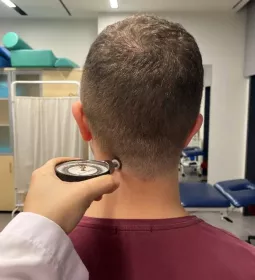




“It all happened so fast. I guess I wasn’t paying attention, and I tripped over a slight incline in a parking lot,” she said. “I tried to stop myself but faceplanted on the pavement. I’m so lucky I didn’t break any bones, but that is when the headaches started.”
I wanted more information about the headaches.
“After the incident, I started having headaches, which then became a daily occurrence,” she said. “After a couple months, the intensity began to increase. Instead of leveling off, both [the frequency and the intensity] have continued to escalate.”

“Have you consulted with any other health-care practitioners?” I asked.
“When the headaches became nearly unbearable, I saw a neurologist,” she said. “He recommended some medicines, but they didn’t really help.”
She described the location of the pain as posterior (occipital) and that it often radiated up the back of her head and to the vertex. She also felt occasional discomfort in her temporomandibular area.
“I’m also a bit sensitive to pressure on the back of my head,” she said.
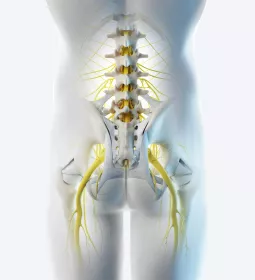
That was a clue to what might be the answer to her pain. Thinking about the mechanics of her fall, the first inclination of the nervous system is to protect the head. As she was falling forward, the posterior musculature massively contracted to prevent her face from hitting the ground. Given the speed of the fall and mass of the head, this was no small task. Thankfully, it softened the blow to her face, resulting in contusions but no broken bones. Running through two of the major muscles that would have contracted to protect her head, the semispinalis capitis and the trapezius muscle, is the greater occipital nerve (GON), which could explain the headaches, vertex pain, and symptoms spreading into the temporomandibular joint (TMJ). The GON can have connections into the trigeminal nucleus caudalis, which can then spread broadly through the cervical area, the muscles of mastication, the sternocleidomastoid (SCM), and the upper trapezius.
There are at least four common areas of entrapment to the GON. The first is where the nerve does a 180-degree turn under the obliquus capitis inferior. The second is where the nerve enters the semispinalis capitis. The third area of concern is the nerve potentially piercing the belly of the upper trapezius muscle. As the nerve travels upward to the occiput, it can again be entrapped by the aponeurotic parts of the trapezius muscle. The difficult task is to release any possible insult to the nerve without further irritating it. Deep pressure directly on the nerve would only exacerbate her symptoms, but avoiding the area altogether likely means little to no relief. It’s a delicate dance to affect the muscles and surrounding tissue without further traumatizing the GON.
I asked my client to start supine on the table, making sure there was a soft pillow to support her head, as clients with extreme GON issues often find it hard to lie supine. Reaching underneath her head, I accessed the rectus capitis minor, a potential culprit in many headaches of this nature. Moving in a medial to lateral direction, I gently addressed this muscle, being careful not to create too much cervical or capital flexion, which can irritate the GON. I sensed her body tense ever so slightly, but just as I was thinking of pulling away, I heard her sigh and felt a softening into my hands. Being careful not to overtreat, I moved to address the thoracic component of the cervical musculature.
I began treating the semispinalis muscle at T4 to begin treatment away from the likely site of entrapment. Working slowly toward the cervical spine, I found more sensitivity the higher I explored. So as not to irritate the GON, I avoided pressure on the area between C4 and C2.
As expected, the upper trapezius muscle was sensitive, bilaterally. I was concerned that direct treatment may be counterproductive so I pivoted to begin by treating the SCM for three reasons. First, the SCM is an influence in the trigeminal complex; relaxing the SCM has a secondary effect on multiple muscles. Second, releasing the area around the spinal accessory nerve has a calming effect on the upper trapezius. Third, parts of the posterior SCM attachments can also affect the GON. After just two minutes working on the SCM, readdressing the upper trapezius revealed a significant decrease in sensitivity, making it much more amenable to direct treatment.
Readdressing the upper cervical area, I found greater intersegmental movement in the first three vertebrae and much less tissue sensitivity. At this point, I also worked up into the occiput near the nerve but was still cautious about direct contact. My pressure there seemed welcome and beneficial, which my client stated with enthusiasm.
Understanding the biomechanics of an injury can be essential to deciphering potential causes for musculoskeletal pain. That knowledge can guide our approach and inform what to address and what to avoid. In this case, I am happy to report that both the intensity and frequency of her headaches improved dramatically after just two sessions.