With the rise of video demonstrations in digital campaigns throughout the massage therapy profession, I have become increasingly aware that many practitioners forget the basics that must be in place to deliver their best work. By “best work,” I’m not only referring to what provides therapeutic value to clients; equally important are healthy stroke application methods that support the therapist’s body.
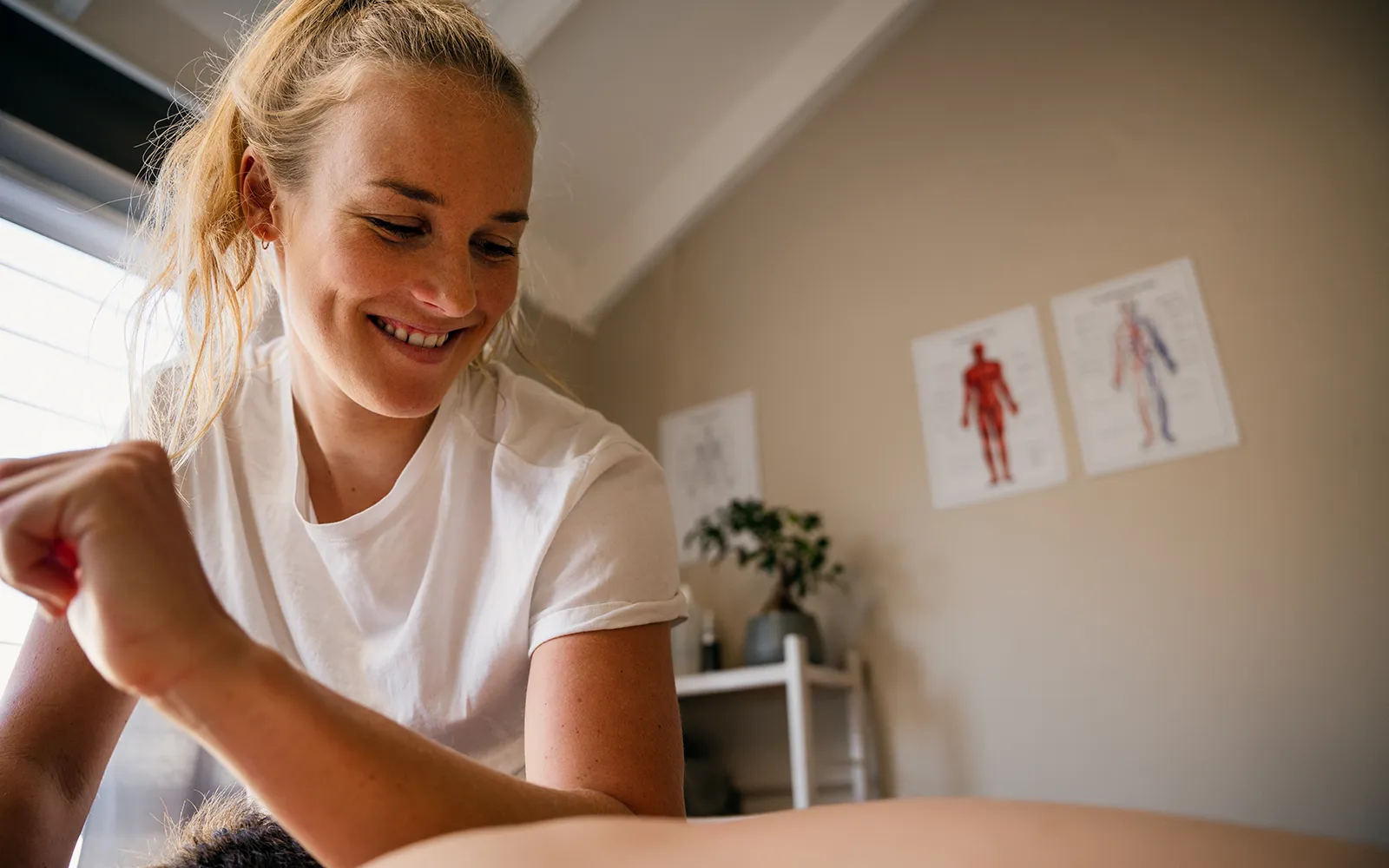
Getty Images.
I’ve seen videos of techniques that would likely feel good to the client and maybe even deliver some therapeutic benefit (although in some cases, it appears the goal is to deliver something unique and impressive). But often missing is an appreciation for simple, effective strokes and body awareness when applying them. This is concerning because skillful body mechanics are arguably the most important aspect of career longevity.
One recent video I watched was particularly concerning because the instructor marketing a technique taught in their course used compromising body positions. Most notably, their shoulders, upper back, and mid back provided strength for the strokes. What I saw motivated me to write this article with a clear call to action—tune in to and use your true power! Every stroke you apply must have the force of your feet, legs, and core behind it.
Spend time training yourself on what “bad” feels like so when you unconsciously go there, your brain signals you to adjust.
There are many aspects to skillful body mechanics. The focus here is on using core power to build a healthy, powerful stroke. Then, I outline what not to do with your body as you apply strokes. Lastly, I encourage you to experiment with both correct and incorrect positioning so you can feel the difference between a powerful stroke and a stroke that causes strain.
How to Build a Powerful Stroke
While the positioning of your core (hips, pelvis, abdomen, and back—specifically, the pelvic floor, gluteal muscles, erector spinae, diaphragm, and abdominal muscles) is your primary guidepost in a healthy stroke, it’s important to recognize that your legs and feet are what put your core in motion. Here are some key guidelines:
The force behind a stroke always originates from pushing against the ground and, through dynamically bent knees, transferring your body weight from one foot to the other—back to front (pushing), front to back (pulling), side to side, or up and down (lifting and lowering or compressing).
The core should be balanced above and between the feet and legs, with hips aligned with the direction of your movement in an open body stance. For example, if you are pushing, your hips are moving forward with the push. If you are pulling, your hips are moving backward with the pull. If you are moving from side to side, such as when kneading, your hips are moving from side to side, and so on.
Your breath adds fuel to the engine: Inhale as you pull, exhale as you push. Inhale as you lift, exhale as you lower.
Your strokes remain close to your body. When strokes are too far away from your body, the core can’t back them up.
Your entire body is continuously in motion. It’s a beautiful, fluid momentum generated from the ground up.
Stroke Application: What Not to Do
Now that we have covered healthy guidelines, let’s learn from the flip side by highlighting what not to do when applying a stroke.
Do not twist your body. Your hips should be open and facing the table. For example, if your client is prone and you are applying a stroke down the right side of their back, you should be in an asymmetrical (lunge) position with your left foot in front and your right foot in back. If your right foot is in front, your hip is against the table, requiring you to twist your body to apply the stroke.
Do not hold your breath or breathe haphazardly. Inhale and exhale intentionally and in rhythm with your movements.
Do not overreach. If you are reaching so much that your upper body is not lined up over your hips, it’s time to adjust your feet so your core and torso return to balance between them.
Do not remain stagnant in your lower body. This includes not keeping your feet planted in one spot and not keeping your knees bent in an immobile squat or lunge. Conversely, do not work on your tiptoes or with your legs straightened.
When you work in any of these incorrect positions, your upper body is burdened with doing all the work. If you need to walk along the side of the table for a longer stroke that connects multiple body parts, do not alternately place one foot in front of the other. Instead, once you have pushed your weight from the back foot to the front foot, step your back foot forward to return underneath you and start again.
Learning from Experience
A lot can be learned by recognizing what causes strain. It’s impactful to consciously place your body in these unhealthy positions and become present with the sensations. All too often, we are so focused on the client that we forget ourselves. Spend time training yourself on what “bad” feels like so when you unconsciously go there, your brain signals you to adjust.
Practice with a partner outside of a professional client session. Start with the first bullet point listed in the “What Not to Do” section: Perform the incorrect approach, then perform the correct approach using the previous stroke guidelines.
Choose Your Power
Your power as a practitioner won’t come from delivering unique and impressive techniques. It will come from delivering quality work that is as healthy for you as it is for the client. As an instructor, it’s my duty to equip you with approaches that help you thrive rather than suffer.
This work, though incredibly rewarding, is undoubtedly demanding on our bodies. These core skills will serve your longevity. Take the time to reinforce them with mindful practice.
A Deeper Diver—Connect to Your Core
Try the following exercise to put your body into a powerful, fluid position.
Stand in a lunge as if you’re going to perform pushing and pulling strokes.
Mimicking the movements of massage with your arms outstretched in front of you, push off your back foot to move your hips and torso forward, transferring your body weight to the front foot.
Then, push off your front foot to pull your hips and torso back, transferring your weight to your back foot. Repeat several times.
Continue this back-and-forth movement but place both hands on your lower belly. Pull up through your pelvic floor muscles. Lift up through your lengthened spine and crown of your head. Notice how the feet, legs, and core work together to generate motion.
Next, add awareness of your breath. Exhale forward, inhale back.
Switch which foot is in front in the lunge position and repeat this entire sequence: first with arms outstretched, then with hands on lower belly, finish with adding the breath.
End by standing with feet side by side, hands and arms relaxed at your sides, eyes closed. Notice what you feel in your feet, legs, and core.
To understand tissue-tension barriers, MTs must be constantly present and mindful. Too light and we will not become efficient at creating the healing change that is needed.