A number of massage techniques require an understanding of what actions a muscle produces at a given joint. These techniques include passive stretching and resisted movement assessments, as well as muscle energy techniques such as post-isometric stretching.
This knowledge is also essential for isolating the contraction of a specific muscle during palpation, when we direct our clients on how to contract that muscle.
If you know the origin and insertion of a muscle, you can assess its joint action(s):
Draw a line between the origin and insertion of a muscle on the joint it crosses. This is its line of pull—the direction a muscular force exerts on a joint.
Bend and/or rotate the joint under the muscle you just traced in the direction of its line of pull. This movement shows the joint action(s) of that muscle.
Figuring out a joint action with these two steps is simple with a uniarticular (one joint) muscle crossing the center of a hinge joint. For example, the vastus intermedius crosses the midline of the knee; therefore, its line of pull produces one action: extension. When a muscle crosses the side of a joint, it exerts a rotational pull. The gluteus maximus arises on the posterior and lateral side of the coxofemoral joint, so its line of pull produces hip extension and lateral rotation.
Diagonal and Multiple Lines of Pull
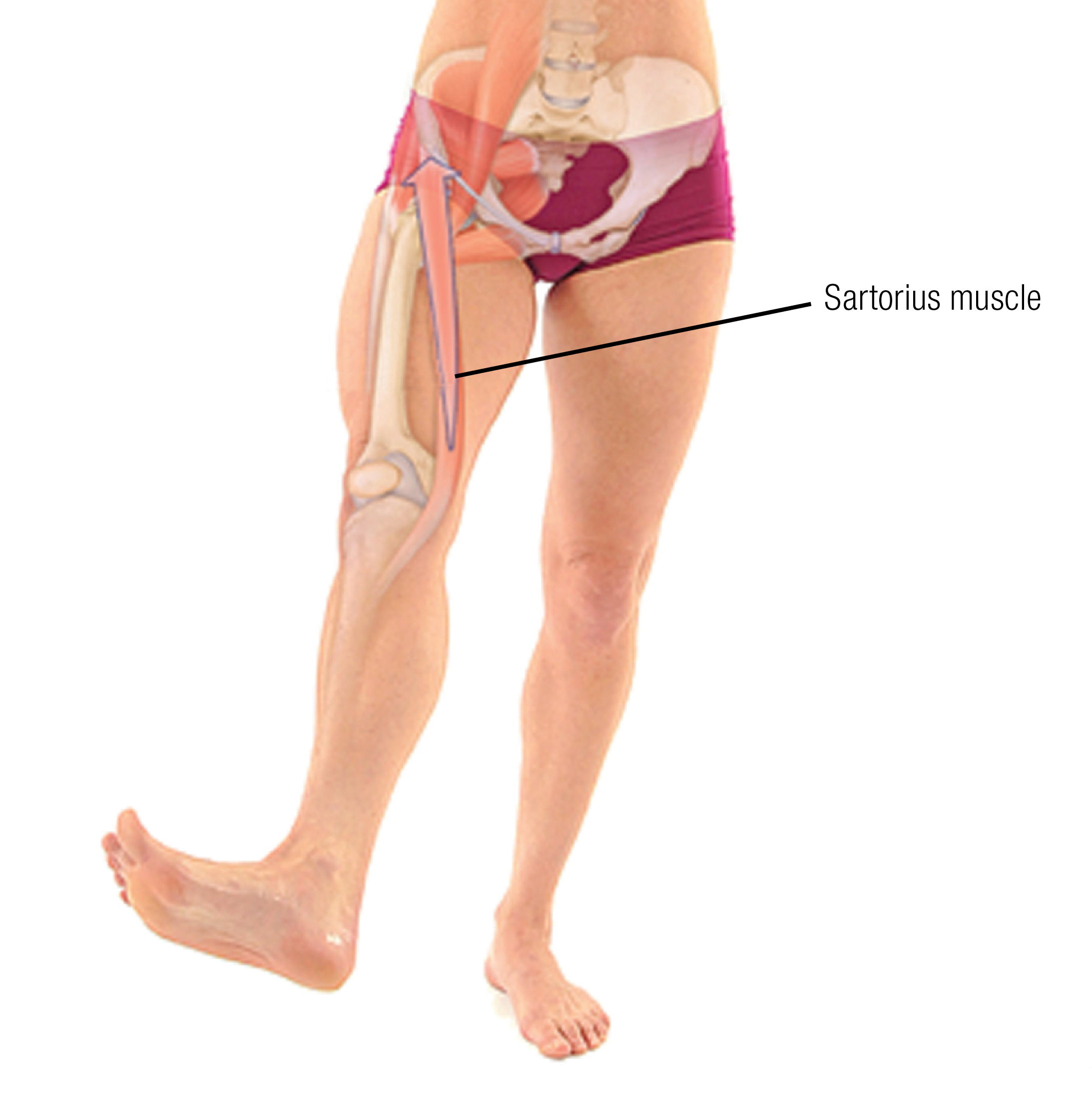
Figuring out joint actions becomes somewhat more complex when a muscle has a diagonal line of pull and/or is biarticular (acting on two joints). Take, for example, the sartorius. It runs from the lateral side of the pelvis to the medial side of the knee and produces a diagonal force that simultaneously flexes and laterally rotates the hip (Image 1). Depending on activity in its synergists or antagonists, the sartorius can also abduct the hip. Since the sartorius inserts below the medial side of the knee, it also medially rotates the knee, but only from a flexed-knee position.
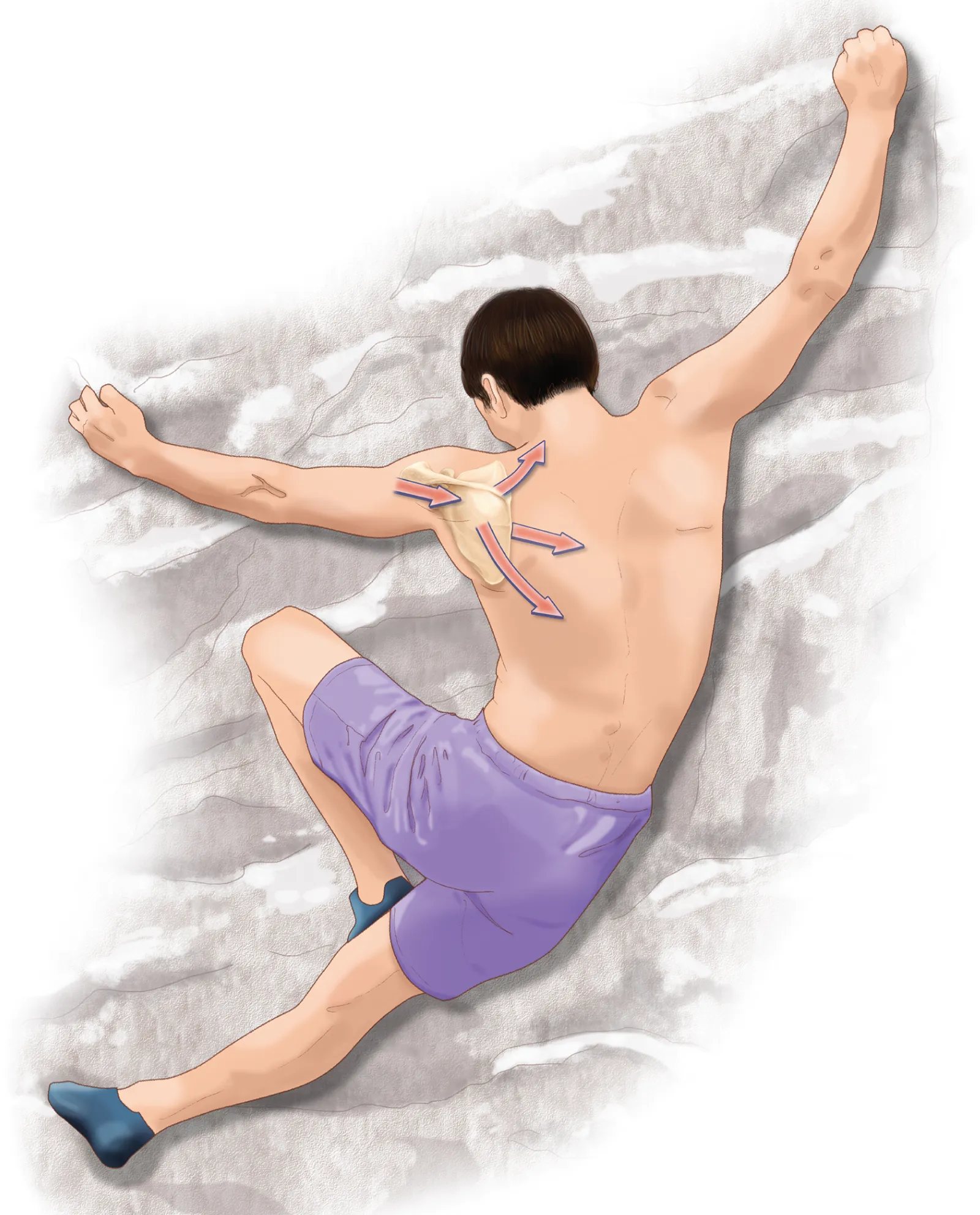
Muscles with broad attachments have multiple lines of pull and multifaceted actions. A classic example is the trapezius, whose upper, middle, and lower parts respectively elevate, retract, and depress the scapula. For instance, during rock-climbing, the lines of pull produced by the trapezius shift like spokes on a turning wheel, progressively moving through its fan of fibers as the climber abducts the arm in an upward or downward arc (Image 2).
Muscles that exert a line of pull around a corner act as anatomical pulleys, changing the direction of muscular pull and/or increasing its magnitude of force. The tendon of the tibialis posterior muscle wraps around the medial malleolus of the ankle, shifting its pull from a vertical to a horizontal force that initially lifts the medial arch and eventually plantarflexes the ankle and inverts the foot.
Stabilization and Joint-Movement Pulls
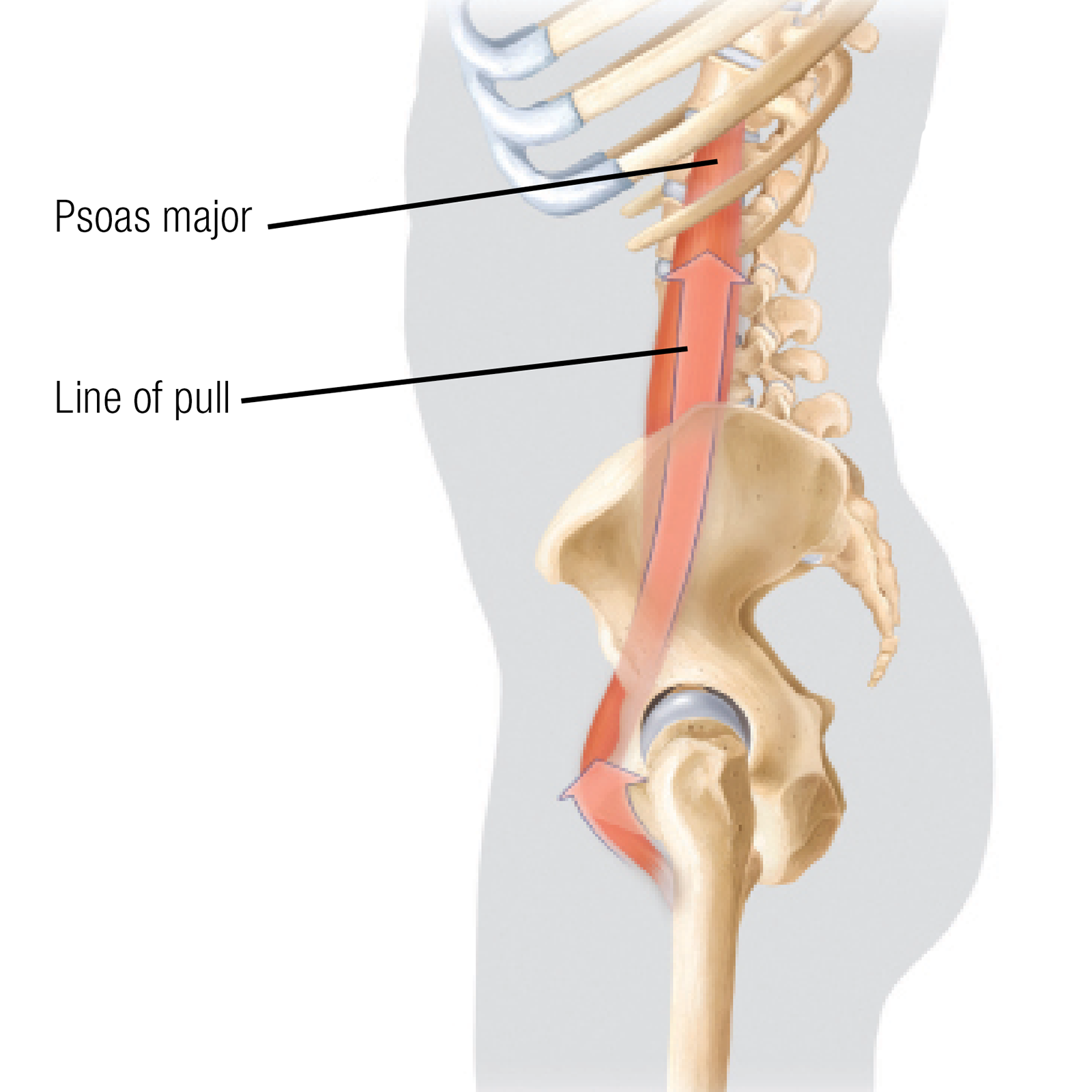
The closer the line of a muscle’s pull is to the axis of joint motion, the greater its stabilizing effect. This occurs with many vertically oriented muscles situated along the spine. A light contraction of the psoas major exerts a stabilizing force on the lumbar spine and hip, drawing the vertebral bodies together and pulling the femoral head into its socket (Image 3). The psoas major reaches its maximum joint-movement force at 90 degrees of hip flexion, either pulling the hip into deeper flexion or the lumbar vertebrae into extension.
Here are a few more tips for assessing joint actions along lines of muscular pull:
Hold the origin and insertion of the target muscle, then shorten the distance between your hands, moving the joint under it.
When assessing a muscle with multiple lines of pull, assess each line one at a time.
When assessing a limb muscle that acts on two or more joints, assess the action at each joint separately.
Exploring Technique
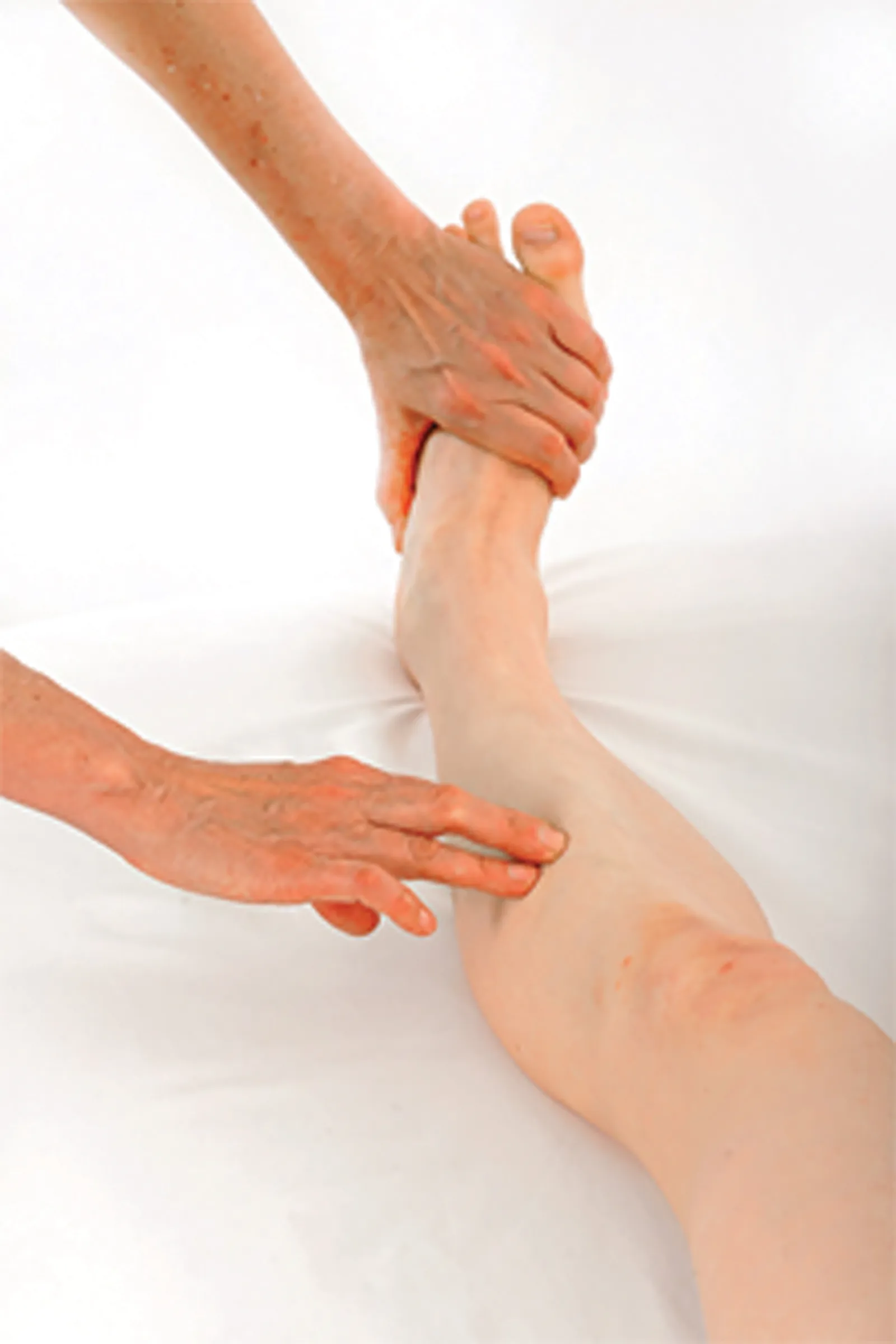
Post-Isometric Stretch for the Tibialis Anterior
This two-step muscle energy technique can be done with any muscle. Begin by figuring out the joint actions of the tibialis anterior, tracing its line of pull from origin to insertion.
1. Since the action of the tibialis anterior is dorsiflexion with inversion, passively move the ankle into this position. Instruct your partner to resist while you lightly pull the ankle in the direction of the antagonist pattern, plantarflexion with eversion. Hold for several seconds.
2. Have your partner relax as you release the hold, then slowly stretch the ankle in the direction of the antagonist pattern—plantarflexion and eversion—until your partner feels the tibialis anterior stretch (make sure to ask). Hold the stretch for several seconds, then release.
To understand tissue-tension barriers, MTs must be constantly present and mindful. Too light and we will not become efficient at creating the healing change that is needed.