The NFL Scouting Combine is a grueling weeklong event in which the nation’s top college football players undergo a series of physical and mental tests in front of NFL coaches and scouts to demonstrate their ability to perform under intense scrutiny. It’s a standout college prospect’s one chance to make an impression on NFL teams—a sort of high-intensity, high-stakes job interview with, potentially, millions of dollars on the line. Everything in the athletes’ lives has led them to this moment, and their futures can quite literally depend on how well they perform. The pressure to succeed is tremendous. The margin for error is nonexistent, and a tiny advantage—a half-inch increase in stride length, a minute shift in confidence—can be a colossal factor in an athlete’s success.
That’s where Tony Villani’s XPE Sports Academy and George Kousaleos’s CORE Myofascial Therapy come in.
Every year, top agents send their top athletes to Villani to prepare them for the NFL Combine, where a fraction of a second in the 40-yard dash can cause a player’s position in the draft to skyrocket or plummet. Villani is known as the “speed guru” to many in the NFL, and it’s his job to help these elite college athletes perform at a higher level than they ever have before.
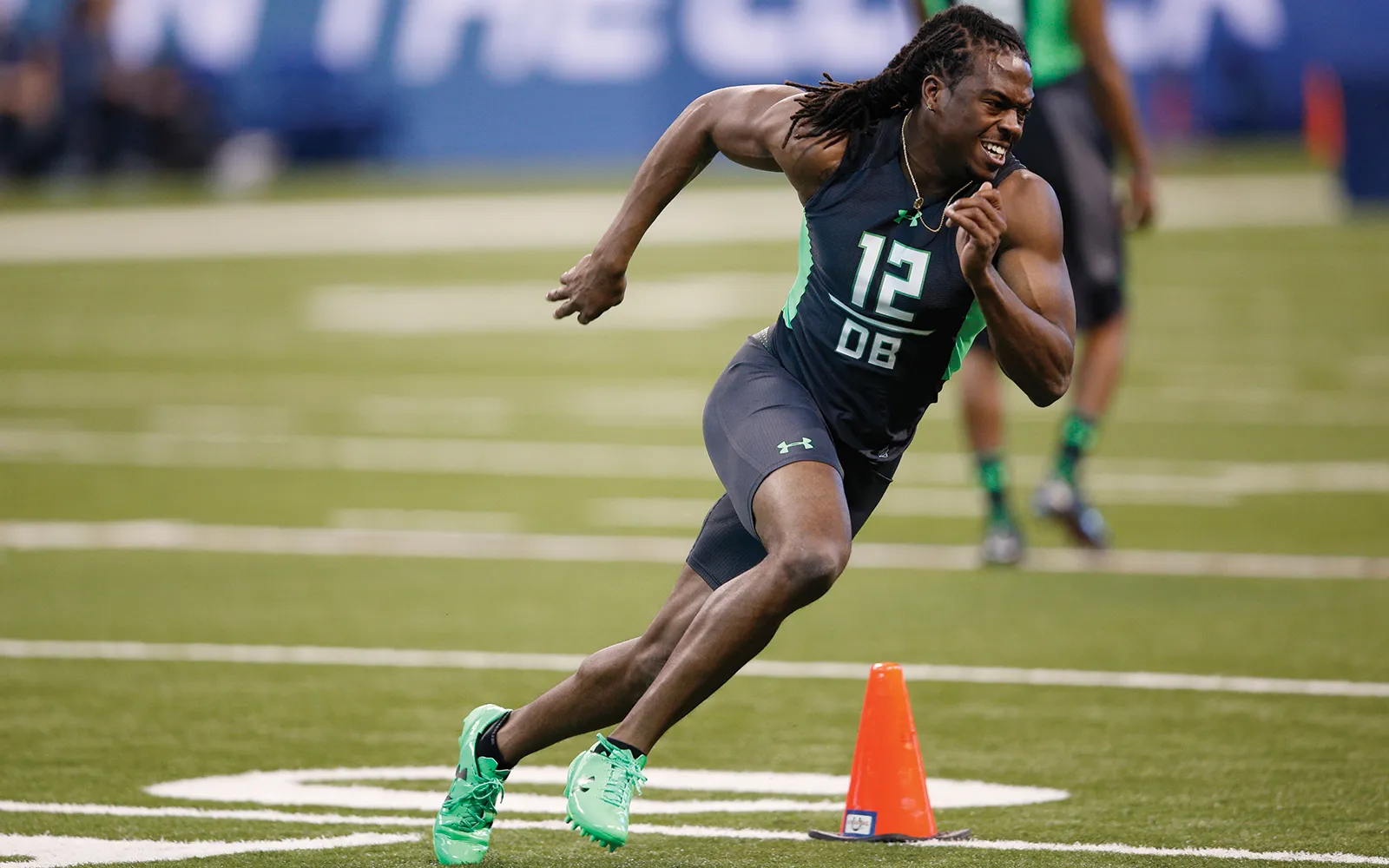
Defensive back Maurice Canady in action during the 2016 NFL Scouting Combine on February 29, 2016 in Indianapolis. Joe Robbins/Getty Images.
“Most of these guys have trained their whole lives in how to be football players,” says XPE’s lead massage therapist and strength trainer Don Stanley. “It’s a very different type of training getting ready for the Combine.”
“We call it running on the razor’s edge,” Villani says. “You’re running the fastest you’ve ever run in your life. Your muscles are working more powerfully than they ever have and usually at a heavier body weight than you’ve ever been in your life. So you’re on that razor’s edge, where you’re trying to run faster than you ever have, without pulling a muscle.”
Kevin Christie, a chiropractic physician and certified strength and conditioning specialist, is XPE’s sports chiropractor. He says, “The reality of Combine training is that you’re pushing the envelope with football players, basically trying to turn them into track stars, and we have to do it in a short period of time.”
Soft-tissue injuries—pulled hamstrings and the like—are common occurrences at this level of training. A similar problem faced massage therapist Kousaleos in 2011, when he was asked to develop a sports bodywork therapy team to work with the Florida State University (FSU) football team. In crafting a strategy, Kousaleos, a former student of sports massage legend Benny Vaughn, drew on the experience he gained as general manager of the British Olympic Association’s sports massage team during the 1996 Olympic Games in Atlanta and as the co-director of the Health Services International sports massage team at the 2004 games in Athens.
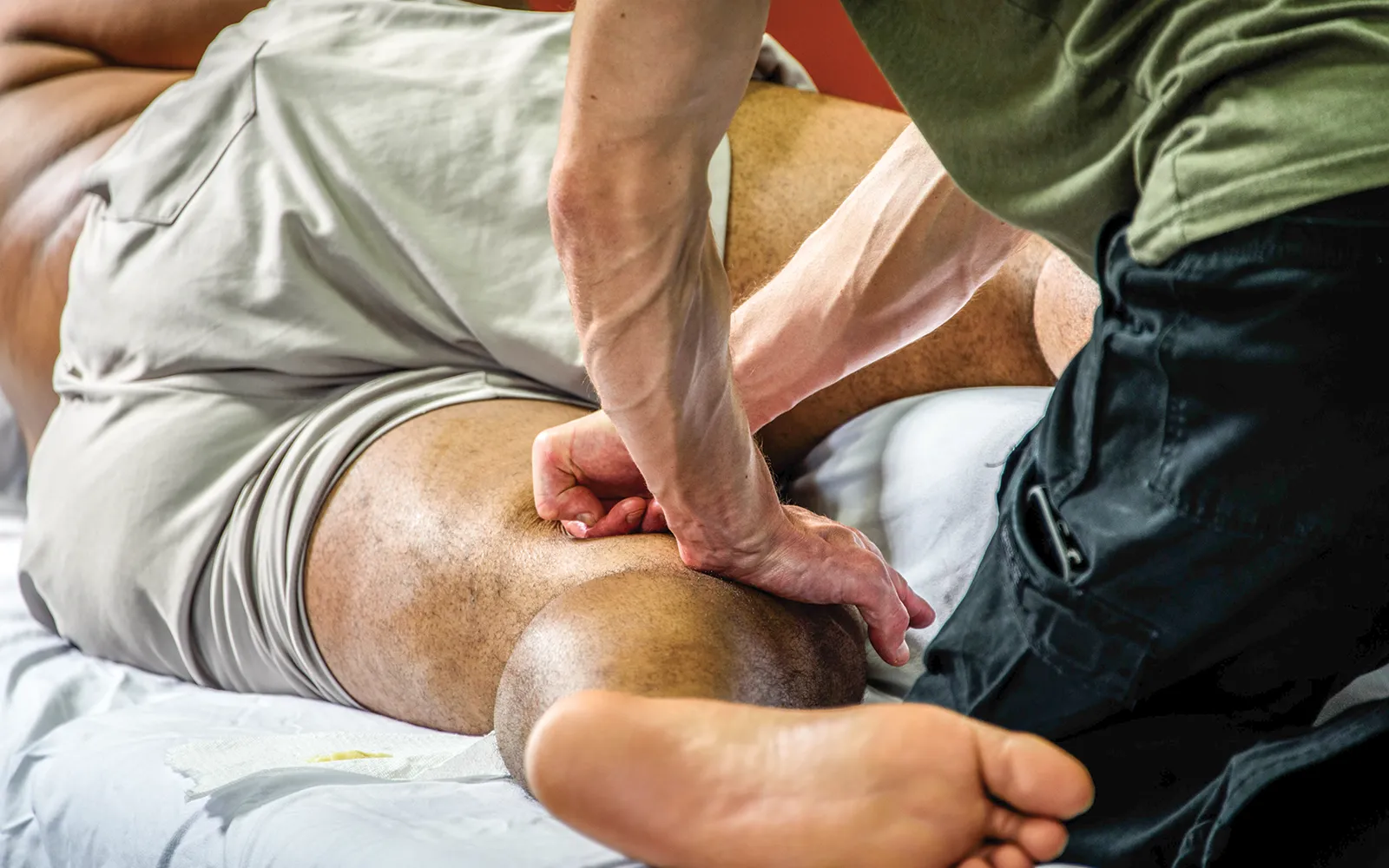
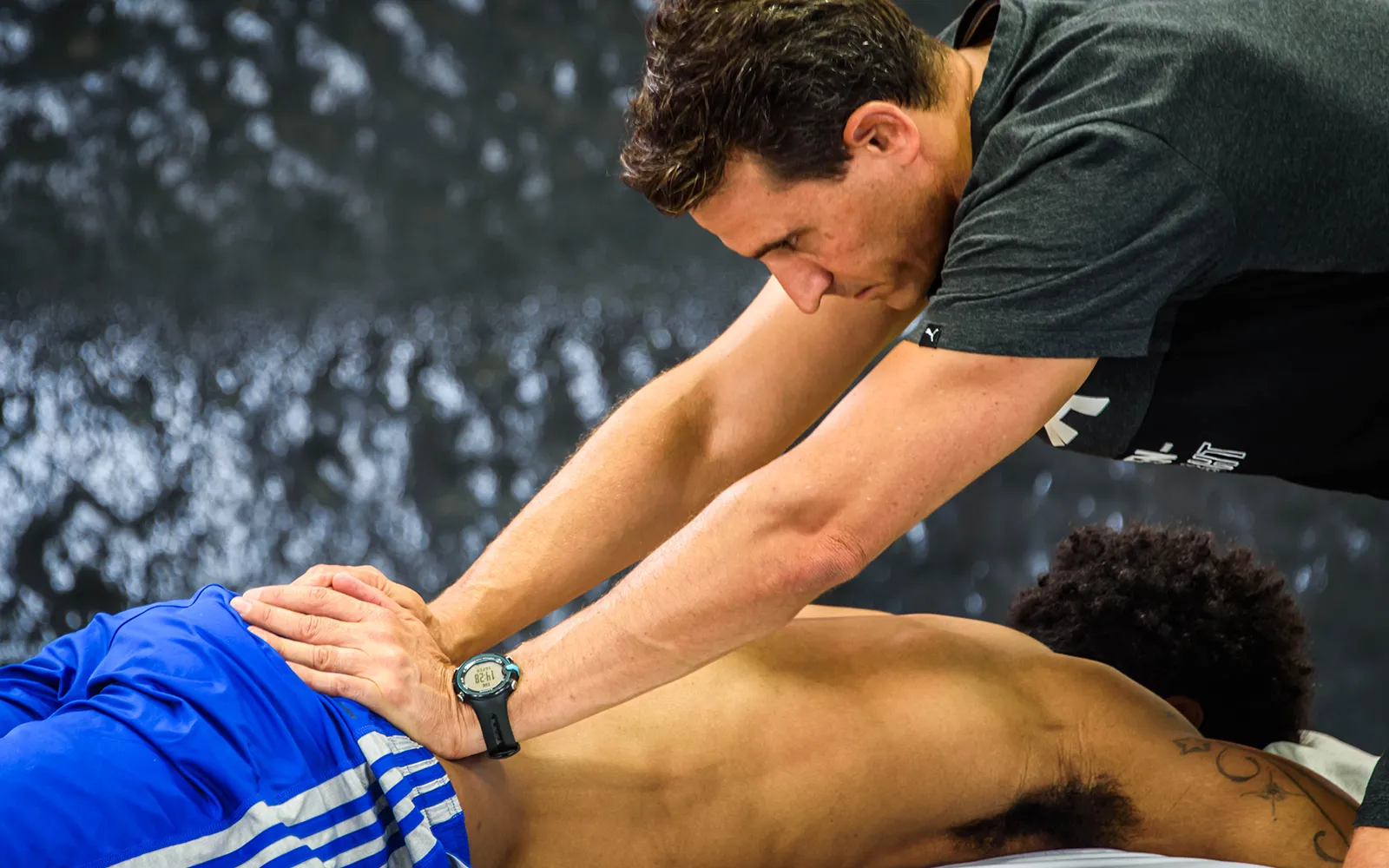
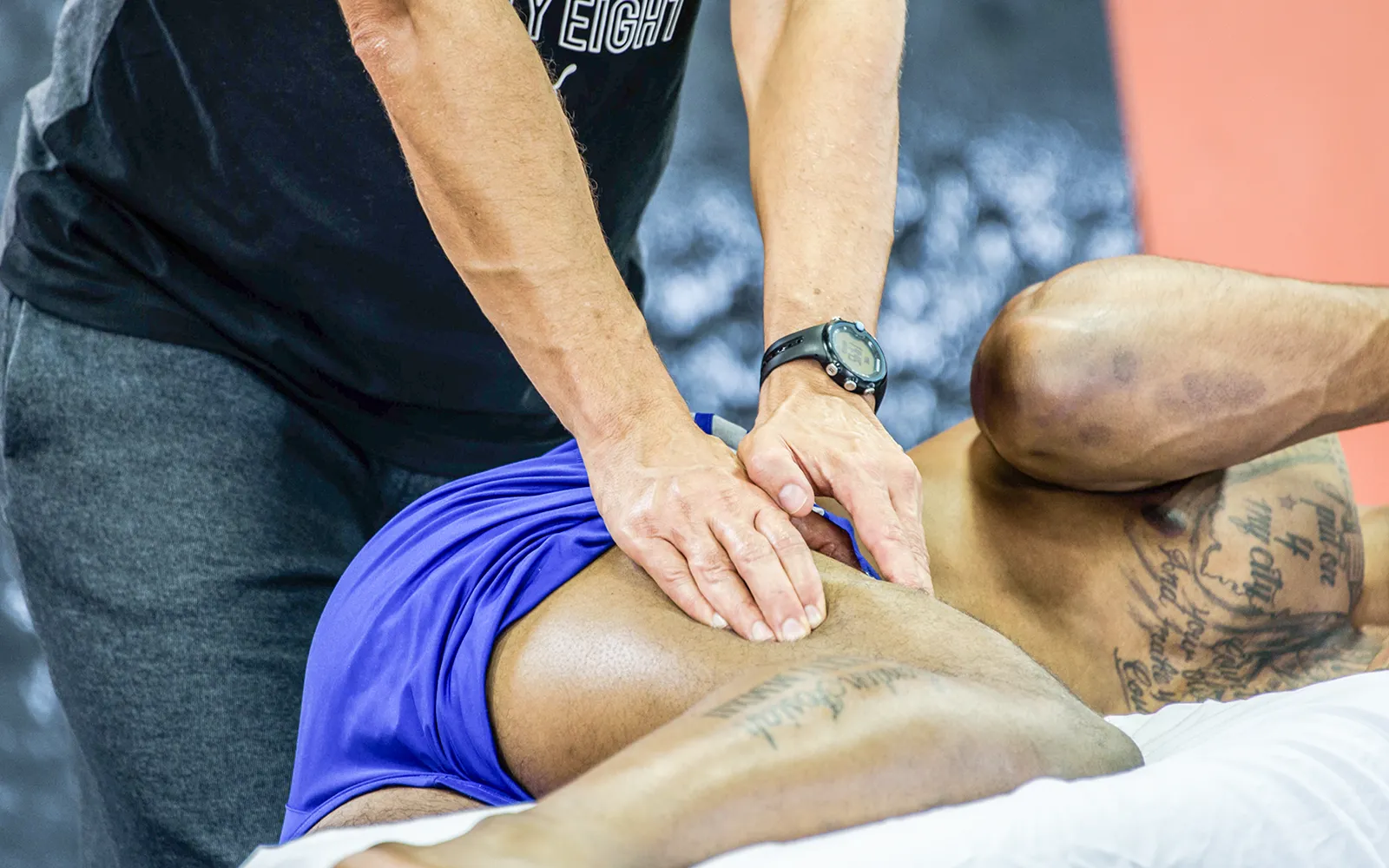
CORE Myofascial Therapy helps NFL hopefuls recover faster so they can train harder. Photo by Patty Kousaleos.
“During the 1996 games, we designed a program of modified myofascial therapy for the athletes who were in intensive training,” Kousaleos says. “We made it slightly lighter, but still comfortably deep, to work with the athletes during their Olympic competitions, and the British team responded to it incredibly well.”
Using the protocols he developed during those Olympic games, Kousaleos was able to significantly lower the soft-tissue injury rate among football athletes at FSU.1 Jake Pfeil, MS, LAT, ATC, the associate director of sports medicine and head football athletic trainer at FSU, says, “One of the secrets to Florida State’s successful 2012 football season was the implementation of massage therapy for all players.” That year marked FSU’s first conference title since 2005.
In 2013, with Kousaleos’s bodywork program in full swing, FSU’s football team won the national championship while enjoying something it had never experienced before: no season-ending injuries for any of their starters.
Meeting of the Minds
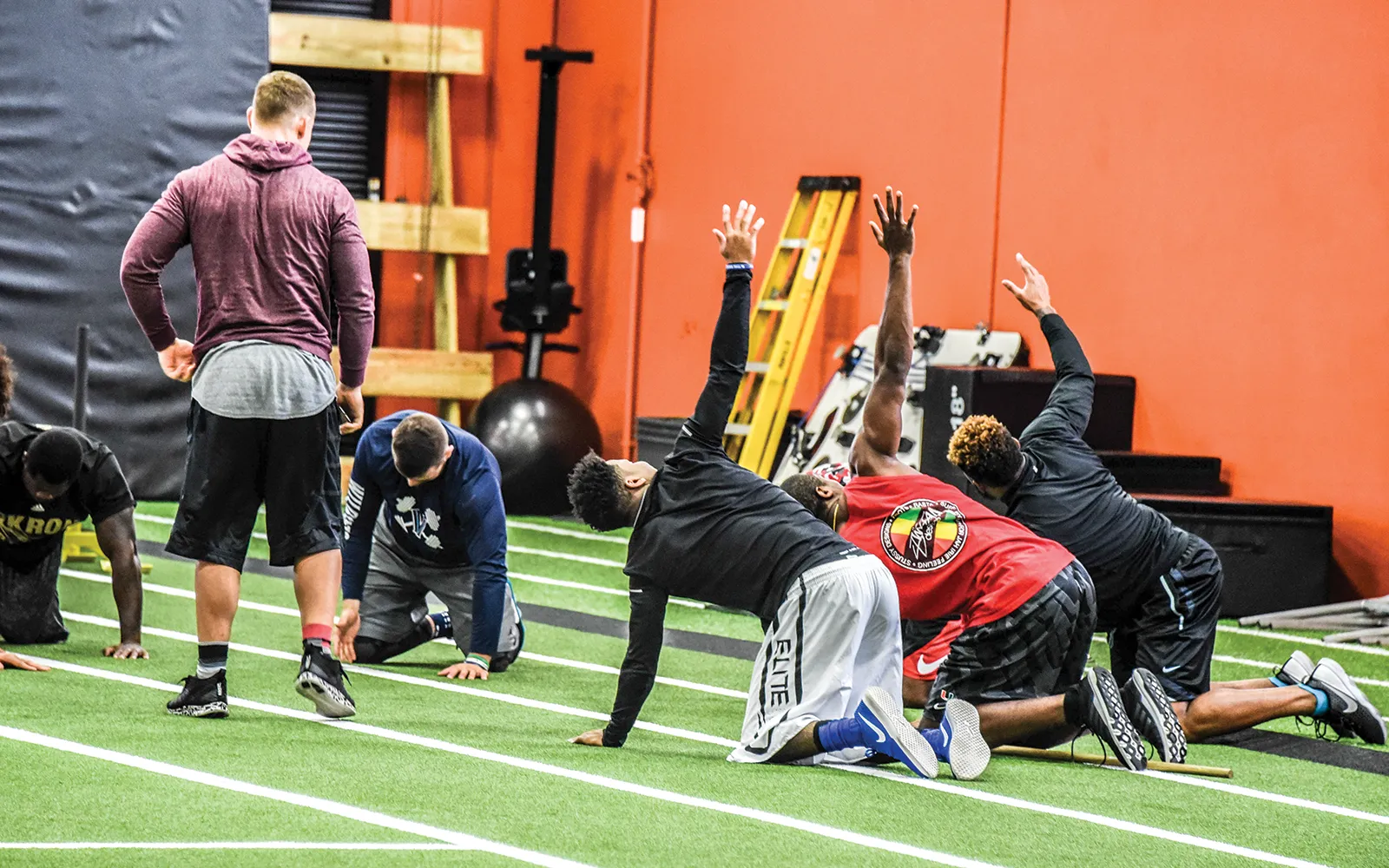
In addition to massage, XPE's trainers incorporate frequent yoga sessions to improve athlete's flexibility and mobility. Photo by Patty Kousaleos.
The partnership between Villani’s XPE Sports Academy and Kousaleos’s CORE Institute began with an introduction by Stanley, a massage therapist who worked with Kousaleos two decades ago during the 1996 Atlanta Olympics. Largely as a result of the experience he gained working with Kousaleos, Stanley designed his subsequent career around structural integration and myofascial therapy for athletes. He also became a certified strength and conditioning coach and physical trainer, reaching an elite level in the field and working with some of the world’s best athletes over his 20-year career. Stanley came to work with Villani at XPE Sports in Boca Raton, Florida, as a trainer and therapist five years ago.
Kousaleos says, “Don Stanley brought Tony Villani and me together this past June, and said, ‘You two are my mentors. Can we put something together where we work as a team and build a camp, much like we did for the British team at the Olympics? But this time, we’ll do it during the NFL Combine training.’”
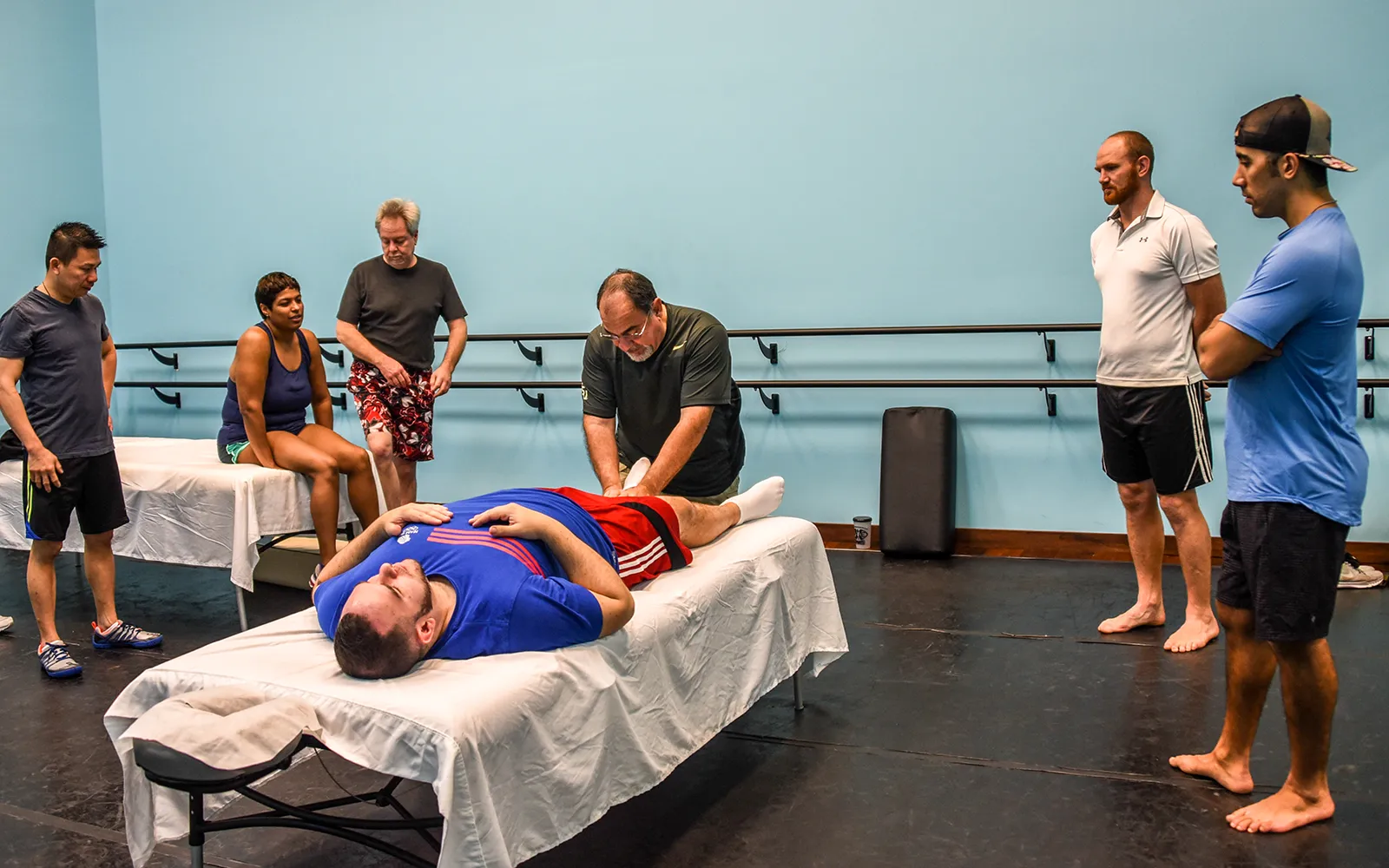
Kousaleos and Villani developed a program in which Kousaleos would train therapists in his modified CORE Myofascial Therapy in the morning while the athletes were training for the Combine. In the afternoon, the therapists would put what they learned in the classroom into hands-on practice on the athletes. Kousaleos tailors his instruction around the work the athletes will be doing that day or the next: for example, if Villani needs his athletes’ legs to be fresh for a big day of running and leg work, Kousaleos and his team of therapists can loosen up the athletes’ hips and glutes the day before.
Villani says, “We have a program that George has built around our day to day training program. But at any given time, if an athlete has a problem area, they can get it worked on, on demand.”
The bodywork Kousaleos brings to XPE is not aimed solely at assisting in recovery from training, but also in making adjustments to the athletes’ bodies so that they are able to perform at a higher level. Bill Welle, a former mentor of Villani and now one of Villani’s XPE Master Trainers, explains, “Speed is based on stride length, stride frequency, and power. Stride length can be improved. If you have a short, choppy stride, you don’t have a lot of power. With this type of bodywork, we can open up the stride so that everything is looser. Even if the athlete is able to drive his knee up just an inch more, that’s going to allow him to develop more power into the ground.”
Having access to the same bodywork that helped FSU win a national championship with no season-ending injuries has helped Villani’s NFL hopefuls recover faster so they can train harder. “Normally, we would have more pulled hamstrings than we have now,” Villani says.
Christie concurs: “It’s been great. We’ve seen a decrease in injury rates and an increase in players recovering from injury sooner. We have a bigger class this year, so to see so few injuries has been really nice.”
It’s this symbiotic dance of training and recovery that allows the athletes to push themselves further than they ever have before, while avoiding the soft-tissue injuries that typically come with overtraining. For a professional athlete, coming back from a major injury is an uphill battle. If Stanley and his team can prevent those injuries from happening in the first place, their clients will have longer, more sustainable careers. They call the approach prehab, not rehab, and it’s aimed at identifying, assessing, and treating potential issues before they become major problems.
“A lot of these athletes have never been through this intense a level of training,” Stanley says. “They’re pushed to the absolute limit. They’ve never experienced this level of soreness in their body, so having unlimited access to a high level of bodywork, where they can get bodywork every single day, has been a unique experience for everybody involved.”
The Structural Bodywork Table
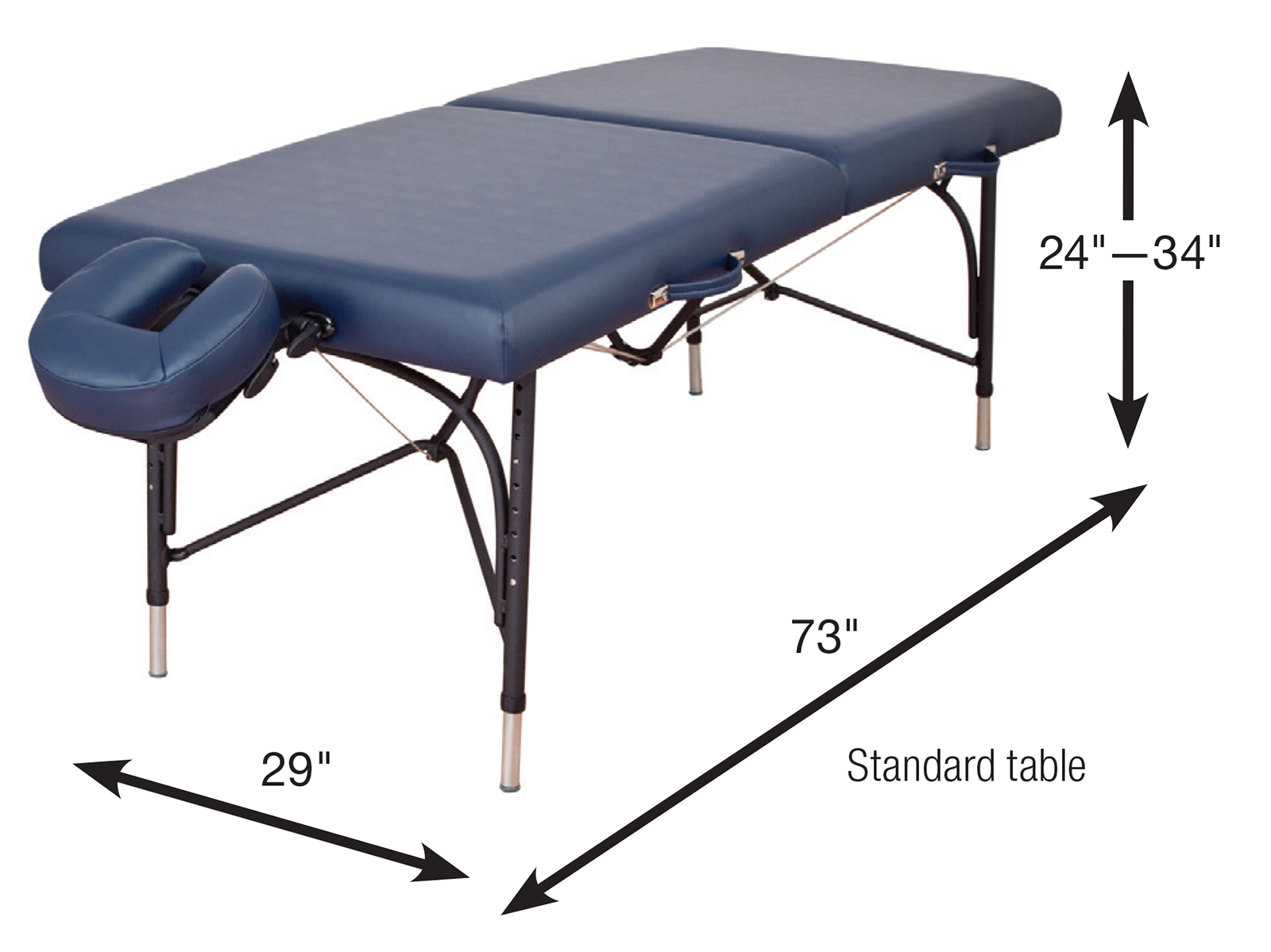
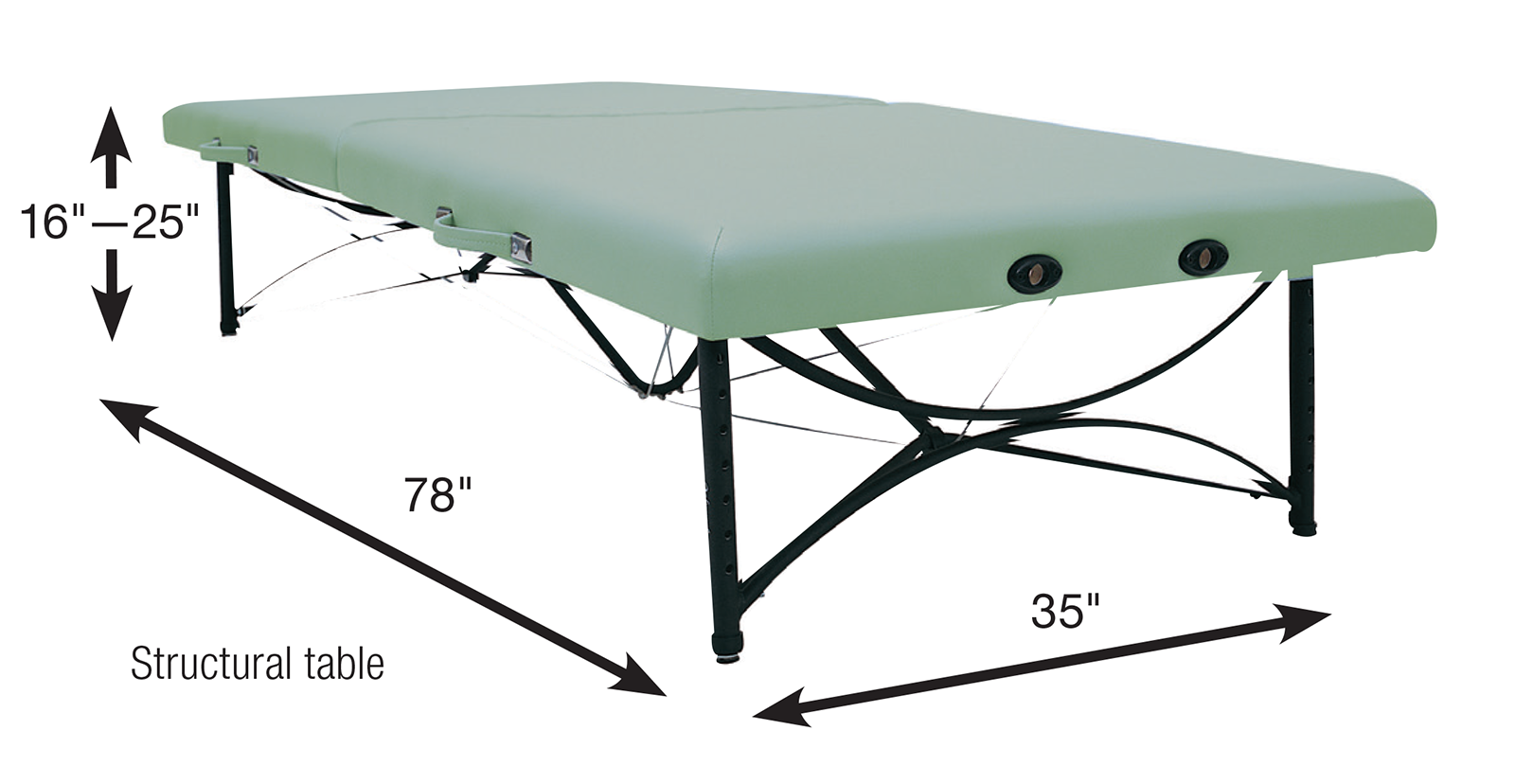
Kousaleos uses the Storable Mat table from Oakworks when performing structural work on athletes. He says, “The Oakworks Storable Mat structural tables are wider (33–40 inches) and can be set significantly lower (16–20 inches) to allow for better leverage, especially when working with a large client in side-lying position. I use an Oakworks Proluxe electric table in my private practice, allowing me to quickly adjust the height of the table during the session, depending on how I position the client.”
The Massage Therapists
For bodyworkers interested in practicing sports massage therapy, getting the opportunity to work on the elite athletes at the XPE Sports Academy is the chance of a lifetime. The therapists who were selected for the certification course come from a wide range of backgrounds, modalities, and experience levels. Wil Daddio, from Dallas, Texas, has been practicing massage therapy for 21 years, while Kim Jackson, from Elmont, New York, has only been practicing for one.
Describing the criteria he used to decide which therapists to accept into the program, Kousaleos says, “We were looking for a diversity of experience, a willingness to work in a team atmosphere, and a passion for helping athletes fulfill their optimal performance skills and abilities.”
Daddio was looking for something that would help him take his practice in a new direction; specifically, working with professional athletes. “When I found out about this course, I knew it was an amazing opportunity,” he says. “This training will open up many different doors for me to work with athletic trainers, chiropractors, and medical practitioners.”
Jackson is a member of a runners’ group in her town, and she says the other members of her group are already requesting bodywork sessions from her: “They can’t wait for me to come back so I can use it on them.” She adds, “I don’t have many private clients yet, and I’m hoping to use this experience and certification to build my practice.”
The CORE approach gives more freedom of movement to athletes, allowing them to train at increasingly intense levels. Photo by Patty Kousaleos.
Other therapists in the program already have experience in myofascial bodywork or structural integration (SI), but see the certification in CORE Myofascial Therapy as a natural extension of their current practice. Atilla Pegan, originally from Budapest, Hungary, now practicing in Savage, Minnesota, is certified in SI and has worked on many athletes in his career. But he was looking for a gentler approach to use on his clients who are in active training. He says, “Structural integration changes so much in the body that if an athlete is in active training or in season, their movement, pitching, throwing, or running is going to be different. Structural integration can actually destabilize them, rather than help them.”
Pegan finds the techniques he is learning to be extremely effective, especially when considering the intensity of the athletes’ training. “We’re not changing the posture like we do in SI. We’re giving more freedom of movement and more range of motion to the athlete, and they can then increase their training. This is now week six, and they’re at the top of their training and still getting structural bodywork, which is awesome.”
The precise, targeted nature of the work gives therapists a deeper understanding of the reasons behind the techniques; they’re not simply repeating the same routine over and over—they’re learning why certain techniques affect certain muscles, and they’re able to view measurable benefits in how those muscles perform.
Tina Hopkins, a massage therapist from Pilot Mountain, North Carolina, who has been practicing for just over two years, says, “I recently started a referral relationship with a personal trainer who started sending me bodybuilders, football players, track runners, and cyclists, and I had to start watching videos on YouTube to learn what techniques to use.” Her research brought her to the CORE myofascial certification program. “The techniques make a lot more sense when put into the context of what the athletes are doing, and why they’re doing it. For example, we work on their hip flexors because they have to be able to pick their legs up higher to run faster. Their shoulder girdles have to be able to move so they can throw the ball farther.”
The Impact of Inches
An NFL team’s criteria for selecting its next player can be acutely specific. Quarterbacks, for example, can be chosen or rejected because of the size of their hands. A span length of 9 inches from the tip of the little finger to the tip of the thumb is considered the minimum benchmark for NFL quarterbacks. Any smaller, and some coaches begin to worry whether the player will be able to maintain a controlled grip on the football in inclement weather.
When Brandon Allen, a quarterback from the University of Arkansas, arrived at the XPE Sports camp, his hand measured 8½ inches. Conventional wisdom would dictate that Allen’s hand size could not be increased, and that his position in the NFL draft would be negatively affected. Kousaleos had other ideas. In 2015, he used myofascial therapy to increase the foot and ankle mobility of Florida State University’s star quarterback and Heisman Trophy winner Jameis Winston, who went on to be the first player selected in the 2015 NFL draft.
Using a similar approach, Kousaleos was able to increase Allen’s hand size to 87/8 inches at Combine time, an increase of three-eighths of an inch in about a month. Kousaleos and Allen plan to improve that to just over 9 inches with continued therapy.
The Academy Protocol
Kousaleos’s approach entails using lighter pressure to spread superficial fascia, facilitating recovery without affecting an athlete’s ability to train at an intense level. He says, “We’ve been able to test our method on a wide range of athletes and body types, and the overall response from the athletes is they feel like they can train at a higher level the next day and aren’t experiencing a lot of the soreness that other massage experiences have given them, with therapists going too deep, too quickly.”
Each week, a new batch of 6–10 therapists arrives in Boca Raton to train with Kousaleos and Stanley. Kousaleos trains them in CORE Myofascial Therapy from 8:00 a.m. to 1:00 p.m., and the therapists work on the athletes from 2:00 p.m. to 5:00 p.m.
Many therapists believe performing sports massage on bigger, more muscular individuals requires a higher degree of physical strength in the therapist; that you need to push harder or go deeper to be effective. That simply isn’t the case, Kousaleos says. Through a combination of intensive training in myofascial treatment protocols and more efficient body mechanics, therapists learn they can capably perform effective bodywork on athletes of all sizes.
“The work we’re learning here now is much less taxing on the body than what I’ve been doing,” Daddio says. “We’re learning the lunge stance, using leverage, putting your client’s body in a position where you don’t use any of your raw power—you’re basically using leverage the whole time, which is incredibly different from what I’ve learned. It’s going to enable me to keep my body healthy for another 10 or 15 years, easy.”
Hopkins agrees: “I do lot a lot of deep-tissue work, and by the end of the day, I’m beat. I use my upper body a lot to lift, push, and pull. This fine-tunes your technique. You’re using gravity to do the work. This is going to lengthen my career, because I’m not working as hard.”
Another keystone of the CORE approach is the amount of lubricant used during a session. A dime-sized portion of Kousaleos’s specially formulated CORE butter is all that is used, which allows the therapist to glide more slowly over the muscles. “We were always taught to use a lot of lotion,” says Hopkins of her massage school education. “This approach uses friction to generate heat, and the heat actually melts the fascia under the skin instead of us forcing the muscle to move. It makes a big difference.”
Tactical Teamwork
More professional athletes and trainers are acknowledging the benefits of sports massage therapy than ever before, but there’s still a long way to go for massage therapy to be fully accepted into the mainstream health-care community. Kousaleos thinks the practical experience his therapists are gaining in working as an integral part of the XPE Sports Academy team is a big step in the right direction.
George Kousaleos, founder of the CORE Institute, instructs therapists in CORE Myofascial Therapy each morning during the XPE pre-Combine training. Photo by Patty Kousaleos.
In previous years, the approach at XPE has been to bring in a diverse range of high-level specialists—strength trainers, physical therapists, chiropractors, massage therapists, etc.—and let them perform work on the athletes as they saw fit. While effective, Stanley knew they could do even better. “When you put these different styles together, the results are not always predictable, and it hasn’t always turned out well for the athletes,” he says. Stanley wanted to bring an increased consistency to the camp this year. “This concept, with everybody on the same team, doing the same protocols, has produced a consistency of results. Just like when you do scientific studies, you try to remove as many variables as possible to get a predictable outcome.”
Working in a support role with clearly defined goals is something that appealed to Pegan. “I’m a big advocate of working in a team. I’m not a physician, or a chiropractor, or a physical trainer,” he says. “Here, we’re working directly with chiropractors, strength trainers, and massage instructors, so we have a lot of support and direction in what we’re doing.”
Somatotypes
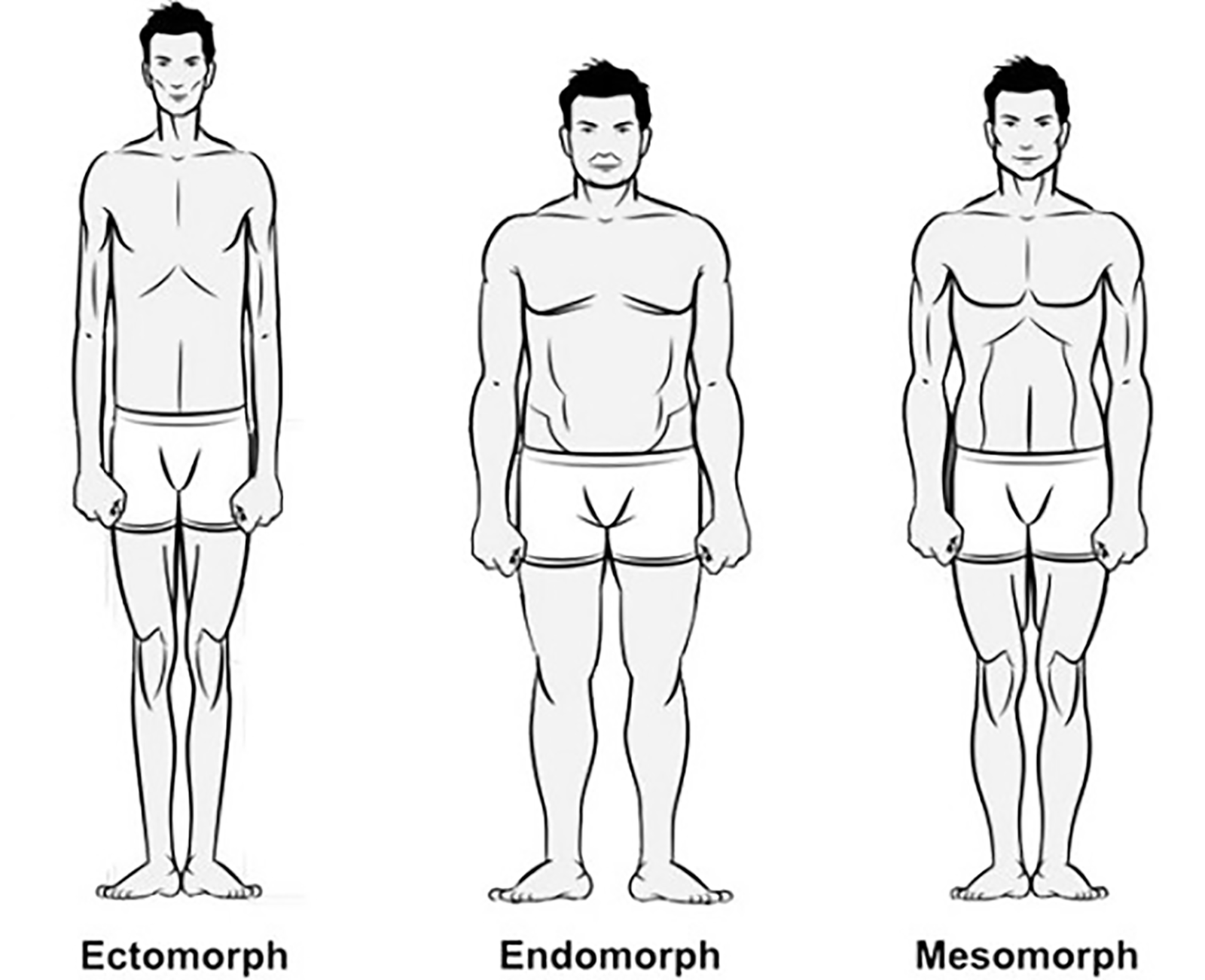
Somatotypes were developed in the 1940s by psychologist William Herbert Sheldon, PhD, to categorize the human physique according to physical traits. Most people do not fall neatly into one type, but are a unique combination of the three body types.
Ectomorph: linear, fragile, delicate, lean, and lightly muscled.
Mesomorph: hard, rugged, triangular, athletically built with well-developed muscles, thick skin, and good posture.
Clients’ body types influence how they will respond to training and treatment. Kousaleos offers these guidelines for performing sports bodywork on each of the three somatotypes:
The ectomorphic structure (lean, endurance) needs more comfortable pressure with less specific depth. Because ectomorphs typically have more neurological sensitivity, the techniques and protocols should be smoother and less deliberate.
The endomorphic structure needs a more layered approach, focusing on broad, less deliberate techniques, especially on the superficial fascia, before attempting to stretch and release the outer layers of dense, fibrous fascia.
The mesomorphic structure of most football players allows for deeper repeated sessions with less postsession soreness and more immediate improvement of both structural and functional outcomes.
The Future
Kousaleos’s long-term goals for the program include a national sports bodywork team that will be made available to every sports medicine department and every strength and conditioning department of Division I universities and every professional sport—from baseball, basketball, and football to soccer and volleyball—men’s and women’s.
“We’re trying to create a team we can promote not only to sports medicine departments, but also to individual professional athletes, because we believe the future of this level of bodywork is working one-on-one with athletes throughout both the season and the off-season,” Kousaleos says. The vision of a national team is another reason Kousaleos picked a diverse group of therapists for the certification training. “Having new therapists working side-by-side with more experienced therapists is a plus.”
An important part of the program is providing the therapists with the practical business tools they need to effectively incorporate their new training into their practices. Christie, XPE’s sports chiropractor, speaks to the therapists on Wednesday mornings about how to create or join an integrated sports medicine team. The idea is to help the therapists create a referral system that supports their athletic clients, athletic teams, and already existing sports medicine departments.
Stanley, who is an entrepreneur and successful business owner as well as a massage therapist, sees a wealth of exciting opportunities for the now-certified CORE therapists to expand their practices in their local community. “Everybody wants to work on the professional football players, but there are only 32 NFL teams across the country, so there are a lot more therapists than there are athletes,” he says. “But there’s a real opportunity for therapists to duplicate this model in their local demographic at the college level. If they can go into a local college or university and develop a contract, hire a team of therapists, and develop a business model where they are the lead therapists bringing other therapists into that environment, they can make money organizing that. They’ve seen that same model work here at XPE, and it’s something they can potentially duplicate and be very successful at.”
The program’s success has led Kousaleos and Villani to offer the same mentorship program again in July of this year, this time working with NFL athletes during their off-season training. “Approximately 150 NFL athletes will be there, training full-bore, getting their legs, upper body, agility, and speed ready for preseason camp, which starts the first week of August,” Kousaleos says. “We’ll be doing that for the next five years.”
Villani has worked with an impressive roster of professional athletes in his career, including NFL veterans Cris Carter, Anquan Boldin, and Osi Umenyiora. Carter, Boldin, and Umenyiora often come by the XPE training facility to speak to the college athletes about the realities of life as an NFL player. “My pro athletes come in and see the access to bodywork these college athletes are getting, and they’re just amazed,” Villani says. “So I think this is going to be the norm for our pro athletes as well, almost year-round. It’s been great. It’s actually been a better experience than I ever thought it would be.”
“That’s because you’ve gotten more massage than ever this year,” says Welle, XPE’s Master Trainer.
Villani smiles. “I’ve gotten a lot of massages.” Considering Villani routinely works 10-, 12-, or 15-hour days getting his athletes ready for the Combine, he clearly deserves it.
Note
1. Jake Pfeil, Training & Conditioning, “Recovered and Ready,” accessed March 2016, www.training-conditioning.com/2013/05/19/recovered_and_ready/index.php.
To understand tissue-tension barriers, MTs must be constantly present and mindful. Too light and we will not become efficient at creating the healing change that is needed.