In my quarter century as a professional bodyworker, I’ve studied and explored many techniques, and I’m convinced the first and most lasting key to good health is learning to take in and let go of deep, cleansing breath on a regular basis. Too many of us slow down our energy by choosing to hold our breath.
I often ponder sayings about breath, or the lack of it: “She took my breath away.” “His anger sucked the air out of the room.” “That fall knocked the wind out of my sails.” “The air was heavy in that place.” Each of these sayings denotes a reason or stimulus that taught us to hold our breath and not move it. We do, however, find positive phrases: “I heaved a sigh of relief.” “She’s a breath of fresh air.” Which of these phrases make you happy and relaxed?
What takes our breath away? We do! Too often we respond to a stimulus from the world outside ourselves by stopping our breath. We seem to believe that holding our breath protects us by blocking the message or stimulus that’s coming at us. While holding our breath may seem to keep problems at arm’s length, we shorten our life and inhibit our activities by doing so.
As we hold our breath, we starve our core. Without breath, we can’t deliver oxygen to the lungs; they can’t clean blood returning to be oxygenated; and the heart can’t pump revitalized blood. We become tired, lethargic, and ill, simply because we don’t breathe deeply.
How do you react when I suggest you bring breath into one of your physical trouble spots? What if that spot is in the hip or ankle? I find amazing results by encouraging a client to find breath in their shoulders while I work in their stomach, pelvis, or even leg area; releases are much stronger and longer lasting. You may already realize how helpful breath images can be to clients, but how do we make it more real for more of them?
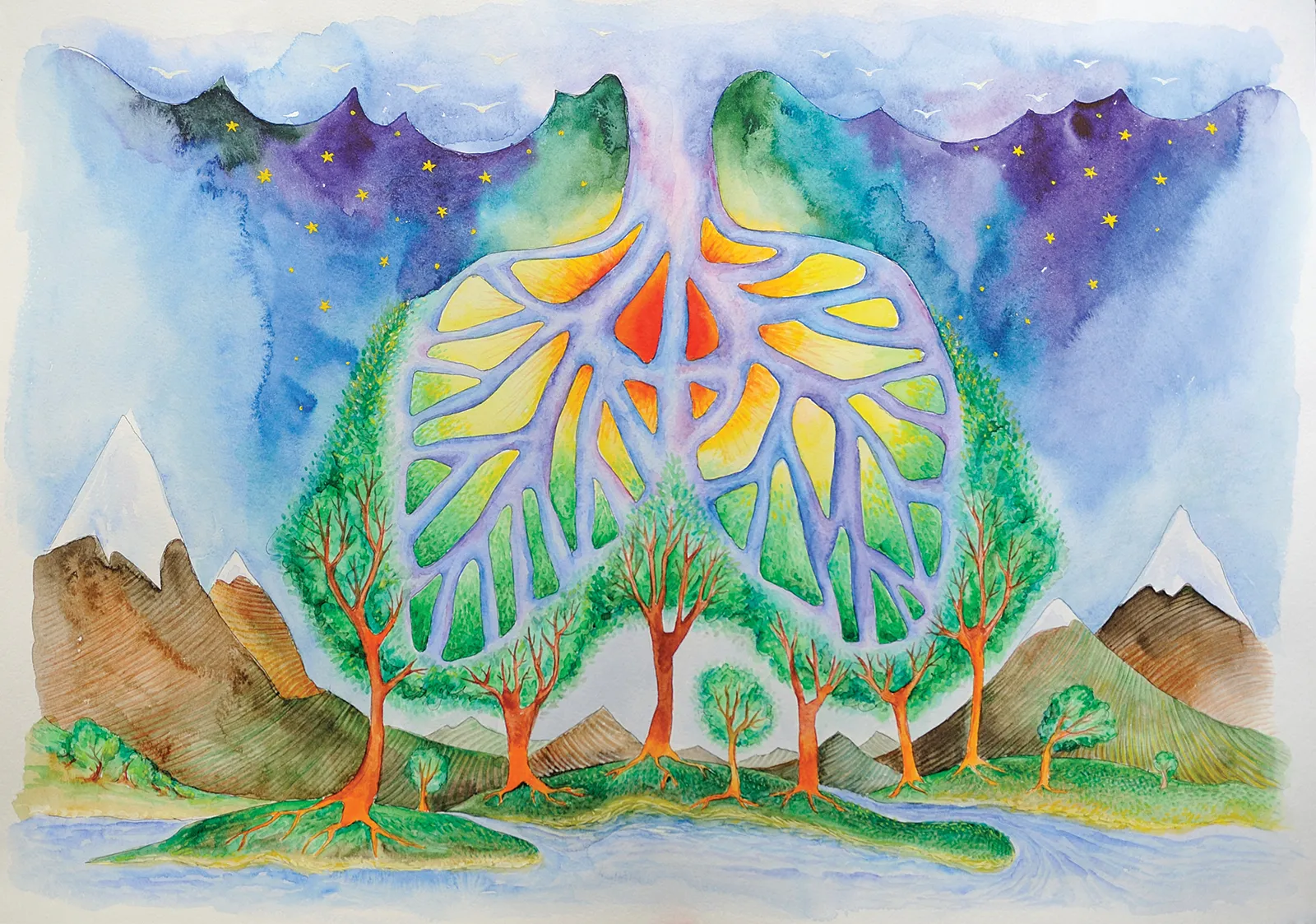
I ask clients to imagine their entire body as a balloon, with a smaller balloon—their lungs—inside. If they inflate the inner lung balloon, won’t the body balloon have to expand, too? As the lungs expand, if clients restrict parts of the outer balloon to redirect that air displacement, they direct air to the top, middle, or bottom of the body. If you can redirect your air, you can direct it toward the traumatized and stuck parts of your body, mind, and core.
The Chakra System
Think about a trauma you’ve absorbed recently—perhaps a physical sprain or strain, a mental/emotional terror, shame, or other assault, or even chemical or energetic poisoning. As you remember the trauma, do you feel the front of your body shrink slightly? Many of us shorten our bodies as we react to trauma. If we focus on the area just below the heart while we relive a negative event or feeling, we may be aware of our fear causing us to close off and make a smaller target for the external threat. While trying to protect our core or essence, we starve it from breath and energy.
A chakra energy center is one of several specific points located along the spine that correspond to a specific branch of our nerve network. Most of us have some chakras and nerve patterns that are too open or active, while others are too congested or inactive. I sometimes think of the chakra system as an elevator; some of us only live on one floor, or never stop at certain floors as we travel, if we travel at all. We could all benefit from balance among, and length between, these energy centers.
The Sanskrit word chakra translates as “wheel” or “disc” because energy seems to spin forth from a chakra, or be stuck in it. The seven main chakras are usually defined as:
first chakra or root (between the anus and genitals)
second chakra or sacral (in the sex organs)
third chakra or solar plexus (the gut)
fourth chakra or heart
fifth chakra or throat
sixth chakra or third eye (just behind the eyes)
seventh chakra or crown (floating just above our head)
In a healthy body, these centers work together to carry us on our journey toward awareness and vitality. I’d suggest you begin to see the chakras in groups of three: 1–3, 4–6, and 7. I associate the following phrases with each of these chakras:
root: instinctively survive without fear.
sacral: responsibly create without shame.
solar plexus: honestly discern without judgment.
heart: enthusiastically quest without yearning.
throat: freely express without censorship.
third eye: rationally think without worry.
crown: consciously thrive without limits.
When any of these statements feels false, that portion of our body may be in trouble.
Freeing the Hourglass
As we look at these traditional centers anchored up and down the spine, the first spot we’ll consider isn’t a chakra, but the gateway between the middle and low groups. If we have a constriction at this spot, our upper and lower body can’t communicate, and we are strained throughout our body as a result. Our elevator is stuck between floors, between the third and fourth chakras at the diaphragm.
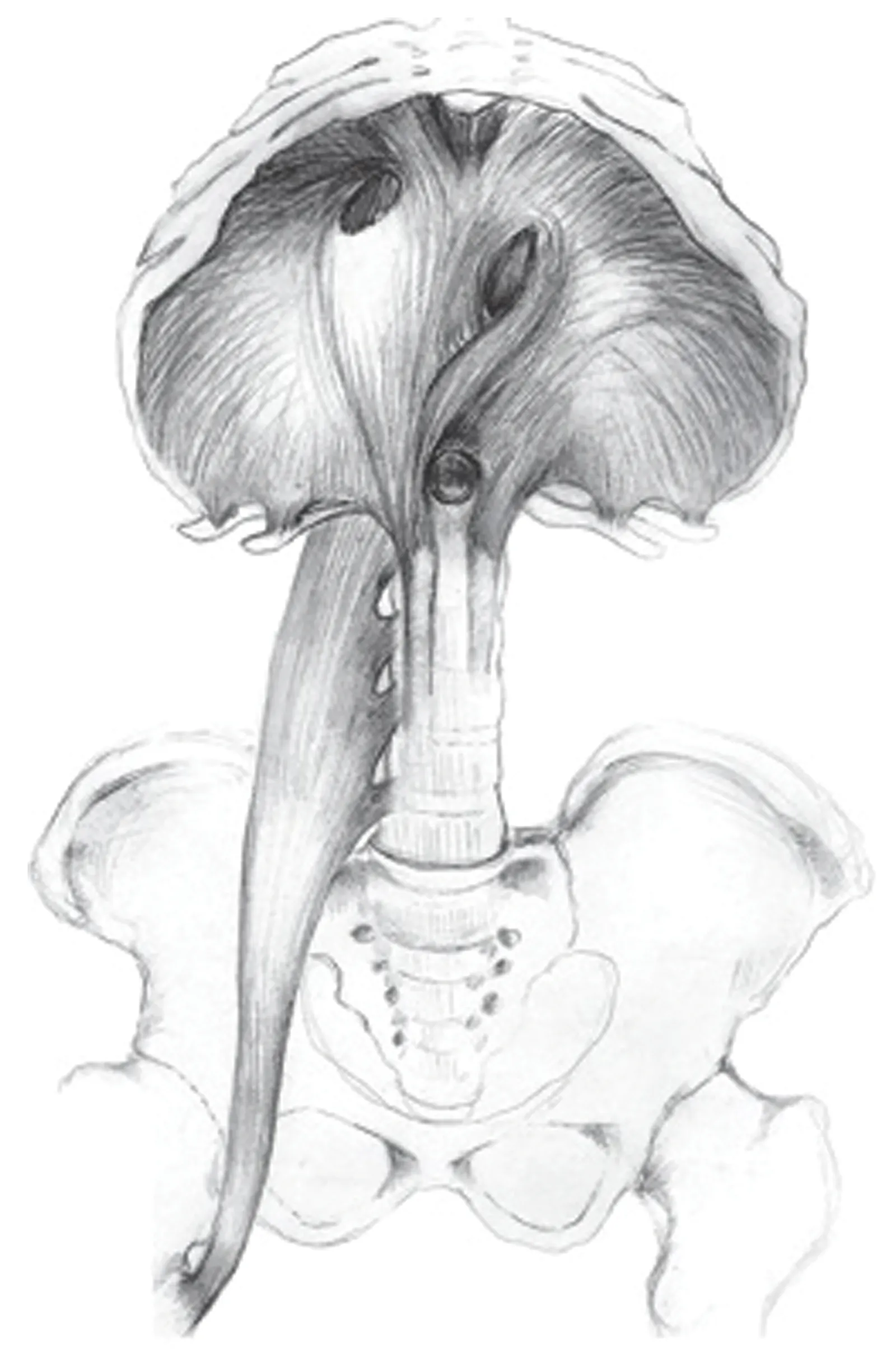
Image 1.
The diaphragm is an umbrella-shaped muscle that forms the roof of the stomach and the floor of the heart (Image 1). It is anchored at its edges to the lower ribs, and its function is to push up and down, with the breath, in a way that moves air into and out of our lungs, expanding and contracting them. Too many of us have forgotten how to use this muscle and instead hold our breath.
Realize also that anchored just behind the diaphragm on the spine is the aorta, the main channel that delivers blood to the body from the heart. Openings known as hiatuses in the umbrella allow the vena cava (which returns blood to the heart) and the esophagus (which delivers food to the stomach) to penetrate the muscle. When we hold our breath, we tighten our diaphragm, either choking these hiatuses and their tubes, or occasionally losing tone in them. We can’t control the blood or food supply through this stuck place, and we become congested and ill.
Visualize the center of your body/mind/core as an hourglass. Actually, try perceiving a series of hourglasses through the deep line of the body, which correlate to the energetic chakras spaced up and down the spine. This diaphragm hourglass is the central and most important. I share this hourglass image with almost every new client within the first series of sessions, often during the first session.
It’s my intention to tap clients’ diaphragm hourglasses so energy can again pour through freely and appropriately. I use bodywork tools and words to move this stuck energy. With a bit of release work, we can open a space for communication between the lowest three and the highest three chakras, and by paying attention to the form of our breath and exercise, and learning to relax our minds as well, we can breathe ourselves to better health.
Releasing the Breath
Shutterstock.
I talk to my clients frequently about “achievement mode.” Too many of us get into this mode during any task, and forget to relax and breathe. We’ve chosen to believe that, in order to complete whatever task has our attention, we must hold our breath to power through it. As we hold our breath, the “sand” in our hourglass slows as the aorta, vena cava, and/or esophagus tighten. It doesn’t register that we could achieve and breathe at the same time to reopen and maintain a relaxed flow or relaxed process.
Often, we believe it’s difficult to breathe because we haven’t made it a priority to learn to breathe fully and deeply. Try practicing this awareness. First, lie on the floor on your back, or sit comfortably but with fairly straight posture, and focus on breathing in and out, deeply and slowly. If you breathe in for a count of four or five, try to slow your breath to lengthen that count to six or eight. Take in the same amount of air if necessary, but inhale more slowly. After a particularly long in-breath, you may find the need to exhale in a rush; after a good out-breath, you may need a quick inhale. Without judging yourself for your lack of breath, intend to expand the time it takes you to breathe, then the amount of breath you’re bringing into your systems.
Once you’ve experimented with this exercise, encourage your clients to practice the awareness as well. As you continue to be aware of your own breath, see if you can improve. Can you focus on bringing in more breath while staying in relaxed flow? When working at your computer, driving, or vacuuming, can you breathe at the same time? Notice your breath or the lack of it. Visualize this stuck hourglass at your diaphragm and teach yourself to allow more breath energy through it. As you become more familiar with tension in your own diaphragm, you’ll be more able to help clients release their own tension, too.
Core Fascial Release of Upper Psoas/Diaphragm
Position the client supine. Locate the costal arch and let your fingertips duplicate the angle of lower ribs just below the 7–10 rib line, outside the rectus abdominis.
Apply mild pressure in the costal area until you feel you’ve hit a subtle, rubber wall.
Check in with the client as to her pain or anxiety level; tug the tissue down to the spine, toward the pubic bone, and medially toward the linea alba. But be careful! Pushing up or in could cause damage, so always tug tissue down. Hold for three to four breaths.
Release, and see if the client’s breath has expanded. You may choose to repeat the touch once or twice more.
To understand tissue-tension barriers, MTs must be constantly present and mindful. Too light and we will not become efficient at creating the healing change that is needed.