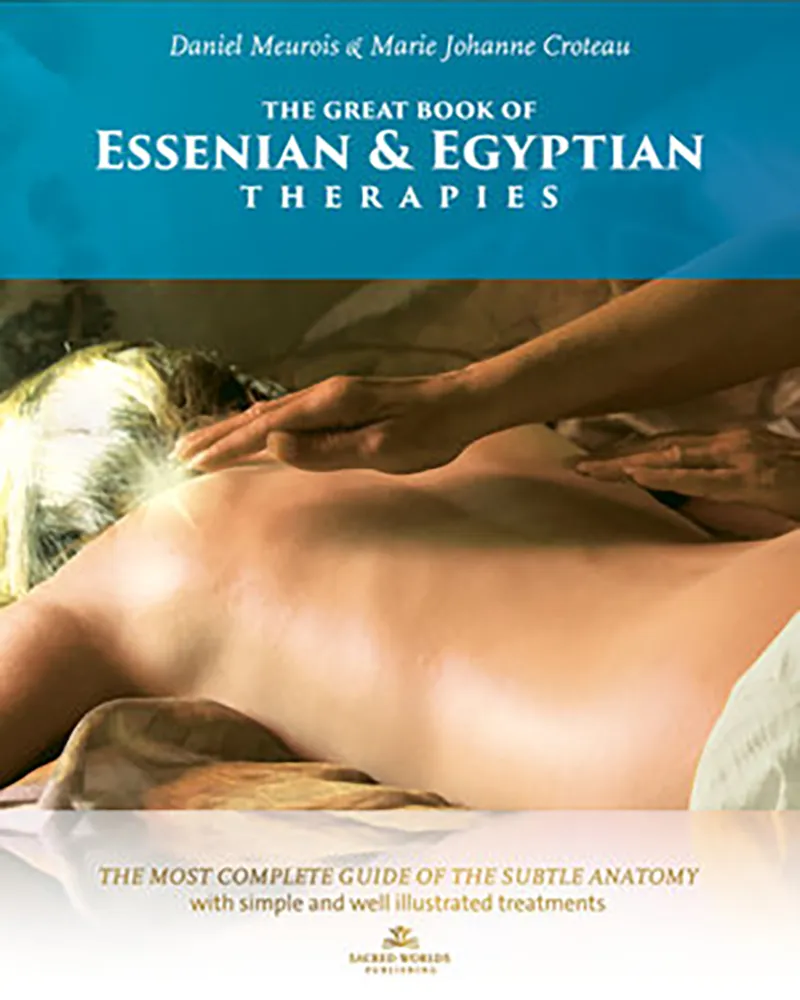
Ancient Essenian and Egyptian healers worked with a person's subtle anatomy, addressing all its luminous layers and auras in a quest for therapeutic healing. Historically passed down only through oral tradition, these ancient tools have found renewed interest through the recent work of Daniel Meurois and Marie Johanne Croteau, authors of The Great Book of Essenian and Egyptian Therapies.
From the Past
The Essenians, or Essenes, came from Ancient Egypt, where they were known as the "Fraternity"—a Hebrew society that lived among the Jewish people. Enlightened by pharaohs Amenophis III and Akhenaten, the Essenians were the guardians of "the knowledge." In this sense, according to the Essenian understanding, the luminous body and its radiations were "carriers of the truth of being."
These healing arts, which unified the body with its own divine essence, were practiced by holy people as early as 4000 BCE and through 100 CE. These master healers were thought to have achieved health at all levels because of their compassionate service to others. Unbound by traditional thought, these early healers saw the spirit—the original source before a physical body manifests—as layers of light (auras) that form a divine bridge between the breath and the physical being.
"This knowledge was directed toward only one goal: mastery of the health of the soul," says Meurois, whose book on the subject was recently translated into English. "Essenian and Egyptian therapies were holistic before the word existed. They considered the global reality of the human being—namely, the multitude of a person's declensions of levels of consciousness, of what we now call a person's vibrational levels."
Daniel Meurois and Marie Johanne Croteau, authors of The Great Book of Essenian & Egyptian Therapies (sacredworldspublishing.com), are energetic healers and devoted students of the Essenes. They have been training bodyworkers and healing therapists in their methods and believe the world, in its current state of materialism and pain, is in great need of these therapies precisely at this time in human history. Croteau, who worked in the ICU, emergency, and trauma wards of a hospital before working as a healing therapist, has found these ancient therapies have deepened and expanded her healing practices.
The Alignment of the Subtle Bodies
This exercise, practiced on the back of the client, allows for a great centering of the etheric, astral, and mental bodies. It indeed happens that these bodies are not correctly "fitted together." So if the client mentions struggles with concentration, sleeping difficulties, and other small symptoms, there is often an atypical, translating desynchronization of their subtle bodies.
This is a simple and efficient technique that can facilitate alignment of the subtle bodies:
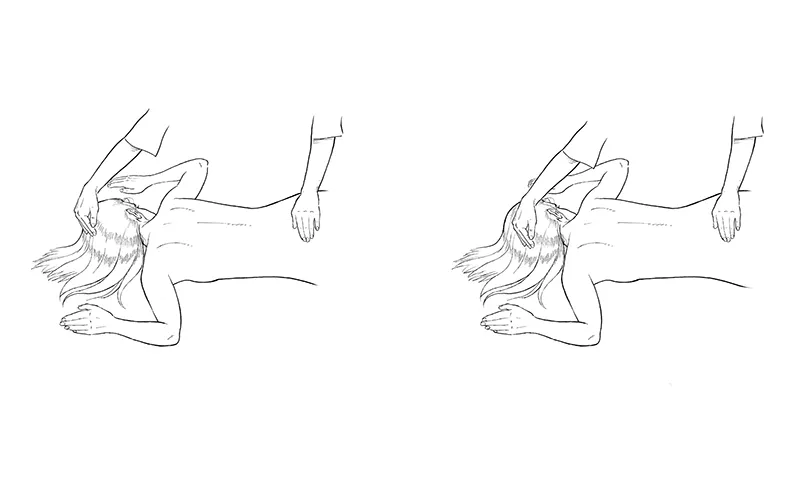
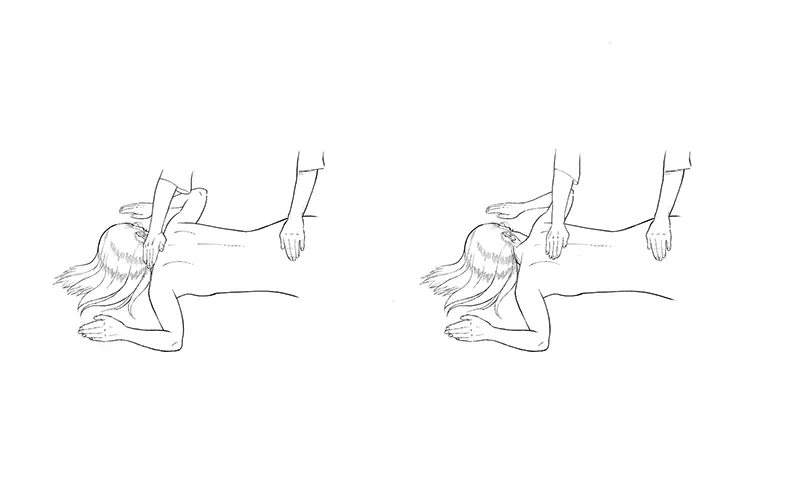
Pause your support hand between the first and second chakras of your client (between the tailbone and the sacrum). Your support hand stays there for the totality of the treatment. Simultaneously, place your active hand at the top of the client's head, in contact with the seventh chakra (Image 1).
While your support hand remains in the same place, move your active hand to the sixth chakra of your client, who is in a prone position with their head turned to the side (Image 2).
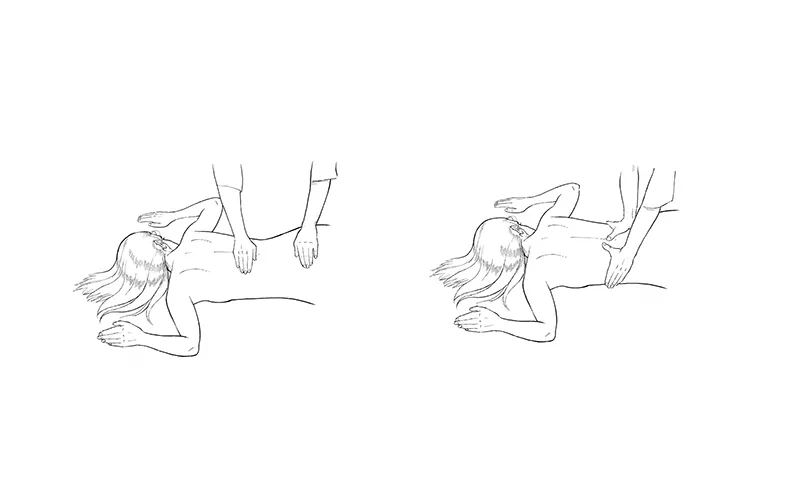
With your support hand remaining in the same place, move your active hand to the fifth chakra (Image 3).
Your active hand should next land delicately on the dorsal vertebrae, at the level of the fourth chakra. Still, the support hand does not move (Image 4).
Then the active hand slides to the third chakra, approximatively to the level of the kidneys of your client. Your support hand will remain still between the tailbone and sacrum (Image 5).
Finally, while slightly pivoting yourself, place both hands in an enveloping way at the midpoint of the back of your client (Image 6).
Steps 1-2.Steps 3-4.Steps 5-6.
What Does It Look Like?
To maximize the client's comfort, an Essenian and Egyptian therapy session can be done on the floor or on a massage table. There are a lot of similarities with traditional massage, like the use of quality oil (including the addition of essential oils), the direct touch to the skin, the organic white linen covering the body, proper draping, and relaxing-meditative music. However, the hands-on strokes and the therapist's approach are based on energetic techniques that feel slow, steady, warm, light, and sometimes firm on the body, depending on the treatment received. The movement of the therapist's hands is like a dance. Meurois says it's like learning a new language; each hand placement and exercise serves a different purpose in the therapy's protocol.
As the principle of anointing was common in the ancient Egyptian era, it is instrumental to the treatment. Both the Egyptians and Essenians attributed the same double function to the oils: to facilitate the movement of the hands on the body during treatments and to amplify or polarize the action of the energetic wave offered to the client.
The Essenian and Egyptian therapies are cosmic and timeless therapies based on in-depth knowledge of the circuits of universal life energy. They restore an energetic and harmonious circulation in the subtle and physical bodies, promote the screening and the elimination of toxic thoughts (which, in this tradition, are often believed to be at the origin of many diseases), and identify and remove wounded memories blocked in the cells of the body.
Practitioners of these therapies have found effectiveness on the physical level (alleviating circulatory problems of the legs, lessening symptoms of PMS and menopause, and addressing grand fatigue, diabetes, sleep apnea, articular rheumatism, intestinal disorders, etc.), as well as on the mental and emotional levels.
Put Into Practice
The practice of Essenian and Egyptian therapies is ideal for spiritually focused practitioners, bodyworkers, yogis, and healers attuned to how spirit and matter relate with one another and is a valuable tool for anyone looking to deepen and expand their healing therapeutic methods.
According to Meurois and Croteau, the "ancient Essenian and Egyptian therapies impose nothing. Rather, they suggest a light of healing that searches for suffering at its root. They don't forbid anything and require no dogma. These therapies help those who offer them the same as those who receive them; to reveal more of themselves, to pacify, and to heal in depth and in full liberty."
To understand tissue-tension barriers, MTs must be constantly present and mindful. Too light and we will not become efficient at creating the healing change that is needed.