

Fascia: The Pericardium-Diaphragm Connection
Understanding how the pericardium relates to breathing can in turn help clients relax into their massage session.
Right now, wherever you are and whatever you’re doing, drop your shoulders. At any given moment, most of us can relax our shoulders more than we realize. And just a little more shoulder relaxation makes whatever we’re doing easier and more enjoyable, whether it’s holding a magazine, working on a client, taking a walk, driving a car, or just twiddling our thumbs.
Why do our shoulders stay so tense? Perhaps it is because they rely on soft tissues for much of their stability, since they have smaller and more mobile bony articulations than the large, sturdy joints of the pelvis and lower limb.1 Or, maybe shoulder tension reflects the pervasive stress of modern life. Raising the shoulders seems to be an instinctive part of sympathetic (fight-or-flight) autonomic arousal—elevating the shoulders readies the arms for action and protects the vulnerable structures of the head and neck.
Try it: raise your shoulders and check in with yourself. Don’t your outlook, mood, and stress level subtly shift?
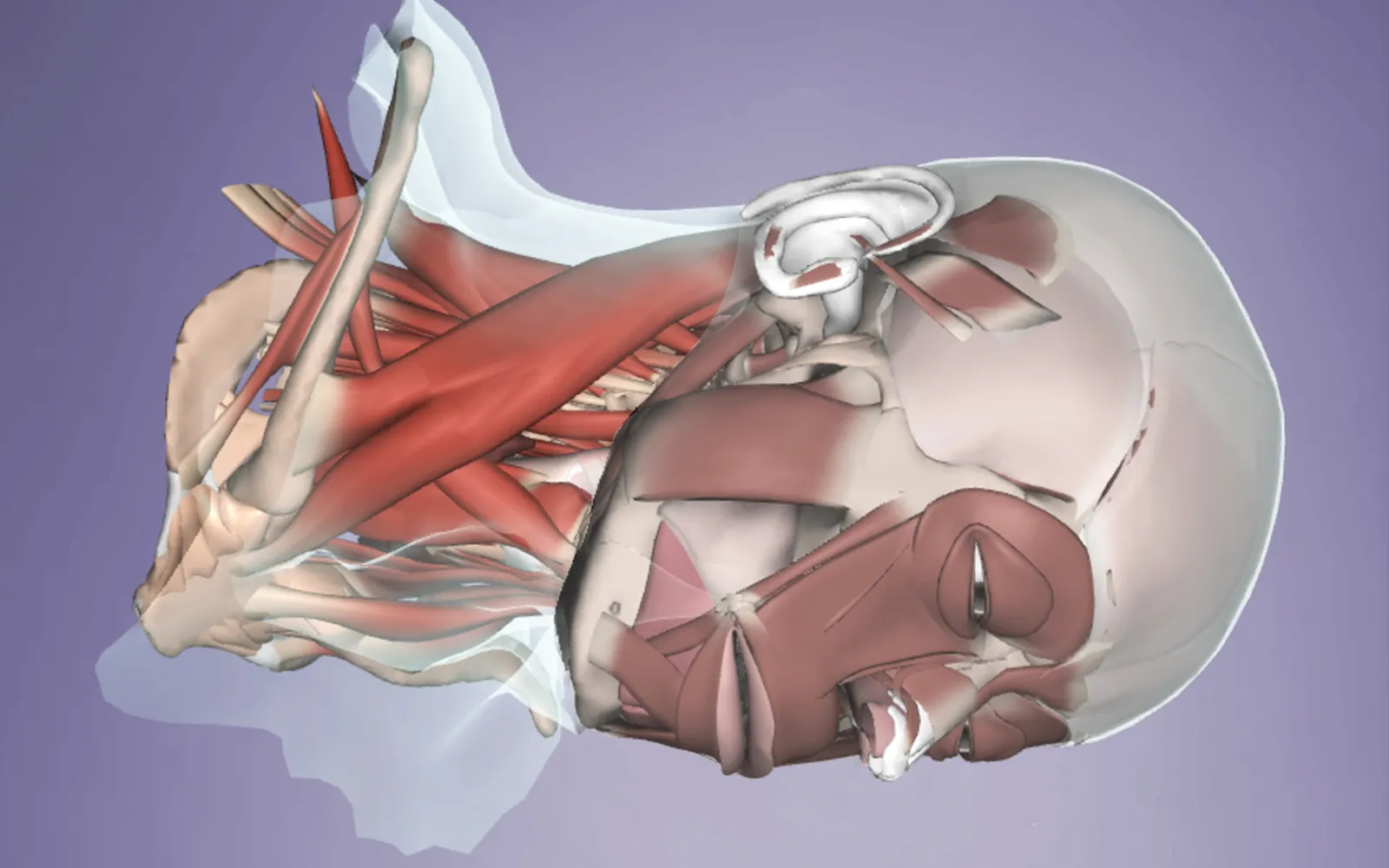
Anatomically, the shoulders provide a broad base for attachments of the angled myofascial structures that converge in the neck: the levator scapulae, trapezius, sternocleidomastoids, and omohyoids, as well as the superficial and deep fascial layers that extend upward around the neck and downward to surround the entire body (Image 1). Shoulders and necks are undeniably interrelated—sometimes, too much so. Injuries, tension, movement restrictions, or pain in either the shoulders or the neck will often affect the other.
When the neck and shoulders’ interconnecting myofascia is undifferentiated or inelastic, it can restrict mobility and contribute to pain.2 And, when our functional (movement and tonus) patterns are undifferentiated (for example, habitually raising the shoulders whenever moving the arm), our daily movements are robbed of their potential grace, efficiency, coordination, and ease. Knowing how to increase your clients’ neck and shoulder differentiation will make your work with both these problem areas even more effective.
Prepare for this technique by helping your client sense and release any tension or subtle bracing at the glenohumeral joint. Not only is this therapeutic in itself, but by beginning with your client’s body awareness, you’ll lay the groundwork for greater client participation and kinesthetic learning.
With your client on her side and her humerus vertical (abducted), use slow, small, passive movements of the arm to explore its range of motion in every direction: front, back, up, and down, as well as swiveling (rotation) and stirring (circumduction). Since we’re interested in fostering more ease and release, have your client’s elbow bent, with the forearm hanging, hand relaxed. Feel for your client’s ability to let her entire arm be heavy. If you feel your client bracing or holding, slow down and wait. Use your movement to show your client where she is holding; if needed, use a verbal cue such as, “Just let your arm be heavy.”
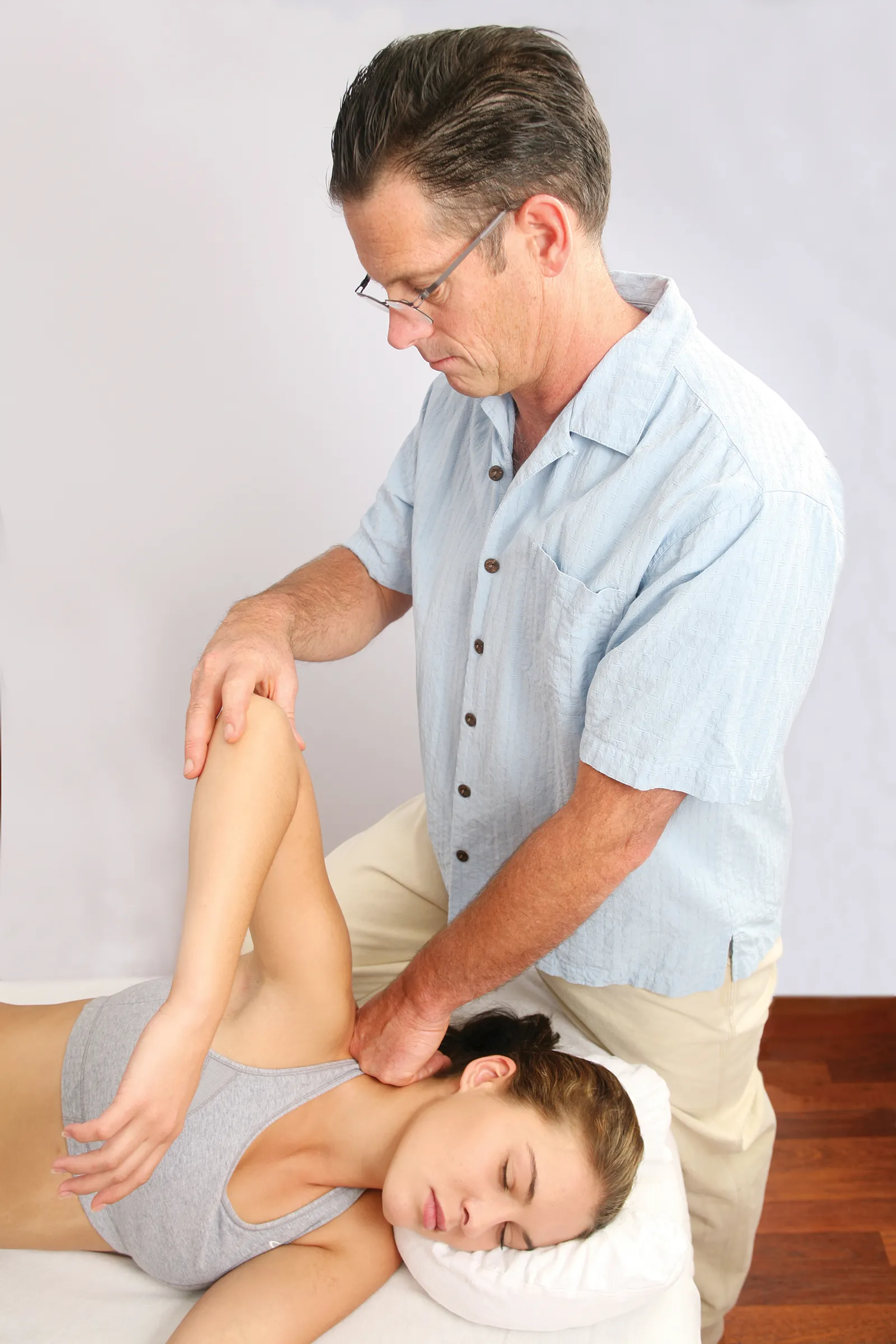
Once your client is able to allow more passive movement, use a gentle, soft fist (Image 2) to anchor the outer fascial layers connecting the neck to the shoulder. Don’t stroke or slide on the surface, but instead use just a bit of friction to stretch the fascia superiorly and medially away from the shoulder and toward the head. Oil or cream will make it difficult to anchor the layers, so if you use these in your work, perform this technique before their application.
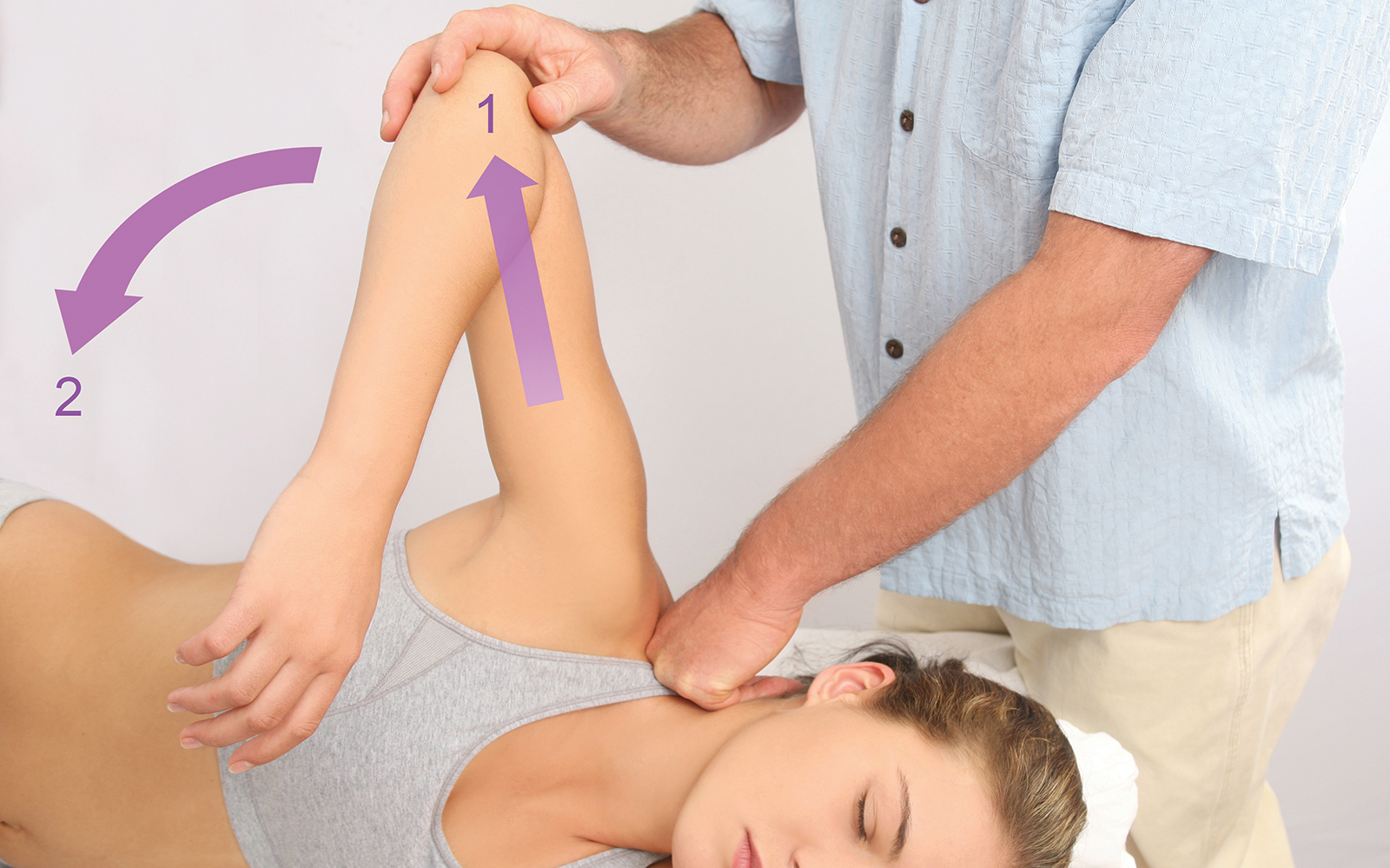
Ask your client to slightly lengthen her arm distally (Image 3, Arrow 1), but without pushing from the shoulder (which overly engages the scapular stabilizers). If this proves difficult, get more specific and creative with your verbal cueing: “Let your elbow lead your movement; leave your shoulder relaxed.”
When your client finds this subtle reaching with the elbow, you will feel her movement stretch the fascial layer you’ve anchored with your soft fist. Only then, invite your client to slowly lower her arm to her side (adduction), while she simultaneously continues to lengthen through the humerus (Image 3, Arrow 2). Her active adduction will further stretch the layer you’re anchoring; allow it to slide now, but only at the pace of her arm movement.
Repeat this maneuver, this time anchoring a slightly deeper layer, such as the fascia that wraps the trapezius, then the trapezius itself, followed by the deeper levator scapulae or even the posterior and medial scalenes (which makes this technique indicated for thoracic outlet syndrome-like symptoms). Vary the angle of your client’s reaching and adduction, encouraging her to find the angle that best connects with the specific structure you’re anchoring.
The Shoulder/Neck Differentiation Technique is an effective way to free the local structures that can over-connect the shoulder to the neck and to increase the subtle body awareness that can sustain the work afterward. Balance and integrate it by working elsewhere around the shoulder (such as the scapula-rib cage relationship) or into the neck.
Your client can continue what you started by practicing these movement awareness exercises after your session:
• Opposite Arm Drop: Drop your left arm to your side, and then tip your head to the right. Feel a stretch? After you pause, breathe and let your body register these sensations. Then, return your head to an upright position, and compare the sensations of this side to the other—is it different in any way? Repeat on the other side.
• Arm Movement, Sans Shoulder: Practice leaving your shoulders relaxed while reaching for a doorknob, shaking someone’s hand, typing a text, holding a steering wheel, etc.
1. Mark D. Miller and Stephen R. Thompson, DeLee & Drez's Orthopaedic Sports Medicine (Philadelphia: Elsevier Health Sciences, 2014): 587.
2. A. Stecco et al., “Ultrasonography in Myofascial Neck Pain: Randomized Clinical Trial for Diagnosis and Follow-Up,” Surgical and Radiologic Anatomy 36, no. 3 (April 2014): 243–53.
Understanding how the pericardium relates to breathing can in turn help clients relax into their massage session.
Superficial fascia may not get the same attention as deep fascia, but it plays an extremely important role in the organization of tissues and the structure of the body.
Understanding tendons—their shapes, lengths, and organization—improves an MT’s touch vocabulary and facilitates a more skilled touch.
While the neck is a bridge, a pathway, the position of the neck and head can also indicate a multitude of other things happening beneath the surface.