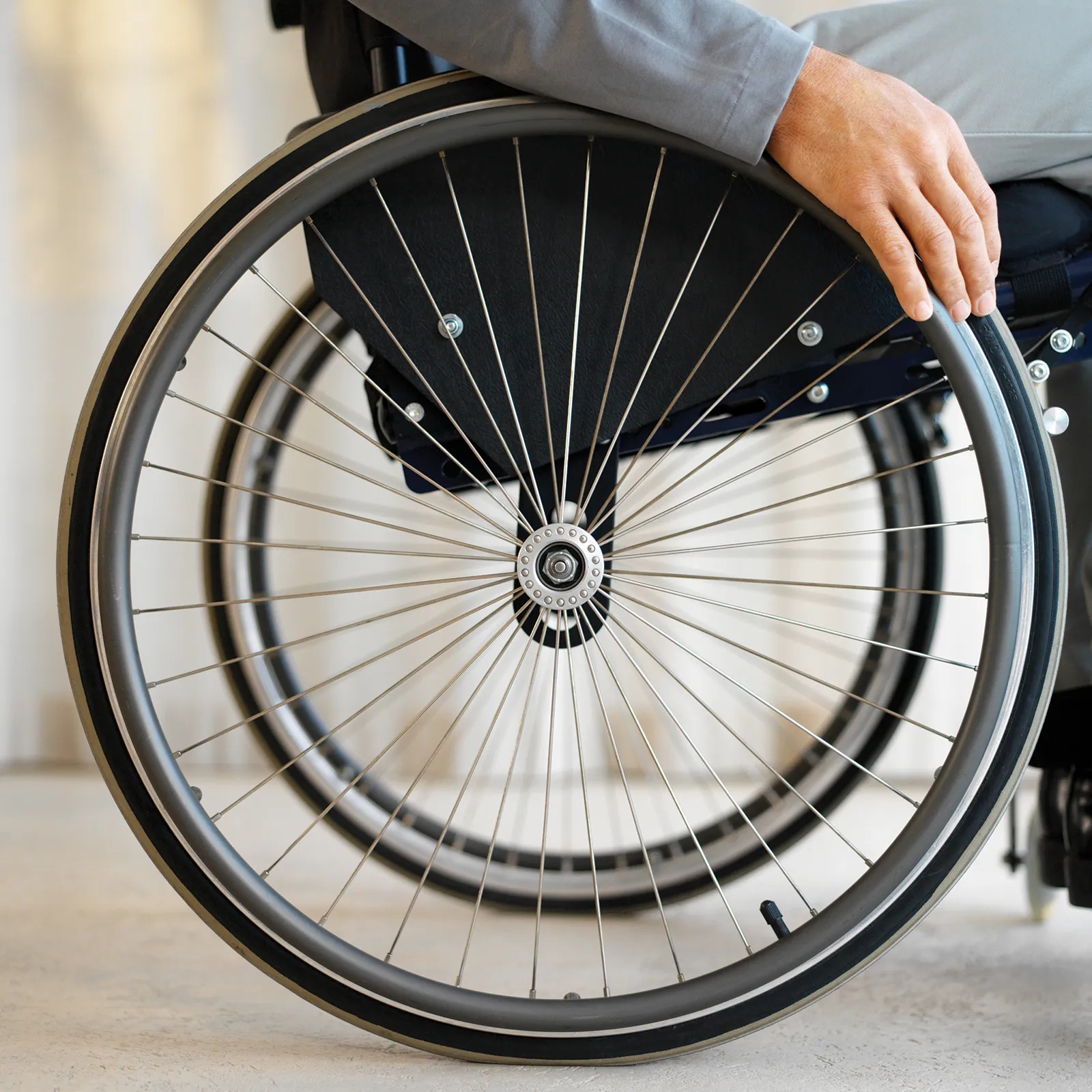
At times, you may have a client in a wheelchair who needs assistance getting on and off your table. When doing so, it is crucial to use proper body mechanics and have a heightened sense of body awareness. The following techniques are a guide—adapt them to your client’s needs, abilities, and wishes.
Wheelchair to Therapy Table
Prep: Make sure your table is approximately the same height as the chair. Place the chair close to the table and lock the wheels.
Before you begin to transfer your client, explain how you intend to move him, and stay in constant communication during the transfer. First, place your client’s feet on the floor, hip-width apart, and align his ankles underneath, or slightly behind, his knees.
Stand with one foot forward facing the client, with the forward leg placed between your client’s legs (this allows you to stand as close as possible). Place your arms around the client’s back or shoulders and, if possible, clasp your hands together. The client’s hands should be on your shoulders or wrapped around your neck.
Before starting the next sequence of movements, explain to your client what you are going to do and what he can do to assist you. Hold your client close and slowly shift your weight back so your client’s upper body leans forward. When your client’s weight is approximately over his legs and feet, slowly straighten your legs, raising your body to bring your client’s body to a standing position.
Once your client is standing, help him turn so his back is to the table. Make sure the backs of your client’s legs are in contact with the table so he knows exactly where the table is.
If your client is unable to come to a sitting position by himself, again, stand in a one-foot-forward stance, with your forward leg placed between your client’s legs. Place your arms around your client’s back or shoulders, with your client holding your shoulders.
Holding your client close, shift your weight back and lower your stance. This will bring your client’s upper body forward, allowing him to bend from the hips, knees, and ankles. When your client’s pelvis is near the table, shift your weight forward and slowly lower your client to a sitting position.
Gently lower the client’s upper body into a sidelying position, assisting with the lifting of his legs onto the table.
Therapy Table to Wheelchair
Prep: Bring the chair close to the table and lock the wheels.
Begin with your client in a side-lying position. If your client is unable to come into a sitting position by himself, cradle his head and neck with one hand, and place your other hand on the client’s upper hip. Push the hip in the direction of the feet, raising the upper body and allowing the client’s feet to slide off the front of the table, bringing him into a sitting position.
Use the strategies that you’ve just learned to help bring your client back up to standing, and then back to his chair.
To understand tissue-tension barriers, MTs must be constantly present and mindful. Too light and we will not become efficient at creating the healing change that is needed.