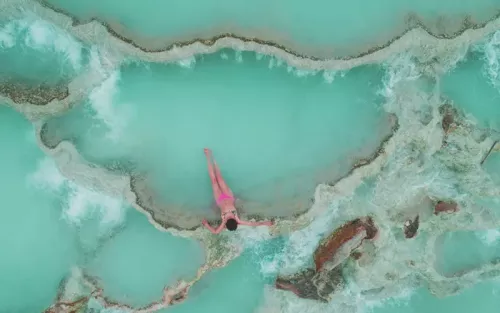
Transparent, tasteless, and odorless, yet integral to all life, water is at once unremarkable and truly fascinating. We've all heard that water makes up 70 percent of the human body and covers 75 percent of the Earth. But did you know that less than 1 percent of the water on Earth can be used as drinking water? Or that there is more water in the atmosphere than in all rivers combined?
Here are some more interesting facts about water and the therapies that utilize its healing potential.
Stocksy.
Water Wise
According to the US Centers for Disease Control and Prevention, water helps your body:
Keep its temperature normal
Lubricate and cushion joints
Protect your spinal cord and other sensitive tissues
Get rid of wastes through urination, perspiration, and bowel movements
Ancient Phrase
"Taking the Waters" is used to describe the medicinal philosophy of spa and curative waters, which are meant to cleanse the body, relax the heart, refresh the mind, and purify the soul.
Did You Know?
Even mild dehydration, as little as 1 percent, can affect mood, concentration, and headache frequency. Consider this: an athlete can lose up to 10 percent of their body's water content through sweat.
Fact
Water is the only substance to be found naturally on Earth in three forms: solid, liquid, and gas.
Hydrotherapy
Although ancient Greece and Rome both adopted the belief that water had healing properties, it was the Romans who first integrated hydrotherapy into their social life, building temples and baths near natural springs. Father Sebastian Kneipp from Wörishofen, Bavaria, was the father of modern-day hydrotherapy in Germany. Various hydrotherapy massage techniques exist and are generally utilized by massage and bodywork practitioners, physical therapists, physicians, and spa technicians. These include underwater massage, herbal baths, thalassotherapy, Kneipp therapy, Vichy treatments, Scotch hoses, Swiss showers, and Watsu.
Did You Know?
The water we have on Earth now is all we will ever have. That means the same water that comes out of your faucet today is the same water that dinosaurs drank.
Thalassotherapy
This treatment uses the therapeutic benefits of the sea and seawater products to restore health and vitality to the skin and hair. The treatment may include a body wrap using seaweed and algae paste or seawater baths using strong, underwater jets.
Water Therapy for Animals Too
Humans aren't the only ones reaping the benefits of a growing trend to use water as a therapeutic tool. Today, horses and dogs have access to state-of-the-art underwater treadmills, many of them mobile, to help with injury recovery.
To understand tissue-tension barriers, MTs must be constantly present and mindful. Too light and we will not become efficient at creating the healing change that is needed.