Mindfulness comes down to one straightforward question: "Is my attention on something happening right now?" Simple.
But if it's that simple, does mindfulness really do everything it claims to do? If you believe the popular media, mindfulness can address everything from depression and stress to immune system disorders, addiction, chronic pain, posttraumatic stress disorder, anxiety, indecision, poor leadership, lost productivity, low emotional intelligence, cognitive bias, insomnia, and bad exam scores.
And how did mindfulness get so popular? It has been featured on the cover of Time magazine.1 Large companies from Silicon Valley (such as Google, Twitter, and Facebook) to Wall Street (Goldman Sachs) to Main Street (General Mills, Aetna) now have "corporate mindfulness initiatives." And, on the talk-show circuit, mindfulness has been endorsed by dozens of celebrities, including Oprah Winfrey and Deepak Chopra (naturally), but also by Angelina Jolie, Kobe Bryant, Ohio Congressman Tim Ryan, and Ivanka Trump.2
For many of us, panacean assertions and faddish popularity can themselves make something suspect. But while there are good reasons to be skeptical about many of the claims made for mindfulness, there could also be good reasons for the popularity of mindfulness, however frivolous it might seem.
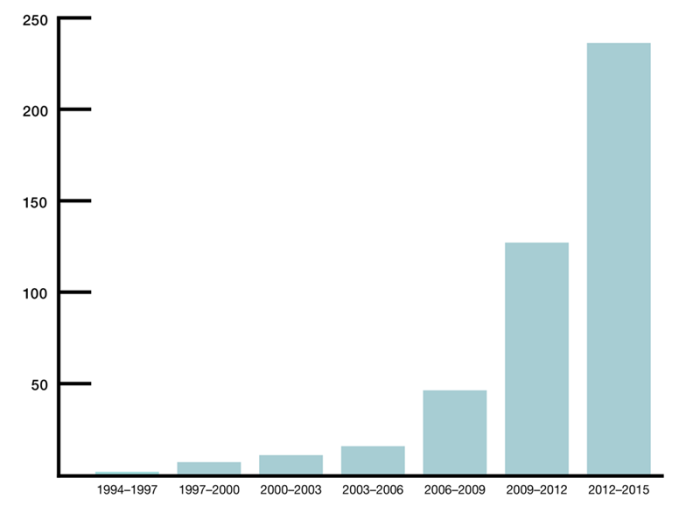
Number of Randomized Controlled Trials About Mindfulness in PubMed
As fleetingly faddish as the current popularity of mindfulness can make it seem, the academic and scientific interest in its therapeutic benefits and applications shows no signs of diminishing. This graph shows the recent surge in randomized controlled trials of mindfulness interventions, as reported by J. D. Creswell, "Mindfulness Interventions," in the Annual Review of Psychology 68 (January 3, 2017): 491-516.
For example, could it be that mindfulness is so popular because we so commonly suffer from mindlessness? Could our hurried, fragmented, task-driven, device-centered lifestyles—punctuated by escape into stimulating but unsatisfying social media, entertainment, and sensational sound bites—leave us with an unsatisfied hunger for the subtle, wholesome nourishment of direct experience, a longing for simplicity and calm, and a way in, rather than just a way to escape? (Interestingly, could these be some of the same reasons people seek out massage and bodywork?)
And though mindfulness has clearly been oversold as a cure-all, there is a rapidly growing body of evidence (see table below) that this simple practice can yield surprising benefits in a range of applications.3 Though research on mindfulness is subject to the same concerns and limitations as research in other fields (such as publication bias and other limitations), there are good indications that mindfulness can be especially useful in dealing with pain and stress; indeed, mindfulness has been shown to provide measurable benefits in each of the areas listed earlier (yes, even test scores).4
Mindfulness and Manual Therapy
Many bodywork and massage therapy practitioners are familiar with the concept of mindfulness, and see value in it. When I polled the 1,553 practitioners in our Advanced Myofascial Techniques discussion group on the question "Do you think mindfulness can be useful to bodyworkers?" 98.5 percent of respondents responded in the affirmative, 1.5 percent weren't sure, and 0 percent disagreed.5 A large number of entry-level massage and bodywork training programs (though not all) include attention to mindfulness or to its cousins therapeutic presence and focused attention. (A whopping 93 percent said mindfulness principles were "included" or "emphasized" in their original bodywork training; only 7 percent said mindfulness was "barely mentioned," or not included.) Numerous body-mind approaches used as extensions or adjuncts to hands-on bodywork, such as Feldenkrais Method, Alexander Technique, focusing, Rosen Method, hakomi, sensory awareness, and somatic experiencing, use mindful attention to bodily sensation as a primary method.
Interoception and Myofascia
Image 1. Inviting your client to let a tensely held arm or leg relax or be heavy is another example of how simple body-based mindfulness is commonly used in hands-on work.Image courtesy Advanced-Trainings.com.
Though different sources interpret "mindfulness" in many different ways, attention to present-moment bodily sensations (interoception) is a key aspect of most, if not all, mindfulness applications.6 (The other aspects common to most mindfulness practices include: attention to sensory experience of one's surroundings, or exteroception; attention to one's thoughts; and an attitude of acceptance and observation, rather than judgment or evaluation.)7
As hands-on practitioners, we know it is mindful attention to body sensation where our scope has the most obvious and relevant overlap. Whether referred to as mindfulness or not, focused body-based attention is an integral part of many manual therapy techniques and approaches. Touch itself tends to focus the receiver's (and the giver's) attention on the point of contact; many methods leverage this effect by intentionally directing the receiver's attention toward the felt experience itself, as a way to enhance or underscore its therapeutic impact. One example of this approach from our Advanced Myofascial Technique repertory is the Core Point Technique (Image 1). In this technique, we're specifically directing the client's attention toward their interoceptive (felt) experience of compression movement. (For more on the Core Point Technique, see "Working with Bone," Massage & Bodywork, November/December 2013, page 114, and the video above.)
In any hands-on modality, whether we realize it or not, we are also invoking body-based mindfulness whenever we:
Ask about our pressure.
Invite the client to let a body part relax or be heavy (Image 1).
Draw a client's attention to their breath, tension, movement, etc.
And as practitioners, we are also practicing interoceptive mindfulness whenever we:
Notice our own discomfort, unnecessary tension, or effort.
Feel or watch for our clients' responses to our touch.
Remind ourselves to breathe, relax, slow down, etc.
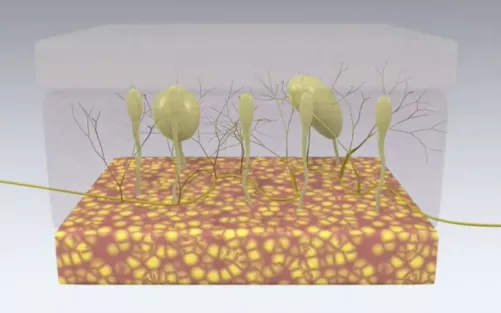
Image 2. Fascia's abundant mechanoreceptors and free nerve endings (shown here in superficial fascia and hypodermis) are so numerous that they likely contribute more than any other source to our interoceptive (body sensation) sense. Image courtesy Hank Grebe, mediaspin.com, used by permission.
How Mindful Are You?
You can take a mindfulness quiz based on the psychometrically validated Philadelphia Mindfulness Scale (developed by researchers at La Salle University and Drexel University) at www.goo.gl/uAhCPQ.
From our myofascial perspective, it is particularly interesting to note that the body's fascial tissues are generally so sensitive and pervasive that they contribute the lion's share of our total interoceptive input. Specifically, the myofascial endomysial and perimysial layers, as well as the periosteum and visceral connective tissues, are so richly innervated with mechanoreceptors and free nerve endings (Image 2) that their quantity of neural receptors "may possibly be equal or even superior to that of the retina, so far considered as the richest human sensory organ," according to fascial researcher Robert Schleip.8
In other words, the majority of your present body sensation comes from your fascia (and the number of fascia-based receptors is likely equal to, or greater than, any other sensory source).
Future Directions
Some of the most interesting mindfulness-related directions now being researched, discussed, and debated include pain, affective touch, and interoception itself.
Chronic pain can respond to mindfulness-based approaches (such as mindfulness-based stress reduction and mindfulness-based cognitive therapy); these and other approaches are using mindfulness to help chronic pain sufferers begin to make a distinction between their actual sensory experience and the reactions, emotions, and assumptions about the overall pain experience itself.9
Interoceptive nerve signals are processed via the brain's insula, which is also associated with emotional and motivational impulses, awareness of self, and a sense of well-being. While interoception has had its own surge of popular interest recently, its classic definition as "organ sensation" is being seen as just one aspect of the many yet-to-be elaborated nuances, varieties, and effects of internal perception.10
Affective touch: the discovery that the skin contains interoceptive, insula-related C-fiber endings that trigger a general sense of calm and well-being has significant implications for hands-on therapeutic work.11
While the popularity of mindfulness and its improbable-sounding list of results can (and maybe should) be taken with a grain of salt, our hands-on work can leverage the effects of mindfulness in surprisingly simple and potent ways, to the benefit of our clients and ourselves.
A Deeper Dive—Practice: Micro-Mindfulness
Shutterstock.
Though mindfulness is often practiced during seated meditation, this simple exercise can be done nearly anywhere, including while doing massage or bodywork.
Note a body sensation you're currently having: tension, pressure, comfort, warmth, etc.
Linger with this sensation; relax; and breathe as you feel it. The sensation may stay the same, it might shift subtly as you pay attention to it, or it might completely disappear—in which case, just pick another sensation to feel.
See if you can notice the moment when your attention goes to something other than sensation: a thought, an image, etc.
Gently bring yourself back to sensation; return to simply feeling a body sensation.
Count the number of times you bring your attention back; go for at least three cycles of feeling and returning.
What's the purpose or goal of this exercise? It's simply to practice sensing our own bodies and to provide a short respite of gentle focus in the midst of our usual habits of distraction, multitasking, and activity.
4. M. D. Mrazek et al., "Mindfulness Training Improves Working Memory Capacity and GRE Performance While Reducing Mind Wandering," Psychological Science 24, no. 5 (May 2013): 776-81. https://doi.org/10.1177/0956797612459659.
11. F. McGlone, J. Wessberg, and H. Olausson, "Discriminative and Affective Touch: Sensing and Feeling," Neuron 82, no. 4 (May 21, 2014): 737-55. https://doi.org/10.1016/j.neuron.2014.05.001.
To understand tissue-tension barriers, MTs must be constantly present and mindful. Too light and we will not become efficient at creating the healing change that is needed.