One of my first Rolfing teachers, Peter Melchior, once told us the secret to his remarkable results. It wasn’t a technique, unique powers, or a special way of using his hands. “I can wait longer than my clients can,” he said. The change he was after, he explained, tended to arrive only after a client reached the limit of their own habitual attention span—after they gave up waiting for something to happen and finally let go. The results lived on the far side of that limit.
I’ve come to think Melchior was describing one of the most underrated skills in our work: the deliberate pause. Most of us were trained to fill a session with doing—to keep our hands moving, to keep working the tissue, to justify the hour with palpable effort. We charge a lot for our work, and stopping can feel like we’re not earning our keep. But there’s an old line I keep coming back to, one that gets passed around in both dance and theater circles: “Don’t just do something, stand there.”1 This reversal speaks to the power of a still presence in dance and dramatic arts, and it captures something true about hands-on work.
Pausing is not the absence of engagement, change, or results. It’s often an integral part of all those.
What Happens While We Wait
Consider what’s actually going on in the space between our active interventions. In the tissue, time is a working ingredient. Fascia and connective tissues are viscoelastic, which means they respond to load not all at once, but gradually. Hold a steady, gentle stretch and the tissue feels to both of us like it slowly lengthens and softens: time-dependent responses biomechanists call creep and stress relaxation.2 These felt changes don’t come from pushing harder; they come from sustaining a modest load and giving it time. Move on too quickly, and we interrupt the very process we were trying to invite. Though the mechanisms for this felt change are much better understood than they were when I trained with Melchior over 40 years ago, this perceived change is often central to both the bodyworker’s and client’s experience.
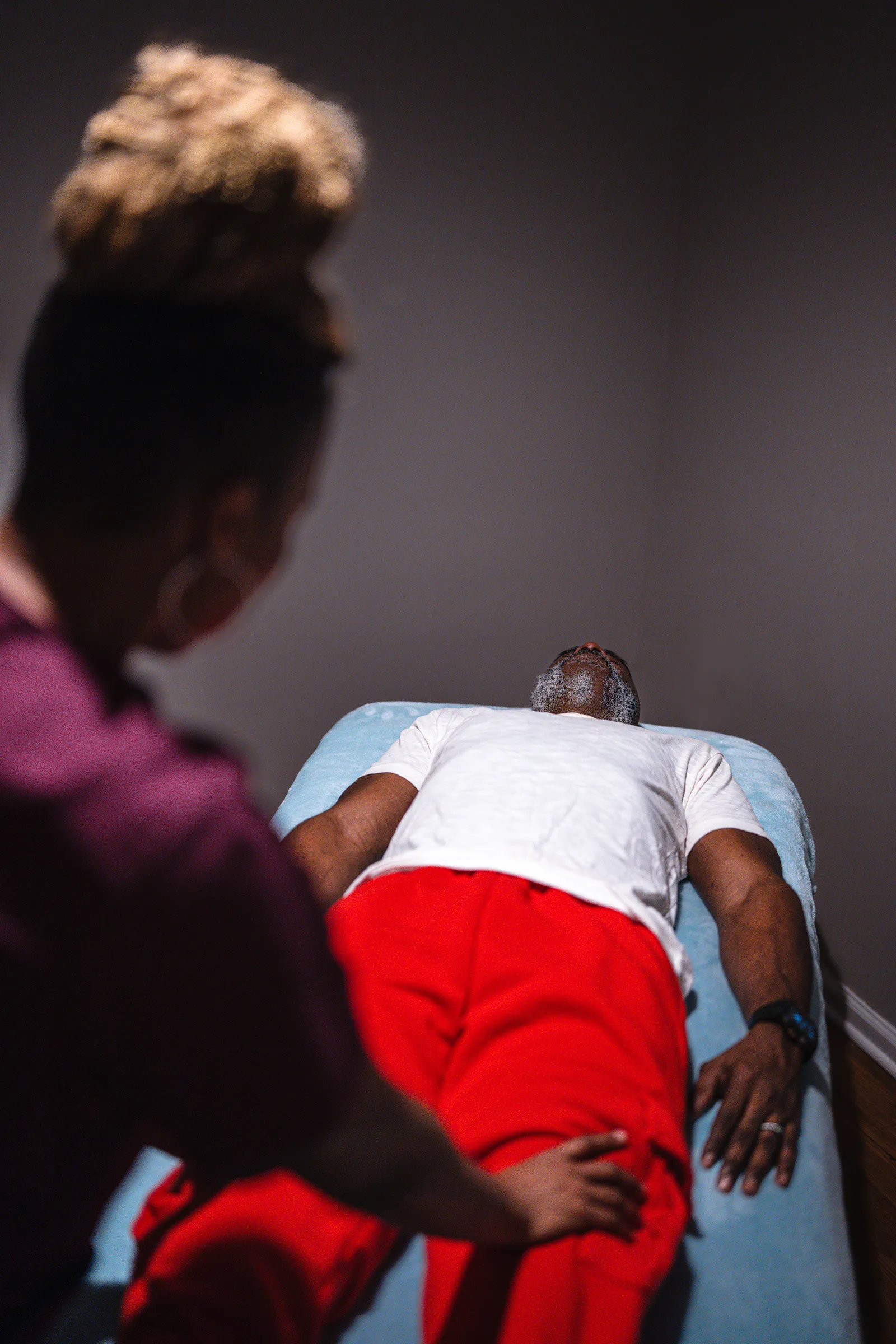
Getty Images.
The nervous system also has its own pace. A pause gives the autonomic system room to downshift and gives the client time to register and integrate what is happening. Much of what we recognize as signs of a receptive state on the client’s part—the long exhale, the felt softening, the sense of settling—happens in the quiet moments, not during our busiest hands-on activity. We might think of it as a form of co-regulation: Our own settled, unhurried state offers the client’s system something to organize around.3 (This polyvagal framework offers one lens on co-regulation, though it remains a model under active discussion.)
And then there’s perception. When a stimulus is constant and busy, the nervous system habituates—it stops registering what is no longer changing. My friend and colleague Larry Koliha used to put it bluntly: “Don’t pet the client.” Constant motion and unbroken tactile stimulation can drown out the very signal we’re hoping the client will notice. A pause lets the next input land.
Pebbles into a Puddle
I often use a simple analogy with students. Imagine tossing a pebble into a still puddle. It sends out a clear set of ripples that you can watch spread and settle. Now imagine throwing a handful of pebbles in quick succession. The ripples collide, cancel, and dissolve into undifferentiated chop. The chaotic surface tells us very little about the client’s experience, only that stillness is absent.
Our interventions are like those pebbles. Each one—a glide, a hold, a movement, a moment of pressure—sends a wave through the client’s system. If we let the ripples settle before the next pebble, both we and the client can perceive the response clearly. If we rush, we get noise. The pause isn’t lost time; it’s what makes each intervention legible, assimilable, and clear.
The Pause as Listening
There’s another reason to wait: The pause is when we gather information. When my hands stop doing and simply wait, I can finally feel what’s happening underneath them—the yielding, the wave of a breath, the subtle shift of a pulse, a flicker of movement. Far from being idle, a pause is some of the most active perceiving we do. We aren’t standing there doing nothing. We’re standing there listening.
This kind of receptive waiting has a long lineage in osteopathy-influenced work. In craniosacral therapy and related modalities, practitioners speak of the “still point,” a momentary suspension in the body’s subtle rhythms they wait for or gently invite and then simply accompany. Whatever one makes of the underlying model, the orientation it cultivates is unmistakable: a quiet, sustained, deeply attentive listening in which the practitioner does almost nothing and perceives almost everything. In a sense, the still point is the pause distilled to its essence—proof of how much can happen and how much can be felt in the space where we stop.
This is also where the discipline comes in, because waiting is genuinely hard. The urge to do something is strong, and silence can feel like a vacuum to fill. It takes a certain confidence to trust that something is happening when, to an outside eye, nothing appears to be. But that trust is teachable and it grows. The pause of listening is very different from the hesitation of uncertainty. Presence is a skill, not the lack of one.
Melchior’s line about outlasting his clients always struck me as more than a quip about patience. When we stop supplying input, we hand something back to the client: the responsibility (and the opportunity) to do their own settling, releasing, and perceiving. The shift we’re after isn’t something we impose so much as something we make room for. Often the most useful thing our hands can offer is to get out of the way long enough for the client’s system to find its way—which may be exactly what Melchior meant by waiting longer than they could.
Practice Patience
The next time you’re with a client, experiment with Melchior’s patience. After an intervention, stop. Rest your hands or take them off entirely. Wait—past the point where you’d normally move on, past your own restless discomfort with the silence, and, if you can, past the client’s wait threshold. Track what shifts in those seconds: the breath, the tone of the tissue, the quality of contact. Let the ripples settle before you toss the next pebble.
You may find, as Melchior did, that the results you’ve been working so hard for were simply waiting for you to stop—to do less and stand there.
Stephen W. Porges, The Polyvagal Theory: Neurophysiological Foundations of Emotions, Attachment, Communication, and Self-Regulation (W. W. Norton, 2011).
A Deeper Dive—The Deliberate Pause
Engage as you normally would. Employ a technique, meet a barrier, feel tissue quality, take up slack, or make easy contact.
Stop adding. Hold your hands still. Stay with what you feel: barrier, resistance, end range, or contact. Resist the urge to adjust, search, or move on to the next thing.
Wait. Let the silence extend past your comfort—and, if you can, past the moment your client expects you to do something. This is Melchior’s wait threshold: the change often arrives just after it.
Listen. Track what changes under your hands or in the room: a softening of tone, a deeper breath, warmth, a shift in pulse, a small involuntary movement, a settling.
Proceed from what you felt, not from your plan. Let the response you just perceived—not the clock or the protocol—decide your next move.
To understand tissue-tension barriers, MTs must be constantly present and mindful. Too light and we will not become efficient at creating the healing change that is needed.