The most beautiful thing about the upper trapezius muscles is that they’re so gratifying to hold on to. There’s something incredibly satisfying about giving them a good squeeze and knowing a deep unraveling is happening under the surface. Even watching a therapist work on a client’s upper traps can be relieving. And while they look simple, there’s more to these übertense muscles than meets the eye.
I like to think about the upper traps like a suspension bridge—the bones as the road and towers and the muscle fibers as the cables—reaching vertically, horizontally, and obliquely. The human form is so much more complex and more impressive though, with its living, breathing components that the muscles, in all honesty, aren’t really like bridge cables. They’re more like a murmuration of starlings contracting and expanding in the sky. Poetic, I know. But seriously, this is what they’re like.
The upper trapezius is grouped in a trio of fiber clusters along with the middle trapezius and the lower trapezius. They’re all notable in their own right, but the thickness of the upper trap doesn’t exist just as a handhold; it’s the mover of many a joint. It influences, in no particular order, the skull, all of the cervical vertebrae (C1–C7), the scapula, and the clavicle. That’s a lot of real estate, which means a lot of fibers pulling in a lot of directions, creating a vast range of motions that the head, neck, and shoulder are capable of achieving.
Getty Images.
The Head and Neck Parts
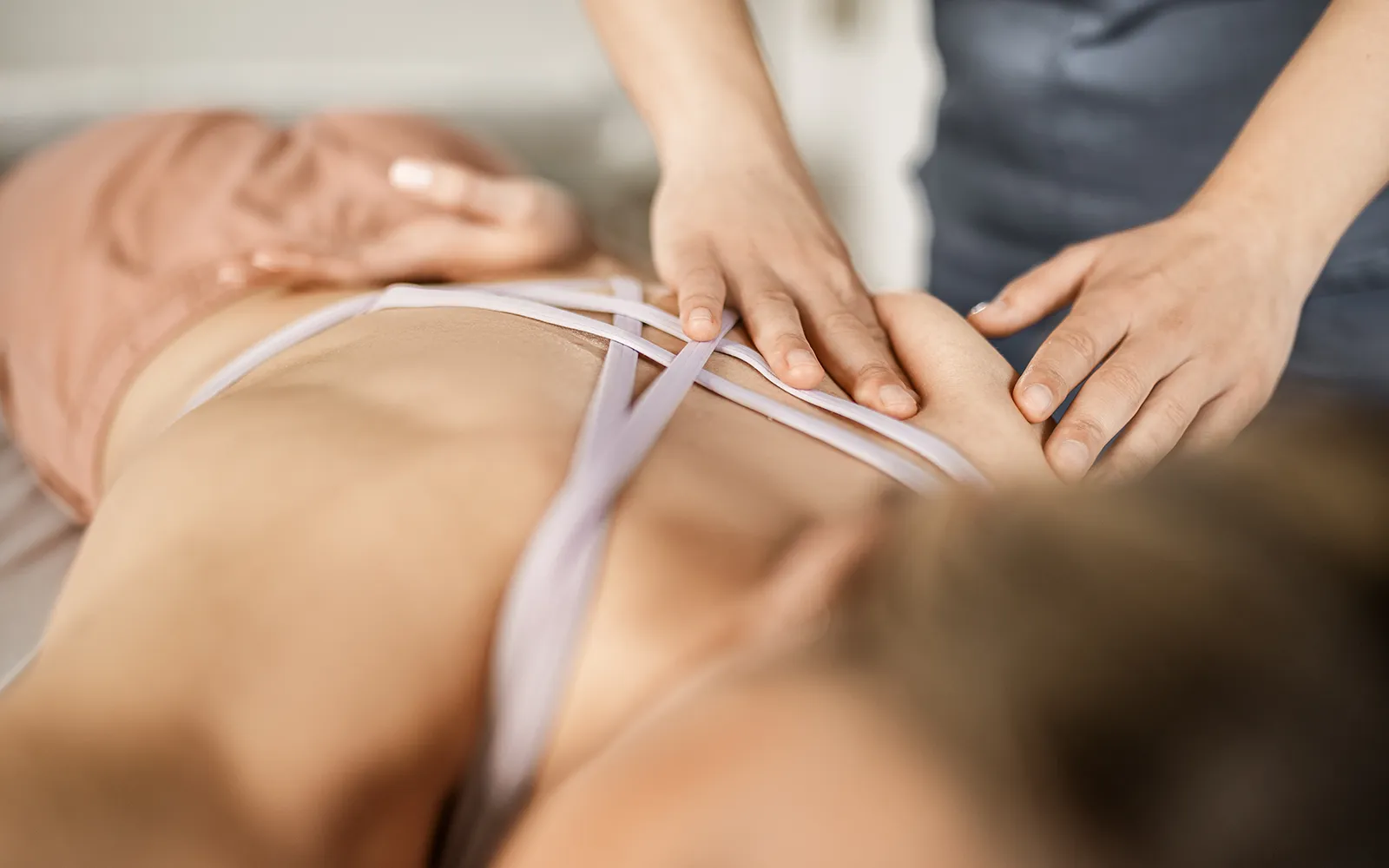
The upper trap attaches to the medial third of the superior nuchal line, external occipital protuberance, and the spinous processes of C1 through C7 by way of the nuchal ligament. Translated into English, this means that when the head and neck move, these fibers move. Translated into massage approaches, this means that compressing into or grasping the upper trap while moving the head and neck can be beneficial.
The Shoulder Parts
The upper trap attaches to the lateral third of the clavicle. That’s it. I know, I know . . . you thought I was going to say scapula too. Some sources do include the acromion process, which is part of the scapula. And even if the traps don’t technically bind to the scapula, they do influence it. Could you imagine moving our clavicle without moving our scapula? That would be creepy. In massage, focusing on the upper trap while moving the shoulder—more specifically, the scapula—yields great results.
More Than Cables
The upper traps are unique, though, in their twist from the back of the head and neck to the forward-facing clavicle. They flip over and change directions. It’s pretty impressive. And that’s what makes them so complex, so responsive, and so unlike anything a bridge cable could do. They’re not linear with movements in one plane. They’re living and breathing like that murmuration of starlings. Bodywork here involves a lot more than a few wrenches and hydraulic jacks. It takes a calm strength and tactical finesse.
What’s most important to keep in mind is that it’s not just that the head and neck rotate, extend, flex, and toss long hair around at heavy metal concerts. It’s also about the scapula. This bone can elevate, depress, slide around the curve of the rib cage, and scratch a cheek when the hands are occupied with a triple smashburger. Combining the actions at each end of this muscle can be dizzying—both literally and figuratively.
It’s in this moment that our ability to switch from acknowledging the whole being to zooming into the minute details is our superpower. Working in tiny increments, finding angles that pay attention to every aspect of these fibers, and methodically employing both passive and active movements for the head, neck, clavicle, and scapula are the kinds of bodywork that address a lot of previously unanswered questions.
Working Together
The upper traps are indeed nothing without their middle and lower brethren. None of this happens in isolation. I’ll be the first to admit that parsing anatomy into categories, fiber directions, and attachment points can create a kind of tunnel vision that works against us. When we carve the body into labeled pieces, we risk forgetting that these pieces have never been separate. But I also know that focusing on the pieces of the whole brings new perspectives. And new perspectives, in my opinion, keep us thinking and on our toes.
Looking at this group of fibers, understanding why they twist and how they move the bones they move is a study in respect. We can’t fully appreciate those starlings until we know that no single bird is in charge. The upper traps are the same: Study the parts, then put them down and feel the whole thing move.
To understand tissue-tension barriers, MTs must be constantly present and mindful. Too light and we will not become efficient at creating the healing change that is needed.