
Regenerative Medicine and Massage Therapy
By
Ruth Werner
Regenerative medicine is broad, rapidly changing, and growing in popularity.
Note: This article is adapted from Ruth Werner’s upcoming textbook A Massage Therapist’s Guide to Pathology, 8th edition. This is presented with the kind permission and support of both Massage & Bodywork and Books of Discovery.
Remember how March 2020 felt like the end of the world? For many older massage therapists, the COVID-19 shutdown marked the end of their professional career. And then months later, for people coming back to work, it all felt like starting from zero again. For people new to the profession, it felt like unknown territory. For everyone, it was hard to find reliable guidance, and many of the messages coming from the government and regulatory bodies seemed irrelevant, unrealistic, or contradictory.
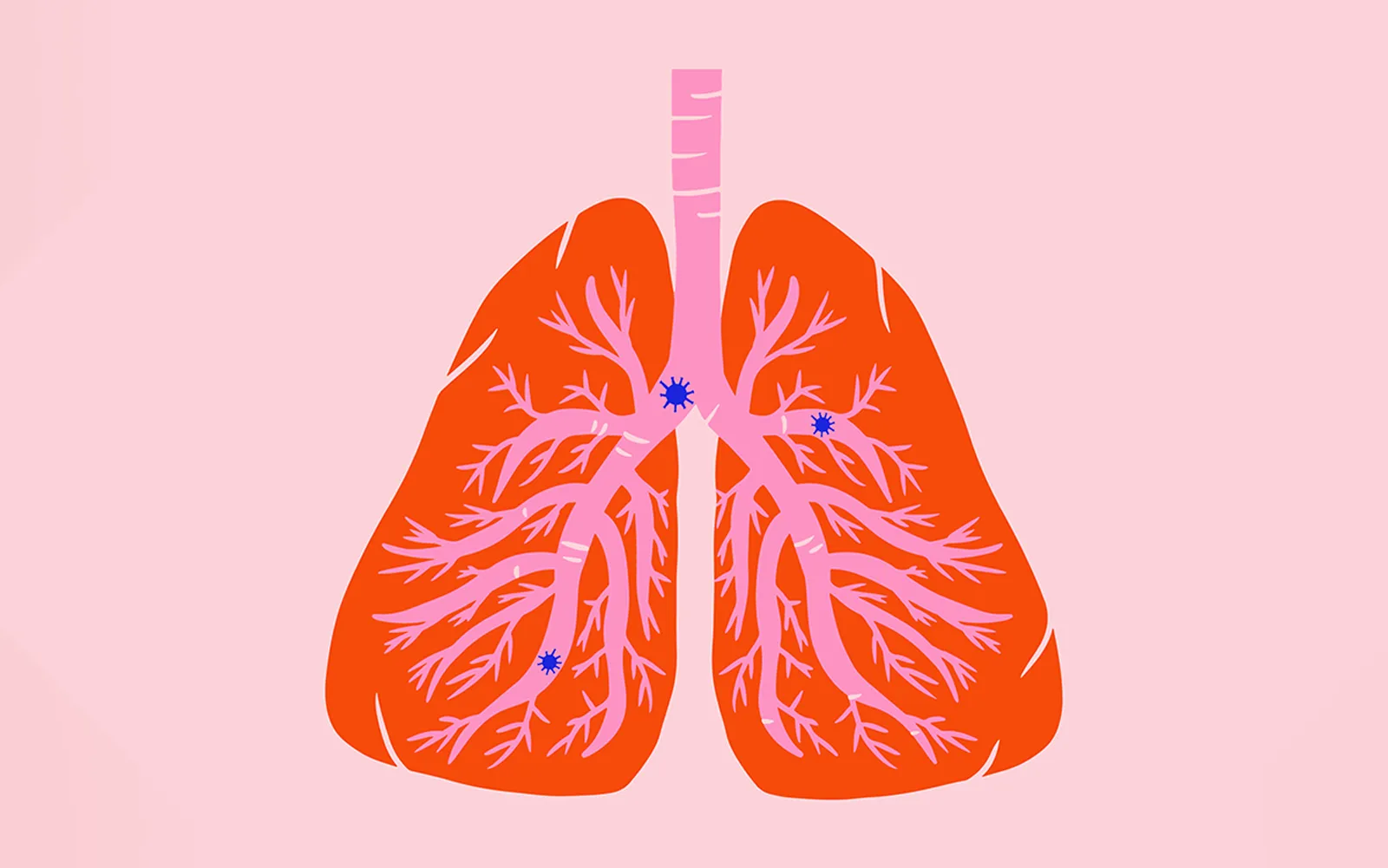
That was a difficult time, and now COVID-19 no longer seems like the threat it was (although it still causes over 50,000 deaths in the US every year). And from that crisis, we watched an entirely new chronic condition reveal itself: long COVID. This complication of COVID is teaching us a lot about some other common disorders, and this may open new avenues for treatment or even prevention.
When COVID-19 was at its peak, we noticed that some people who survived the initial infection didn’t go through what might be called a “normal” recovery. Their symptoms lingered, sometimes for weeks or months—or longer. Some of them got sick that first year, and their problems persist to this day. Other people regained function in the short run, but then developed entirely new, often unrelated, and sometimes bizarre symptoms in the weeks and months after their infection. For some, symptoms cleared up after a year or more, and for others it seems they may never get back to pre-infection function.
Early theories did not explain all the aspects of long COVID, and we had no treatment options that would improve the prognosis. Since then, we have learned a lot, but long COVID continues to be a challenge for many.
Long COVID is still not well understood and may eventually be identified as a collection of completely different disease processes. For now, the main factors and theories include the following overlapping issues.
This result of CNS damage includes postural orthostatic tachycardia syndrome (POTS), digestive problems, brain fog, headaches, shortness of breath, and temperature dysregulation.
Some people with long COVID develop new autoimmune diseases. We also find that people with pre-existing autoimmune diseases have an increased risk of developing long COVID, compared to the general population.
Many survivors of COVID-19, especially the first wave before vaccines were available, sustained irreversible damage to the brain, heart, lungs, kidneys, and more. Loss of function in these organs also contributes to long-term symptoms, including a need for organ transplants.
Viral damage to blood vessels causes clotting and ischemia. This can affect many organs, including muscles and the brain.
The virus that causes COVID-19, SARS-CoV-2, may linger in some tissues, where it continues to elicit responses that cause symptoms. At the same time, other latent viruses, notably Epstein-Barr virus, herpes simplex, and cytomegalovirus, may reactivate.
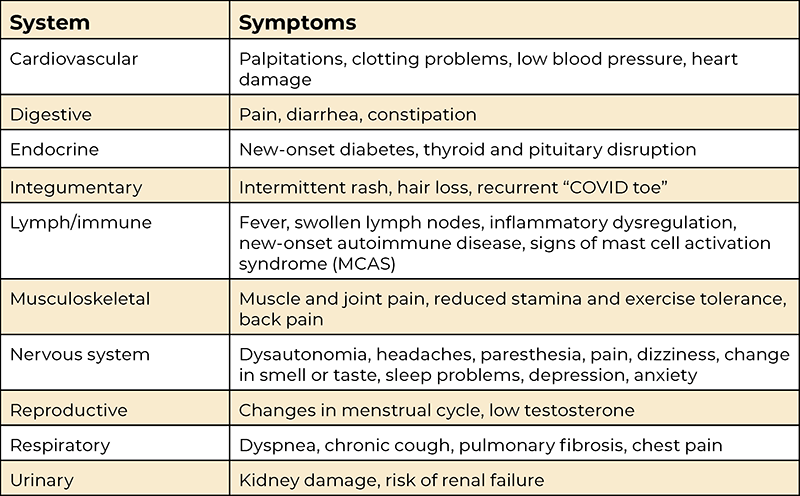
For many patients, symptoms may come and go in unpredictable patterns. The most commonly reported symptoms include brain fog, fatigue, and post-exertional malaise—which makes long COVID sound almost identical to another common post-acute infection syndrome, myalgic encephalomyelitis/chronic fatigue syndrome (ME/CFS). Other symptoms demonstrate how long COVID affects every system in the body (see “Long COVID Effects”).
Long COVID affects somewhere between 5 to 10 percent of all people who get COVID-19. The risk of developing long COVID increases with each subsequent COVID infection. Therefore, the best way to prevent long COVID is to not get infected. Vaccinations, along with basic personal protection in the form of masks, conscientious hygienic practices, and good air filtration systems can reduce this risk in a massage therapy setting.
At this point, long COVID has no cure or treatment that is effective for the majority of patients. Instead, it’s addressed on a symptomatic basis, with the goal to restore normal activity and pre-infection quality of life. Sleep quality, diet, and exercise are first strategies, but exercise must be done with care—it’s easy to overdo. Respiratory therapy and pulmonary rehabilitation can help to improve lung function, and medications to improve other symptoms may be recommended.
It’s possible that massage therapy could be helpful and even restorative for some people with long COVID, as long as specific cautions are observed.
Bear in mind that COVID infections can cause long-term damage to the heart, lungs, kidneys, and other organs, so those complications must be identified in order to make appropriate accommodations. Further, each person’s experience varies from one day to another; this can be unpredictable. Finally, some people may have long-term problems with skin lesions and blood clotting. (See “Beyond the Intake Form” for more details on seeing clients with long COVID.)
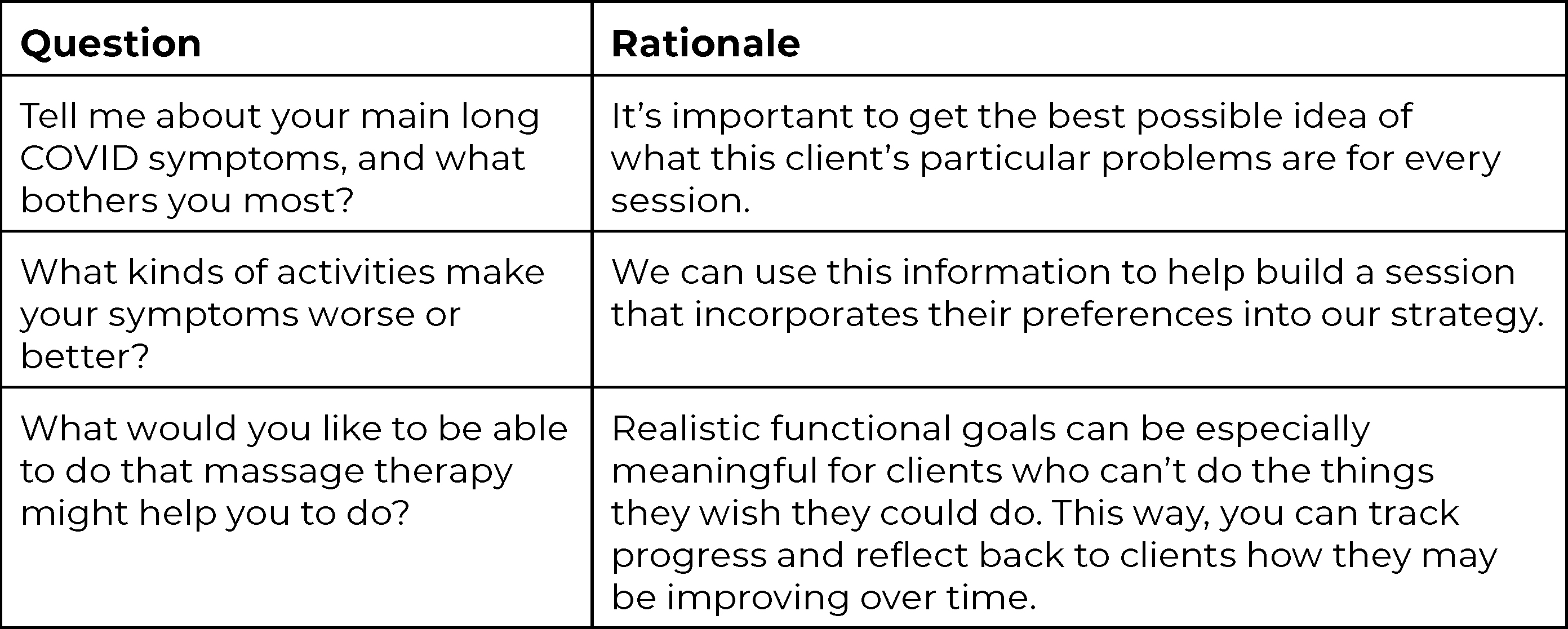
It’s well established that massage therapy can help with many symptoms of long COVID, and several studies suggest that these findings can be applied to long COVID patients. Other studies have looked at lymphatic massage for fatigue and breathlessness, and acupressure for anxiety (see Resources).
Massage therapy for people with long COVID must be guided by their symptoms and priorities. In the absence of skin lesions and blood clotting problems, most massage therapy that respects the client’s resilience is safe and appropriate.
For clients who are affected by dysautonomia, be aware that dizziness and POTS may be a problem when they change position. This can sometimes be addressed by inviting them to sequentially tighten and release muscles from the extremities to their core—this redirects blood flow and improves awareness to lessen problems with dizziness and balance.
Public health surveys suggest that 15–20 million adults in the US are living with long COVID. Their symptoms may persist for months or years. And our work can be helpful if we offer it with appropriate care. I’m eager to hear more stories for my podcast “I Have a Client Who . . .” on The ABMP Podcast Network about successful outcomes for our clients who struggle with this difficult situation.
Bilc, M., and H. Cramer. “Use of Complementary Medicine Among US Adults with Post-COVID-19: Results from the 2022 National Health Interview Survey.” The American Journal of Medicine 138, no. 5 (May 2025): 862–9.e2.
Castanares-Zapatero, D., et al. “Pathophysiology and Mechanism of Long COVID: A Comprehensive Review.” Annals of Medicine 54, no. 1 (2022): 1473–87.
CDC. “Long COVID.” Accessed May 10, 2026. https://cdc.gov/long-covid/index.html.
Chen, B., et al. “Viral Persistence, Reactivation, and Mechanisms of Long COVID.,” eLife 12 (2023): e86015.
Dani, M., et al. “Autonomic Dysfunction in ‘Long COVID’: Rationale, Physiology and Management Strategies.” Clinical Medicine 21, no. 1 (January 2021): e63–7.
Ganesh, R., and B. Munipalli. “Long COVID and Hypermobility Spectrum Disorders Have Shared Pathophysiology.” Frontiers in Neurology 15 (2024): 1455498.
Grout, L. “Use of Complementary and Integrative Health Approaches in Adults with Long COVID in the US, a Nationally Representative Survey.” Journal of Integrative and Complementary Medicine 31, no. 2 (February 2025): 143–54.
Heald, A. H., et al. “Reducing Fatigue-Related Symptoms in Long COVID-19: A Preliminary Report of a Lymphatic Drainage Intervention.” Cardiovascular Endocrinology & Metabolism 11, no. 2 (June 2022): e0261.
Riste, L., et al. “Testing the Feasibility of a Self-Help Intervention That Includes Lymphatic Drainage to Reduce Fatigue-Related Symptoms Among Patients with Long COVID in General Practice: Experiences from Our Randomized Controlled Trial (RCT).” Infectious Diseases and Therapy 15, no. 2 (February 2026): 577–89.
Taieb, A., et al. “The Growing Understanding of the Pituitary Implication in the Pathogenesis of Long COVID-19 Syndrome: A Narrative Review.” Advances in Respiratory Medicine 92, no. 1 (February 2024): 96–109.
Wheibe, E., et al. “The Multisystem Effects of Long COVID Syndrome and Potential Benefits of Massage Therapy in Long COVID Care.” International Journal of Therapeutic Massage & Bodywork 17, no. 1 (March 2024): 19–42.
Regenerative medicine is broad, rapidly changing, and growing in popularity.
Understanding hypothyroidism’s symptoms, causes, and treatments can guide MTs in better interacting with these clients.
Clients who have had head injuries can most benefit when their massage therapist makes them feel safe.
It's important to know the slight differences between fainting (syncope), and feeling faint, dizzy, or lightheaded.