


Healthy fascia provides for pain-free, easy movements and supports a balance of muscle flexibility and functional strength. Dysfunctional fascia limits or even prohibits our ability to comfortably perform specialized movements and routine tasks like sitting, standing, walking, or laying down with ease.
Is there anywhere you are experiencing pain or limited mobility? Therapy balls can provide that assist. Therapy balls, foam rollers, and other similar tools are convenient remedies that offset the athletic and repetitive demands bodywork places on our bodies.
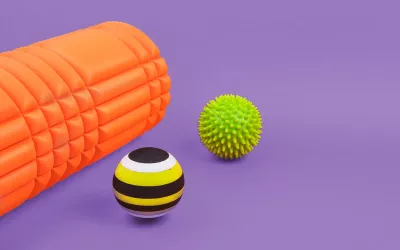
In her book, The MELT Method, Sue Hitzmann describes how to use tools to restore, rehydrate, and reorganize disorganized tissue and eradicate trigger points. Hitzmann recommends providing positive pressure with an instrument (like a foam roller or therapy ball) into restricted fascia and then initiating movement around the affected area (known as direct sheer) or adjacent areas (indirect sheer). Our regular practice of rolling out commonly stiff or vulnerable areas of tension has helped and continues to provide relief and improve functional movement. Additional therapy tool benefits include improved posture and alignment, sensorimotor control, and better sleep and digestion. We have also found that having go-to tools that reliably support our own healing is empowering!
Let’s Get Rollin’
You can purchase professionally designed therapy balls or foam rollers of different firmness and sizes, though you can also effectively explore with a tennis ball, lacrosse ball, racquetball, or similar. The firmer the ball or roller, the more intense the sensation. The following exercise may be performed standing against a wall or laying on the floor, a bed, or a massage table. (We also recommend sharing this exercise with your clients.)
Relief for the Low Back and Hips
Avoid putting direct pressure onto highly mobile bones (like floating ribs or vertebrae) as you position your therapy ball on or near one of the following locations: upper quadratus lumborum (QL), lower QL, gluteus medius, piriformis, or tensor fascia latae. Be gentle and curious as you explore the perfect intensity for you: not so much you hold your breath, not so little you don’t feel a challenge. You can vary the intensity by leaning or pressing more or less firmly and by adding or removing layers of padding, like positioning a thick blanket between your body and the ball so it’s comfortably deep.
Once you find your “Goldilocks intensity,” hold for 30–90 seconds or longer. Enjoy deep breaths and hang out in passive, resting positions. Or, add more functional opening by moving, exploring, and stretching out the target or adjacent areas of concern. When you feel complete with one spot, find another “sensory rich experience” and explore some more. Because most painful areas are asymmetrical, consider spending 2–3 times more attention and time on the challenge side versus the noncomplaining side. Practice this most days of the week and you’ll see the difference a few regular infusions of myofascial melting can make in your life!