

Spot Predatory Clients
Many massage therapists have stories of at least one client who crossed a line. Yet formal reporting in our profession remains rare.
Thanks to the women of the #MeToo movement, who have courageously exposed rampant sexual harassment and assault, our society is being forced to confront this upsetting reality and change it for future generations. The massage treatment room is a microcosm of the greater society, so we sadly find the same types of issues there. Much like in the greater community, more attention needs to be paid to this phenomenon in the field of massage.
We typically focus on bad-apple therapists abusing clients, but it happens in reverse quite frequently. Almost every massage therapist, including myself, has at least one story of such harassment. Typically, the offenders are male clients who feel entitled to be abusive by saying inappropriate things, touching their therapist, or breaching social and physical boundaries in myriad other ways. While rarer, sometimes female clients also behave inappropriately and ask for sexual acts from their therapist. Predatory sexual behavior by the client is a serious issue and not something you should ignore or try to manage on your own.
You are entitled to work in an environment free of sexual abuse. If violations happen, you have the right to make yourself safe, remove yourself from the situation, and take all available steps to have the abuser reported and made responsible for their actions. You are not alone, and you are not powerless. It is the responsibility of clinic and spa owners, industry leaders, and educators to expose these issues and devise ways to protect massage therapists from this mistreatment. One of the principle challenges to reaching this goal is that many people in power across our country are condoning and/or committing sexual harassment and assault. So it becomes particularly challenging to avoid replicating this in a given field, like massage therapy. This means it is all the more important for us to set clear boundaries in our field and support all our practitioners.
For you to be empowered when addressing any level of sexual harassment, you need an understanding of how you can respond. Here is a compilation of personal accounts shared by currently practicing massage therapists that demonstrate different types of boundary crossings or sexual assault in the treatment room, followed by a brief discussion of potential effects, interventions, and prevention techniques.
While an erection is one of the most obvious indicators of physiological arousal, it doesn't necessarily mean emotional or sexual desire is also present. Touch itself on any part of the body can stimulate a physiological response that results in a partial or complete erection. Not all forms of (accidental) arousal or discussion of sexual anatomy are inappropriate. Practitioners need to immediately clarify with their client when instances of erections or other forms of arousal occur, especially to rule out whether the behavior was inadvertent and without sexual intent. Once one party is uncomfortable, the session isn't going to be truly beneficial because attention is diverted.
It is also important to be aware of clients who repeatedly expose themselves during the treatment. One or two episodes may be accidental, poor boundaries, or a lapse in judgment. Regardless of the reason, the practitioner needs to verbalize the physical boundary of draping at the first instance of self-exposure.
Below are a few specific therapist accounts of what they've experienced in the treatment room, followed by a list of more general examples.

Client: "I'm having fun at your expense."
Therapist: "Oh? In what way?"
Client: "I've been telling everybody I have a young woman who comes to see me and tells me to get naked and get on the table (laughs)."
Therapist: "So, what do you think that costs me?"
Client: "What do you mean?"
Therapist: "Well, you said it's at my expense, so what do you think a joke like that costs me?"
Client: "Nothing. It's just a joke."
Therapist: "Well, if it's at my expense, it means it cost me something, so let's think about it. Maybe my reputation as a professional? Maybe my safety in that somebody might think it's OK to try something with me? Maybe future clients who think I do sex work? So really, what do you think it costs me?"
Client: (long pause) "I was trying to be funny. I am so sorry. I never thought of it that way."
"A man took my hand while I was massaging his forearm, telling me how lucky my husband was. He attempted to kiss me after the massage while his bathrobe was untied. Then he made it clear (by stacking cash on the end of the table and choosing only small bills) that I could have had much more money had I complied."
"I had this happen to me alone in my office for the very first time when I was fresh out of school. He was a returning client and I [would] just get into [a routine] . . . [until] I noticed when I'd move, he'd move. Took me a minute to realize he was grinding my table. I ended the massage, he left, and I went to change the table and he'd left a mess! Didn't even bother to cover it or hide it."
"Male client in his 60s was face down on my table. He lifted his pelvis and reached his hand between his legs. He was trying to catch my hand, as I was working his leg, and he said he wanted to 'show me what he wanted me to do.' I told him this wasn't that kind of place, and he said, 'Everyone has their price.' He offered a thousand extra dollars, and each time I said no, he added a thousand, eventually offering $3,000. He kept trying to 'normalize' it by saying, 'It's not sex, it's just the body. They do this at all the places in Europe.' "
Here are a few more examples collected by surveying dozens of currently practicing massage therapists:
In response to inappropriate behavior, therapists experience a range of emotions depending on their own personal history and the nature of the client interaction.
"I was so upset and angry I closed my office for a week. I felt violated, confused, and angry. I questioned every person who was ever on my table and wondered if they had done the same and maybe I just didn't realize it. It damaged me to my core. I know we're trained to understand it will usually happen, but it rocked me. I never really thought it would happen to me. I tried to make my office as clinical as possible [after that]."
"I was really stressed and scared, being a survivor of sexual abuse."
"The feeling is that the person with the money is held in higher power by the spa."
Spa management often says they will support their therapists, but many therapists report not feeling like they have the authority to end an uncomfortable session. Some even fear that if they report a client's inappropriate behavior it will reflect poorly on them. This is not true in all spa settings, but should you be in this situation, know that it is your right to end a session at any time under any circumstance. When you are interviewing at a spa, you can ask them questions about their policies and the support they offer their therapists in these situations.
Therapists recall feeling:
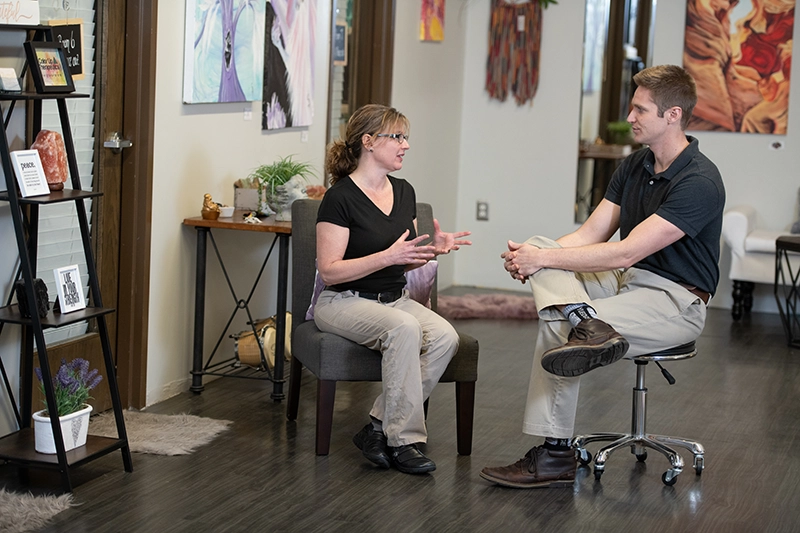
"If we are to be taken seriously and respected for our commitment, we must stand up and speak up to all inappropriate behavior," as one practitioner said.
Here is what you need to say: "I'm not comfortable with what's going on here, and it's time for you to leave." Depending on the severity of the situation, therapists describe doing the following when a client behaves inappropriately:
There is also something called "The Intervention Model"—a communication model developed by Daphne Chellos for practitioners to use when verbal or nonverbal communication from a client is unclear or when practitioners feel their boundaries are being violated. The Intervention Model is a gender- and orientation-free process. Depending on the situation, you may be able to stop after one step, or you may need to go through all the steps.
"Allowing any boundary crossings makes sexual boundary crossings more likely," as one practitioner put it. Massage therapists have had success in reducing or eliminating client boundary crossings by implementing some or all of the following procedures:
If you model a healthy comfort level talking about all physiological changes a client might experience during a session, you have provided several things: an opening for the client to express concerns, an education for a client about how the body works, good boundaries, and a safe environment.
As Cherie Sohnen-Moe writes in her article "Desexualizing the Touch Experience," therapists can take proactive steps to avoid client boundary crossings by doing the following: be prepared, be conscientious about your language and behavior, have a clinical-feeling office space, monitor treatment interactions, and be thoughtful about representation in marketing materials.1
It is essential that massage therapists feel safe in the work they do. It is our field's responsibility to do all we can to educate about, prevent, intervene, and recover from boundary crossings in the massage setting. By explicitly naming the issues and offering up some suggested policies and procedures, we can contribute to minimizing these instances of sexual misconduct and their harmful effects.
1. Cherie Sohnen-Moe, "Desexualizing the Touch Experience: A Proactive Approach," Sohnen-Moe Associates, Inc., 2011, www.sohnen-moe.com/articles/desexualizing-the-touch-experience-part-1.
Many massage therapists have stories of at least one client who crossed a line. Yet formal reporting in our profession remains rare.
Predatory sexual behavior by any potential or current clients is a serious issue. Let’s review ways in which therapists can advocate for their own safety and for safe working environments.
A new theoretical framework for massage considers how intention before, during, and after a session can profoundly impact the efficacy of your work.