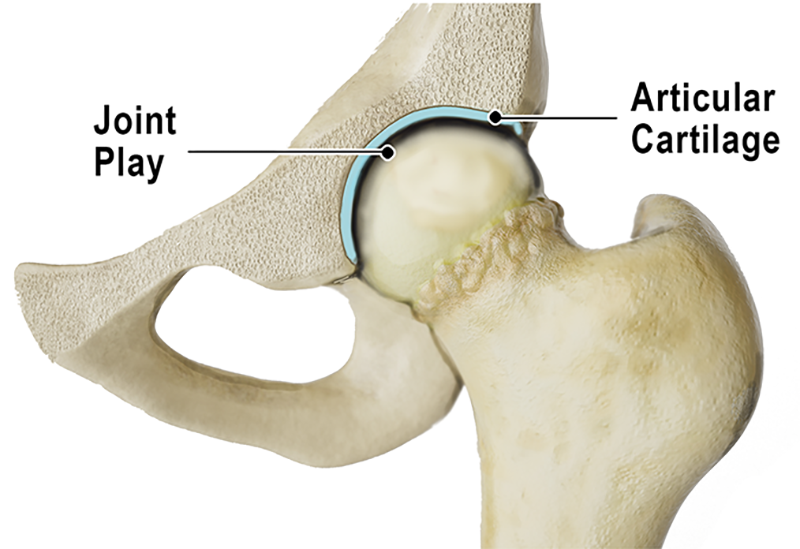
In nature, friction exists wherever there is movement, and it affects objects in all sorts of ways. By briskly rubbing our hands together, we create thermal energy to warm them up. When we press the brakes on a car, we generate friction to reduce speed. To counter the negative effects of friction, everything made to move has a built-in factor of "play" that lessens friction and promotes efficient movement (Image 1). The wheel on a car axle, the piston in the cylinder, and even the simple door hinge all have calculated play between their moving parts. Such play is critical to the function of human joints as well.
Image 1. Joint play between the femoral head and the acetabulum helps reduce friction.
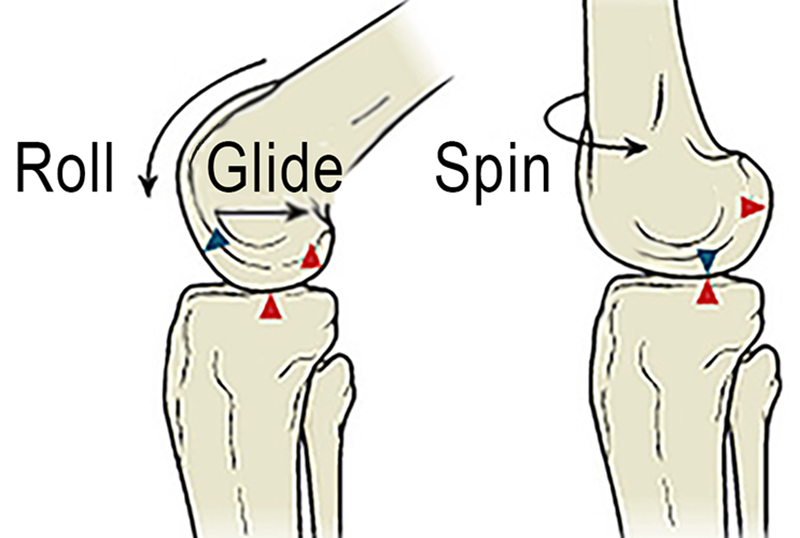
In his classic book Joint Pain, John Mennell, MD, explores the role of joint play in the human body. His research pinpoints three available movements in every synovial joint: active, passive, and joint play. Mennell described joint play as "small movements within the joint that are independent of voluntary muscle contraction."1 Although these movements measure less than one-eighth of an inch in any plane, they provide combinations of roll, glide, and spin to aid in smooth joint motion and better muscular control (Image 2). Mennell stressed that it is the integrity of these movements, not their range, that is important, and that it is the summation of joint play and voluntary movement that helps reduce friction, enrich sensory input, and boost motor output.
Image 2. Joint play provides roll, glide, and spin to aid in smooth joint motion.
Through decades of collecting anecdotal research, Mennell developed the following four basic joint play concepts:
Normal muscle function is dependent on normal joint movement.
When a joint is not free to move, the muscles intended to move the joint are not free to move it.
Muscles cannot be restored to normal tone if the joints they control are not free to move.
Impaired muscle function may, in turn, lead to greater derangement of motion-restricted joints.
Assessment and Correction
One of the goals of myoskeletal therapy is to help reduce joint friction due to tension, trauma, and weak posture. To accomplish this, we often use bones as levers to relieve muscle spasm or atrophy. During assessment, if joint play restrictions appear to be causing reactive muscle spasm, various low-force compact/distract and oscillating techniques are used. There may be individual variations in the degree of joint play at any specific synovial joint, but there is no variation of technique for eliciting each movement.
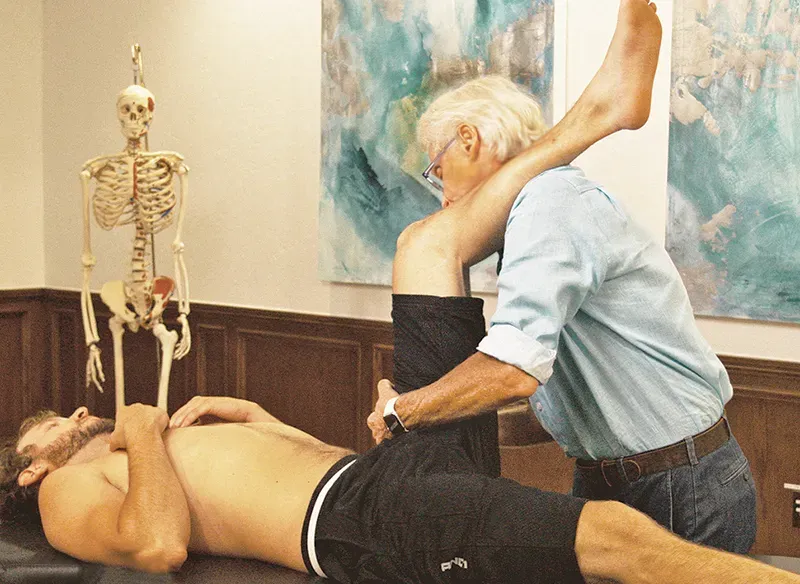
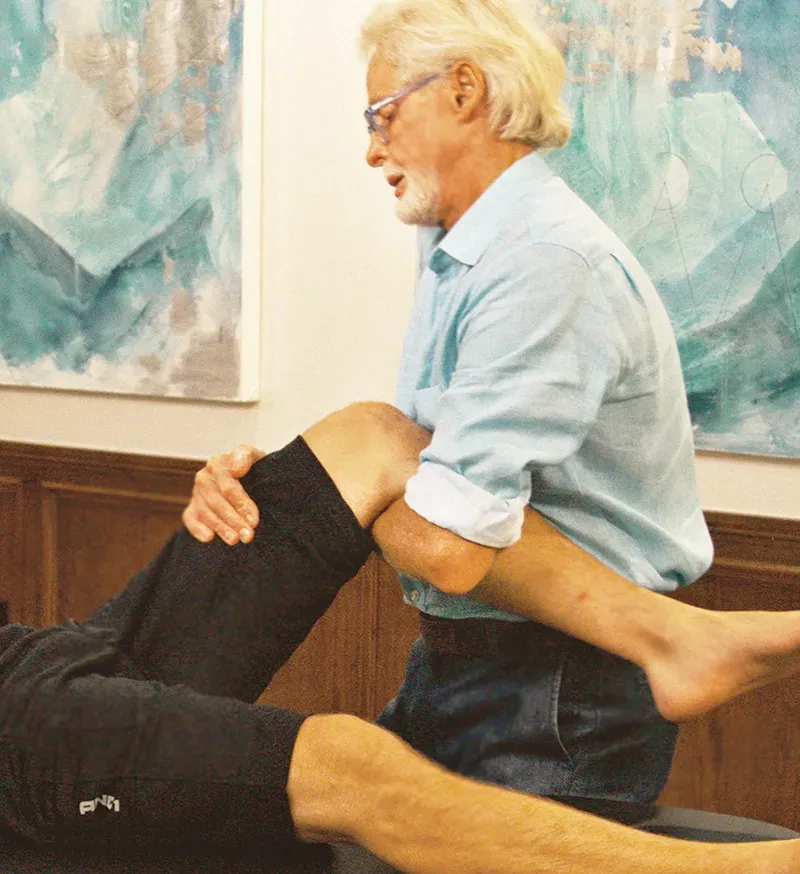
Image 3. Assess hip joint play restrictions. The therapist flexes the client's left hip and knee to 90 degrees, and places the leg on his left shoulder. Using his hands to secure the proximal thigh near the femoroacetabular joint, the therapist slowly leans his body weight back to bring the client's hip capsule to its first restrictive barrier. Without letting up on his grip, the therapist distracts and jostles the hip joint, assessing for joint play restrictions. Image courtesy Erik Dalton.
Image 4. Correcting hip joint play restrictions. The therapist flexes the client's hip, allowing his left hand to "snake" under the client's left knee. The therapist's right hand braces the client's anterior thigh, and his left hand grasps his own forearm. The therapist adjusts his body weight so he can distract, compact, abduct, and internally/externally rotate the client's femur to restore joint play. Image courtesy Erik Dalton.
In the examination of all synovial joints and their associated connective tissues, the client must be relaxed, with the therapist applying a grasp that is firm and protective but not restrictive. In Images 3 and 4, for example, I demonstrate a myoskeletal joint play assessment and treatment routine for restrictions at the femoroacetabular joint. Loss of joint play at the hip is a common finding, and left untreated this loss can lead to muscular imbalances that adversely affect strength, flexibility, and performance.
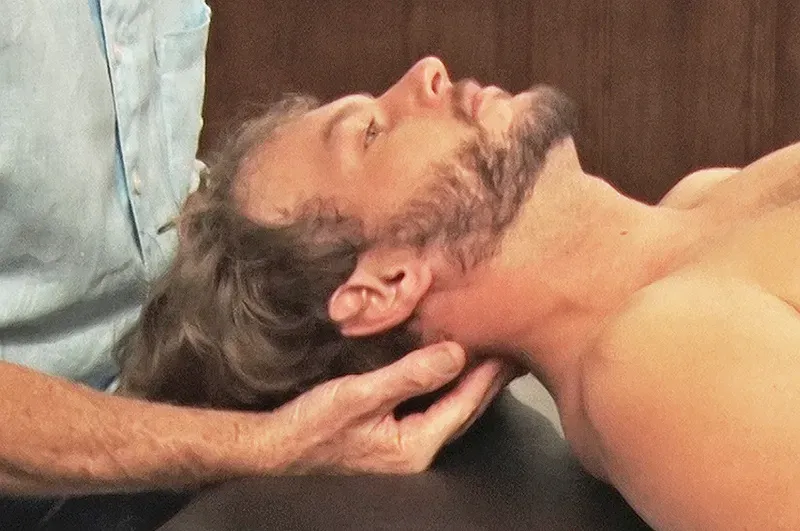
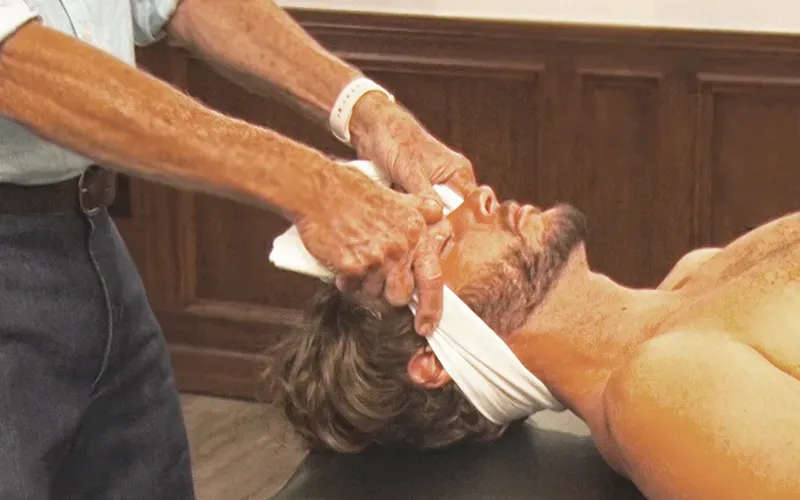
When dealing with joint play issues in smaller joints, such as the cervical spine, I often use the fingers of both hands to assess each vertebral segment from C2-3 down to C7-T1. If I discover a specific joint that does not spring like the rest, I secure the bones and connective tissues above and below the restriction, then repeat the gentle springing maneuver (Images 5 and 6).
Image 5. Assess cervical joint play restrictions. The therapist's fingers come under the client's cervical spine and gently push into the lamina groove starting at C2-3 and moving down through C7-T1 to assess for joint play restrictions or loss of cervical curve. Image courtesy Erik Dalton.
Image 6. Correct cervical joint play restrictions. The therapist uses a pillowcase (or hands) to gently distract the client's cervical spine. The therapist grips the ends of the pillowcase and places his thumbs on the client's forehead. The therapist slowly leans his body weight back to gently decompress joints and connective tissues. Image courtesy Erik Dalton.
Summary
Emphasis is typically placed on muscle disorders when assessing for functional motion loss in traditional bodywork trainings. This emphasis encourages us to focus on relieving muscle hypertonicity or retraining muscle inhibition. However, a vicious cycle of undesirable effects often occurs with musculoskeletal problems. It's important to note that some of the fault may lie in the synovial joints.
Mennell argued that joint disorders are often the cause of secondary muscle changes, particularly atrophy and spasm. Therefore, restoration of joint play should be considered an essential contributing factor for improved brain-body functioning and optimal performance. If the prime fault can be corrected, sensory input and motor output are enhanced. This helps calm central nervous system noise, relieves protective muscle guarding, and reduces reflexogenic pain-spasm-pain cycles.
Good clinical assessment and the application of appropriate soft-tissue massage techniques for pain reduction, as well as relevant exercise advice for strength, endurance, and motor control, can be used as a management strategy. In order to find a more permanent solution, remember to look for the "cause of the cause" of the client's dysfunction.
Note
1. John M. Mennell, Joint Pain: Diagnosis and Treatment Using Manipulative Techniques (Boston: Little Brown & Company, 1964).
To understand tissue-tension barriers, MTs must be constantly present and mindful. Too light and we will not become efficient at creating the healing change that is needed.