The massage therapy profession has changed, primarily due to COVID-19. Although to a lesser degree now, lack of a sense of safety caused many therapists to choose to leave the profession—not just short term, but indefinitely. The silver lining is that those of us who stuck with it and are still (or back) in practice are likely booked out weeks in advance because there are more clients to serve than there are practitioners to serve them. The not-so-silver lining is that we are seeing a lot of clients, often back-to-back, which can be extremely challenging on our bodies.
In school, you likely learned the importance of self-care before and after a work shift. However, it's just as important to rebalance your body between each session. Even if you do back-to-back sessions (especially if you do back-to-back sessions!), you must take a minimum of five minutes to unwind the tension patterns that are likely produced as you work. Even with the best body mechanics, you are still performing taxing repetitive movements.
Getty Images.
Just as you would advise self-care between sessions for your clients that involve lengthening areas that are contracted and strengthening areas that are overly lengthened, you also must keep your body balanced—ideally, between every session. It's one of the best ways to avoid pain, injury, and burnout. Plus, it demonstrates to your body that you love and care for it and that your relationship with it is significant. Your body will undoubtedly respond to that!
For long-term health, massage therapists should take a few minutes between clients to stretch and rebalance their bodies.
Essential Movements
To that end, following are five brief and effective movements that will address the most common work-related musculoskeletal complaints in massage practitioners, as recently reported in a 2022 PubMed study.1
Upper Extremity Nerve Flossing
Nerve flossing is a gentle exercise designed to mobilize a nerve along its path with the goal of breaking it free from adhesions or entrapment, reducing pain, and increasing range of motion of the extremity within which the nerve resides. It is also referred to as neural gliding or nerve glides. The following two exercises can be performed while standing or sitting with spine erect.
Radial Nerve
Place your arm straight out to the side at a 90-degree angle to the body with the palm facing toward the ground.
Keeping your fingers straight, bend up and down at the wrist.
Achieve fuller access to the entire nerve by laterally flexing the head to the opposite side (ear to shoulder) as you extend the wrist, then returning to neutral as you flex the wrist.
If this movement fails to elicit sufficient sensation, reposition the arm slightly behind your body and repeat the process.
Perform up to 10 movements on each arm.
Ulnar Nerve
Touch your index finger to your thumb while holding the other three fingers in the air (as if making the OK sign).
Bring your hand toward your face, leading with the pinkie finger, and place it at the lateral edge of the eye socket.
Achieve fuller access to the entire nerve by laterally flexing the head to the opposite side (ear to shoulder) as you bring the pinkie toward the eye, then returning to neutral as you extend the arm back to the starting position.
Reverse the movement after a brief hold.
Perform up to 10 movements on each arm.
Spinal Extension/Flexion
Sit in a chair with your feet flat on the floor and your spine lifted in a neutral position. Place your hands on your knees.
As you inhale, extend your spine. Lift your head up and slightly back and lift your gaze without overextending your cervical spine. Retract your scapulae by pulling them back and down your rib cage. Your arms will be bent.
As you exhale, reverse the movement. Flex the spine, making sure to contract the abdominals. Push the back body toward the space behind you. Allow the scapula to protract. Drop your chin toward your chest. Your arms will be extended.
Repeat each cycle 5-10 times. A complete cycle involves extension and flexion.
Wall Angel
Stand with your entire back body against a wall. Extend your arms out to each side with palms facing forward (hands will be at hip level).
As you inhale, slowly raise your arms overhead while maintaining contact with the wall.
As you exhale, slowly lower your arms back to the starting position while maintaining contact with the wall.
Repeat each cycle 5-10 times. A complete cycle involves raising and lowering the arms.
Knee Rocking
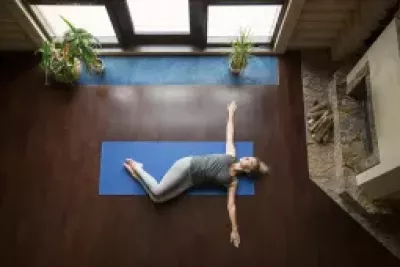
Lie on your back with your knees bent. Keep knees and feet together. Feet can be touching the floor or suspended in the air.
Bring your arms out to a T-shape along the floor with palms facing down.
Rock your knees from side to side as far as possible while keeping your shoulders in contact with the floor.
As you rock your knees, rock your head from side to side in the opposite direction of the knees.
Exhale as you rock to one side; inhale as you return to neutral. Each movement is performed with your natural breathing rhythm, so the pace of the movement from side to side will vary per individual.
Repeat each cycle 5-10 times. A complete cycle involves rocking the knees to each side one time.
The Self-Care Sandwich
While this article focuses on movements to engage between each session, it's also important to warm up and cool down at the beginning and end of a work shift. The following sequential set of movements, which I like to call the "joint journey," is excellent for warming up and cooling down all your joints. This sequence is excellent for lubricating the joints, reducing adhesions, and increasing range of motion.
Starting at the feet, progress through each major joint of the body, taking it through its available range of motion. Repeat each movement 5-7 times.
For example, begin with the talocrural (ankle) joint. Take the joint through dorsiflexion and plantar flexion 5-7 rounds. While the next movement is at the subtalar joint rather than the talocrural joint, you might even incorporate inversion and eversion for 5-7 rounds, and so on.
Similarly, perform active range of motion for the tibiofibular (knee) joint, coxal (hip) joint, spinal column, glenohumeral (shoulder) joint, humeroulnar (elbow) joint, distal radiocarpal (wrist) joint, and the temporomandibular joint (jaw).
Five Minutes to Freedom
Freeing our muscles, connective tissues, nerves, and joints is essential to longevity in a career that is highly physical in nature. It's far too easy to simply move from client to client without taking the time to care for yourself, recover from the work you've done, and negate pain and injury before they happen. If you work in an environment where five minutes between sessions is not available, seriously consider renegotiating your schedule. Your health, fitness, and physical recovery as a massage practitioner is of the utmost importance and is worth your self-advocacy.
Note
1. Elena Sirbu et al., "Work-Related Musculoskeletal Complaints in Massage Practitioners," Work 72, no. 3 (2022): 901-7. https://doi.org/10.3233/WOR-205306.
Context is powerful: Even light, mindful touch can significantly shift pain and proprioception, reminding us that how we work matters as much as what we do.