Letting go gives us freedom, and freedom is the only condition for happiness. If, in our heart, we still cling to anything—anger, anxiety, or possessions—we cannot be free.
—Thich Nhat Hanh
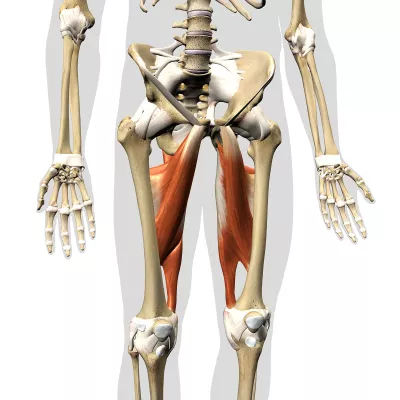
There are a handful of muscles in the body that are notorious for being difficult to stretch. The abdominals, the iliopsoas, and the tibialis anterior and posterior top the list. But the adductors take the cake for being simultaneously easy and hard to stretch.
Getty Images.
For a large group of the population, posing with a wide stance and bending one knee can be quite the challenge. The adductors are getting stretched, but are they really elongating? Not so much. And, in my opinion, having worked with them on thousands of clients and owning some myself, I believe the adductors are secretly proud of themselves for this title. For massage therapists and bodyworkers worldwide, the challenge presented to us when a client walks (or limps) into our office with tight or torn adductors never fails to keep us guessing. How we work on them, it turns out, is like the paradox of how to find inner happiness.
No Rest for the Adductors
When we are born, our adductors are as supple as butter and as stretchy as gummy worms. Our little bodies are sweet-smelling balls of bread dough that can mush into positions that make our adult bodies jealous. Our legs, more specifically, lend us so much movement that we can not only reach our knees to our ears but some of us even discover that we can suck on our toes. It would be even sweeter if our flexibility stayed with us as we aged, but, alas, it does not. The desire to walk comes with the necessity of stability. And so, our muscles become strong to prevent bobbling around like Bambi on an ice-covered pond.
For massage therapists and bodyworkers worldwide, the challenge presented to us when a client walks (or limps) into our office with tight or torn adductors never fails to keep us guessing.
The problem is that the muscles that require the most strength are the adductors. True, standing and walking takes a lot of coordination from a lot of muscle groups. The quads, hamstrings, calves, and core muscles get worked. Growing up and doing things proves to be a great exercise that morphs a body from squishy to awkward in just a handful of years. But if those adductors aren't working overtime, the possibility of falling into a spontaneous split increases tremendously—which would be a tad embarrassing. (Or maybe not if you like to play the comedian.) The other previously mentioned muscles get the occasional break—like the quads rest when the hamstrings take over what the knee does. And vice versa. But the adductors? If they relax for even a minute, all hell breaks loose.
OK, maybe not all hell. But small amounts of hell over an extended period of time eventually translates into a lot of hell. There's too much that can go wrong with the hip complex. If those adductors aren't dialed in and in control, a little shift can equate to a downward spiral of pain. So the adductors learn early that being in control is a necessity. And they perfect it. Which is great. We need someone to be in control. But, as I always say, a person's (or a muscle's) greatest asset is also their biggest downfall.
In their secret efforts to master the art of puppeteering, the adductors fall victim to the inability to let go. And letting go, as you might have heard, is the key to happiness. But teaching the adductors to let go is like asking DNA to stop writing code. It's not going to happen. The best we can do is shine a light on how being a control freak can be a little destructive. Just a little . . .
Step by Step
Try this:
With your client in the sidelying position, have them slide toward you so that their back is close to the edge of the table. Preferably they are wearing exercise shorts, because draping with groin work can be cumbersome. Have the client bend their top leg toward their chest and extend their leg that is on the table.
Standing at their back and situated at the hamstrings, hold the ankle that is on the table and passively flex their knee, bringing their foot toward your hip. With your free hand, grasp the adductors and tell them they can let go—this might not come easy to them.
With your fingers sinking into the relationship between the adductors and the quads, your thumb palpating the communication between the adductors and the hamstrings, and your palm getting a good read on the adductors, continue to flex and extend your client's knee to get a feel for each of these interactions.
Talk It Out
To up your awareness, you can have your client chime in both physically and verbally. Ask them to actively flex and extend their knee against your resistance, giving you more information about how the knees behave with each other. Also ask your client to tell you how each of these movements feels, giving you a better sense of how things are going internally.
From here, you can do all the work you have been trained to do. Compression, friction, pin and stretch—it's up to you. Just remember that the adductors aren't very well acquainted with the happiness that comes with letting go. This will be new for them. They will need some time to adjust.
Context is powerful: Even light, mindful touch can significantly shift pain and proprioception, reminding us that how we work matters as much as what we do.