Attention to detail can make all the difference. On the other hand, stepping back and looking at a bigger picture can help us see important things we might have otherwise missed.
The rib cage is a place where both principles apply. With more than 100 joints, hundreds of named soft-tissue structures, numerous vital functions (including organ protection, posture, and breathing), and key roles in movement of the spine, upper limb, and walking, working with the rib cage means we need to understand its fine details, and at the same time, how they relate to its big-picture functioning.
One example of the rib cage's abundance of details: Where the ribs meet the spine, each costovertebral joint has a very small amount of movement. But considering that each of the 24 ribs can have as many as four spinal articulations (typically, with two adjacent vertebrae, the intervertebral disc between them, and a transverse process superiorly), we can see how the cumulative movement range for all these tiny joints together becomes the whole-spine rotation involved in walking, or the side-bending flexibility needed to reach or step, or the balance of thoracic flexion and extension mobility essential for comfortable sitting.
Techniques such as the Costovertebral Joint Technique (see "Working with Rib Restrictions," Massage & Bodywork January/February 2012 issue) can help us assess and address the individual costovertebral joints in a thorough and detailed way. But with so many anatomical and functional details, when working with the rib cage it's easy to lose the forest for the trees. As an alternative to narrowing in on the rib cage's details, we're often even more effective when we broaden our focus to include its larger functional groupings as well.
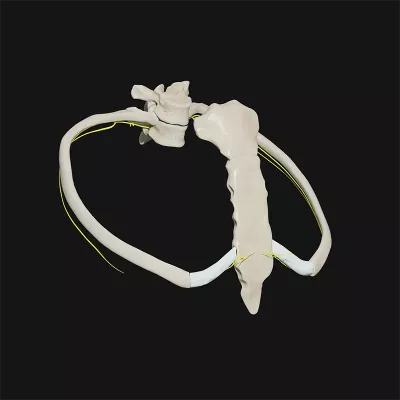
One functional group I'm currently thinking about in my own work is the thoracic "rings."1 Each left and right pair of ribs, the two vertebrae they articulate with, and the sternum can be thought of as forming a single ring-shaped unit (Image 1). Though each ring typically has 13 bony joints within it, rib rings move as a whole in relationship to their neighboring rings, oftentimes more than the bones they're made up of move in relation to each other*.2
Image 1. Each pair of ribs, together with the two vertebrae they articulate with and the sternum, can be thought of as forming a single ring-shaped unit. Typically, there is more mobility between adjacent rib rings than between the individual bones they're made up of. Rib-ring mobility restrictions or sensitivity can adversely affect spine, trunk, neck, and limb mobility. Image courtesy Complete Anatomy.
Twisting, flexing, and side-bending the torso all involve moving these ring-units against one another. In breathing, the rings move like the pleats in a squeeze-box, or the hoops of an unfolding or collapsing Chinese paper lantern. In static sitting or standing, they can be thought of as functioning like a stack of plates. In bending the trunk (forward, backward, or laterally), the rings move like the coils of a slinky toy.
These are good analogies—when the rib rings are evenly mobile, that is. When they're not mobile, whether because of stiffness or pain, our work can help, and thinking of the rib cage as a series of rings opens up many new hands-on possibilities. When a client complains of a restricted or painful movement, you can use your hands, your eyes, and your client's reported sensations to find out which big-picture movements are difficult or sensitive, and thus how to proceed. Feel these things on yourself now, and ask yourself these questions:
When Breathing
Does the space between each ring expand and contract all the way around?
Does the anterior part of each ring lift and fall with the breath (pump handle motion)?
Do the rings raise at their lateral edges during inhalation (bucket handle motion)?
When Bending the Spine
Does each space open and close as expected (for example, does each space open in the back and close in the front when flexing, or open on the right and close on the left when bending left)?
Do the rings slide laterally toward the opening side a bit (e.g., translate right when bending left)?*
When Twisting the Trunk, as When Looking Over One Shoulder
Do the rib cage's rings each rotate in relation to their neighbors?
Does each ring slide off to the opposite side a bit (e.g., translate right when looking left)?*
Does each ring also warp a little (rotate upward in back on the opposite side of head rotation direction, and downward in back on the same side as head rotation)?*
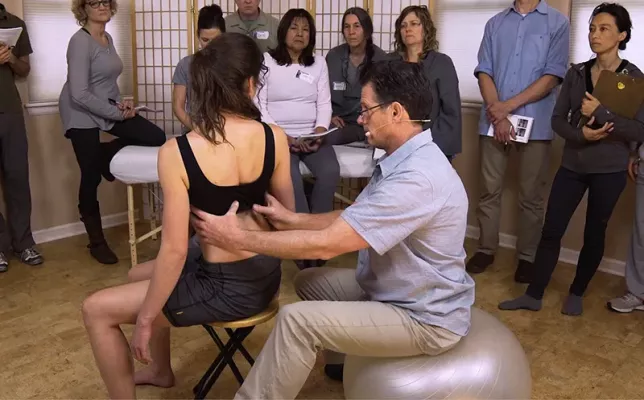
When any of these questions reveal a more difficult or more sensitive movement direction, we have a variety of seated or on-the-table techniques to choose from. For example, the Barber Pole Technique (Image 2, see below) is especially suited for assessment, mobilization, and desensitization of rib-ring rotation.
Image 2. The Barber Pole Technique (named after the evenly spiraling stripes of a barber pole) helps assess and address left/right rib-ring rotation (as well as other ring movements) at each level of the thoracic spine. Image courtesy Advanced-Training.com.
Your preferred therapeutic modality and style will determine whether you take a soft-tissue, articular, movement, proprioceptive, manipulative, or other approach. It'll also influence your choice to stay big picture and work with the entire ring, or go for smaller joint-, ligament-, or muscle-specific details. Whatever your approach, just as you don't want to let the "trees" of the ribs obscure the "forest" of the rib cage, you don't have to limit your consideration of these rib-ring movements solely to the times clients complain of rib cage-specific symptoms per se. Other functions such as neck rotation, arm and shoulder use, seated posture, bending, walking, and stepping all require rib-ring mobility as well.
One tip: A simple way to assess for these big-picture connections is to support or hold a movement-impaired rib ring into the direction of more difficulty (that is, help it do more of what it wasn't doing on its own), and see if the difficult or sensitive neck, spine, or shoulder motion improves.
Most of all, don't be surprised by dramatic relief from both locally stiff or painful spots, as well as improvements in big-picture functions like bending, walking, or breathing, when you help refine rib-ring proprioception and increase the options for rib-ring mobility.
*In the list of rib-ring movements, the starred movement options are often quite small, and so the most challenging to assess. They are also the rib-ring movements with the most controversy around them. Sliding (contralateral translation) and warping (upward rotation of the contralateral rib and downward rotation of the ipsilateral rib) are thought by some3 to be normal biomechanical movements associated with the shape of the joints involved, while others4 debate the usefulness of the "normal" movement concept, as well as the clinical significance of the smaller movements described. Personally, I have found all of these concepts useful in my own work with clients, so I have included them here. The debates are however important reminders that there are many factors involved in the improvements we see in our work, and that our ideas of what is normal or significant are conceptual maps rather than objective facts.
Notes
1. The thoracic ring concept, common in physical therapy, is attributed to Canadian physiotherapist L. J. Lee. Her trademarked Thoracic Ring Approach is described at https://ljlee.ca/.
2. ". . . Each ring typically has 13 bony joints within it:" This statement applies to ribs 1-10. The floating 11th and 12th ribs form open caliper-like (versus closed ring-like) units, since they are not connected anteriorly to the sternum. As they are connected to only one vertebra each, and do not connect to transverse processes, they have more intrinsic rib-to-vertebra mobility than the closed rings of ribs 1-10.
Difficult or painful trunk, spine, neck, shoulder, or breath movements
Purpose
Assess rib-ring mobility, sensitivity, and connection to other movement issues
Instructions
As your seated client looks over one shoulder, assess each rib ring's rotation for range, movement quality, and sensitivity.
Optionally, feel for the ring to shift (translate laterally) away from the direction of head rotation or for the small warping movement described in the text.
Compare with rotation in the opposite direction.
In each place restrictions were found, use the same grip to gently encourage mobility in the more difficult direction. Wait for a breath; release; repeat.
And/or, use other techniques to address the mobility restrictions found, then repeat the assessment.
Context is powerful: Even light, mindful touch can significantly shift pain and proprioception, reminding us that how we work matters as much as what we do.