
Strengthen Your Vagal Tone
Use this self-care technique to generate a state of calm alertness.
Can you feel your heart pulsing in your chest? How about in your fingertips? What happens when you notice your heartbeat in your feet? Consciously directing our attention on a point of intentional focus is essential to growing our intuition and expanding our sensory prowess. Likewise, reversing the polarity of our head-centric culture by "placing our brain in our feet" generates a cornucopia of whole-body healing possibilities.
Reimagine new contexts for your feet and build an inner architecture for your consciousness that reliably allows you to presence yourself and feel good in your body.
When you consider feet, what associations arise? Clean/dirty, tired/happy, ugly/beautiful, and everything in between informs how we approach our clients' feet and treat our own. The grandmother of Western reflexology, Eunice Ingham, declared in her seminal publication, Stories the Feet Can Tell Thru Reflexology, all of our feet have stories to tell.
Genius visionary, inventor, and early anatomical wonderer Leonardo da Vinci once said, "The human foot is a masterpiece of engineering and a work of art." Indeed, Renaissance architecture—flying buttresses allowing for impossibly high domed cathedrals—extolled the functionality and beauty exemplified by the feet.
Daily, we traverse the earth with three primary foot arches, flying buttresses in support of our human architecture. In harmony and resonance with earth and sky, gravity, and ground reaction force, we walk, massage, dance, run, jump, and stand. In fact, we wouldn't have modern "arch"itecture were it not for arches.
Ida Rolf once said you either engage with gravity or you are compressed by it. In an effort to engage with gravity, we have put together a series of healing moves for the feet that rehab or prehab injuries, sustain a harmonious engagement with gravity, and promote multidimensionality of movement. In general, when rehabbing any area, we recommend moving in the following four-level progression of intensity.
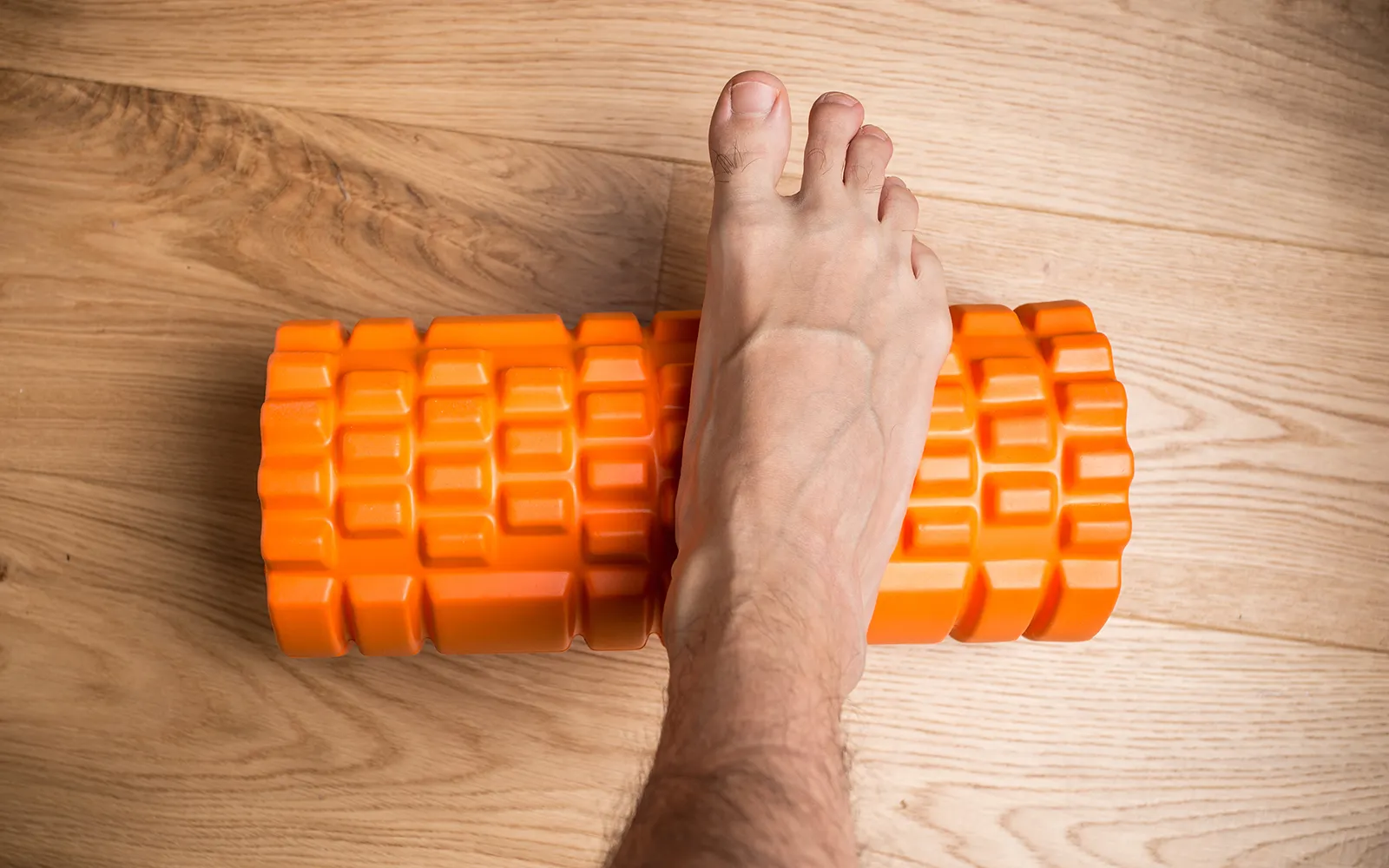
Range of motion (ROM) is within the natural movement possibilities of the joint (no forcing or hyperextending).
A common "call for motion" repatterning popularized in the structural integration tradition, this simple and potent first-aid healing move for knee, ankle, and foot pain activates and coordinates the muscles of the lower extremity to recalibrate synergistic movement among these structures.
Another oldie but goodie from the repatterning coaching of structural integration, this healing move may be performed while sitting with your legs stretched out in front of you.
This healing move generates strength and foot dexterity while reinforcing strength and flexibility of the foot arches. When the muscles and nerves in our feet are communicating and coordinating smoothly, we create more stability around our ankles, knees, and hips and greater support for our lower back.
Practicing your favorite healing moves for five minutes daily will often provide better results than practicing for an hour every other day. Committing daily to a little self-care and TLC for your feet generates a strong foundation, a launchpad for a healthy spine, and a clear mind from the ground up. And, by regularly directing loving attention to all our parts, we build and fortify a conscious architecture of inner reliance, trust, and sure-footedness in our body and mind.
In middle school, my pediatrician alerted me that my left foot's arch was collapsing. "Nothing to worry about," he said, just a change he noticed during that year's annual physical. Later in my early 20s, I began to notice my toes were beginning to take the shape of what I later learned were hammer toes, much like my pop pop's misshapen and crookedly arranged toes.
Though there was no pain associated with this, I figured I needed my feet to be happy at least another 60-80 years. So I chose to get proactive. My experiential and anatomical study of the human body began, with particular emphasis on the structure of the feet. I began to use my left foot as the laboratory, experimenting with all forms of movement, including yoga, medical qigong, myofascial, and chiropractic repatterning exercises. I hypothesized that I could actually regrow my arches and straighten my toes. And I did! After six years of patiently and diligently giving my feet my curious attention, I started to see results.
Use this self-care technique to generate a state of calm alertness.
Use this cord-cutting exercise to reclaim your energy and restore your vitality.
Sound healing can be easy to incorporate into your practice and into your daily self-care routine.
It’s easy for us to get stuck in our work—physically, mentally, emotionally. Let’s look beyond the usual self-care routines to find better ways to get unstuck and back to the work you love.