How the body heals has not changed, but the techniques, research, and science behind what we do has exploded since I graduated from massage school. The numbers and effectiveness of newer modalities are blooming to awesome levels, and one technique that exemplifies this trend most exquisitely is the active engagement technique (AET).
If you haven't heard of AET, it may be because there are a lot of techniques out there with aliases, depending on when and where you were educated. There is also a good chance you are already using this technique in your practice and didn't even know it. Yes, you are that smart.
Bodywork, massage therapy, healing touch—these have been around for thousands of years. The intuitiveness of what we do is what sets us apart from mainstream medicine. My guess is that there are infinitely more techniques than what has been documented and trademarked.
In a typical session, perhaps you work through a dysfunction, ease tension, calm anxiety, or simply activate the parasympathetic nervous system. The placement of your hands; the rate of your strokes; and the pressure, depth, and broadness or sharpness of your contact are all enormously differentiating. All these layers of approach vary so much from therapist to therapist that it creates an opportunity for diversity in any one technique or, more expansively, the blending of multiple techniques.
AET Engages Your Client
The technique at hand, though, AET, is one that doesn't solely encapsulate the variants previously mentioned. It also engages the activity of your client. And I love this.
All too often, in my years as a newbie therapist, I found myself feeling zapped at the end of a long day—and sometimes even at the end of a short day. I was working very hard, as we do, and could not figure out how to keep my energy up. Physically, my body was exhausted. But it was deeper than that. I was emotionally depleted. The client was there to relax and the responsibility to accommodate that was something I took seriously. I would say things like, "This is your hour to completely let go." Or "Give yourself permission to let me do the work for you." I was proud of this nurturing side of me. But holy cow it was draining.
iStock.
Enter teamwork. We all understand the idea that healing starts from within. It is a concept we are taught in school, and it's incredible when we see it actualized. A shift in perspective, for example, can change our entire emotional state from judgmental to sympathetic, or from confused to enlightened. So why not activate that response within our clients? We ask them to practice self-care when they leave a session. Why not ask them to do the same in the moment?
Asking your client to engage in their healing is something that will not only definitively increase your emotional capacity for work, but will also give your clients a new relationship with their own health and wellness. AET has the power to pull client awareness into the session; educate them about muscle isolation; unveil any unconscious holding, guarding, or firing patterns; and leave them with a deeper wisdom about their own body.
Asking a client to actively engage in a technique breaks the mold of the therapist doing all the work—and with the most amazing results.
Performing AET
The basic principle of AET lies in the idea that once a muscle is engaged, and then relaxed, it relaxes beyond its normal resting state. Similar to the principles behind proprioceptive neuromuscular facilitation, we can use this knowledge to our advantage.
AETs are typically used with muscles or tissues that are dense or are not letting go. Finding depth can be difficult. Try these simple steps first. Once you've mastered them, the capacity for this technique is limitless. To start:
Isolate the muscle you are targeting—the biceps, for instance.
Bring the muscle into a neutral position. For the biceps, bend the elbow to about 90 degrees of flexion. You want to optimize its ability to contract.
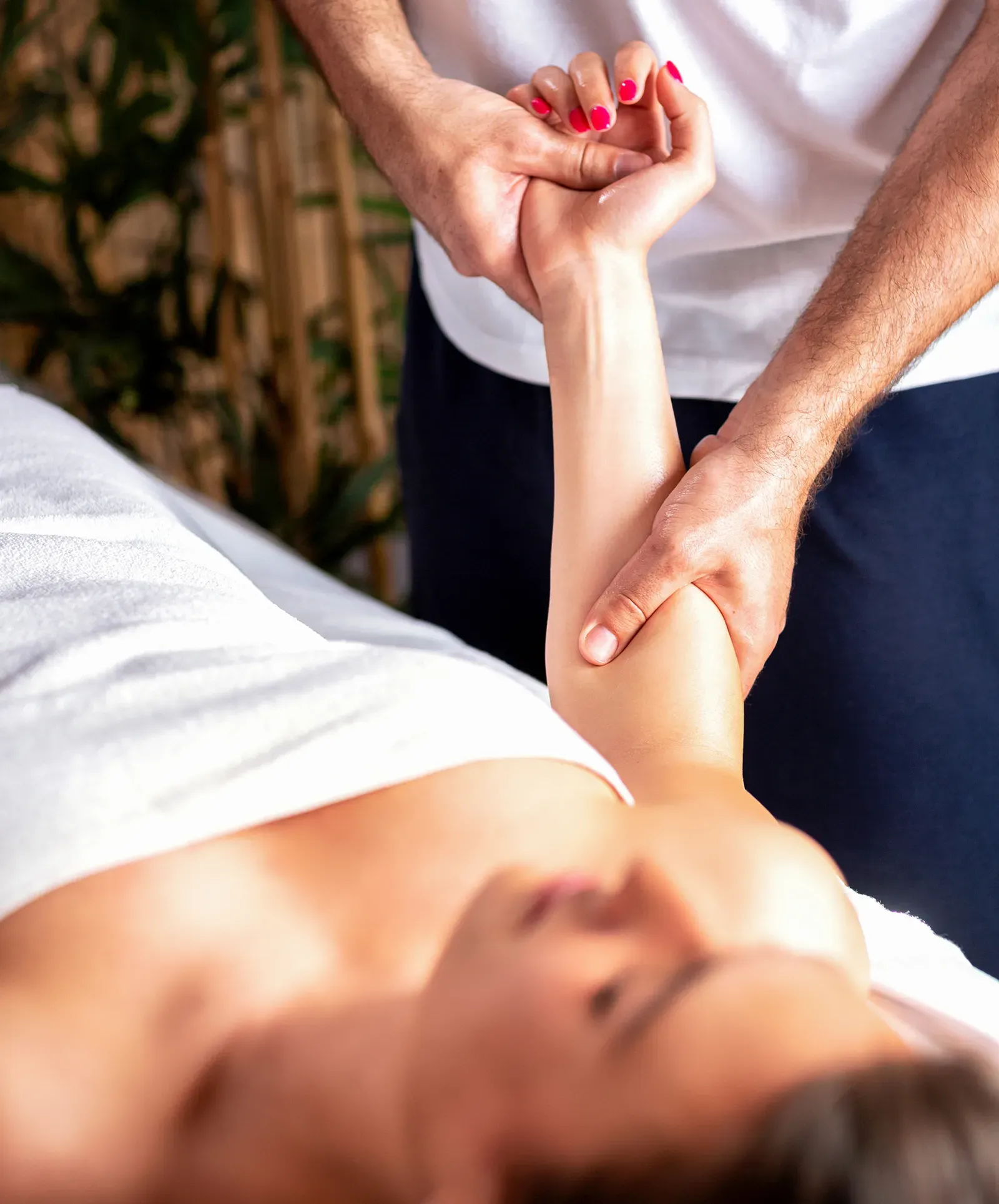
Apply pressure to the muscle with one hand. Use your other hand to supply a resistance. In this example, you are holding your client's hand or wrist while sinking into the muscle with your other hand.
Ask your client to engage the targeted muscle. In this example, asking your client to bring their hand toward their shoulder contracts the fibers of the biceps.
Hold this isometric contraction, using about 20 percent of their energy, for about 5-10 seconds.
Once your client releases the engagement, sink into the muscle a little deeper. How much further you sink in, or whether you dovetail in a pin and stretch or some myofascial release work, is up to you.
Every client is unique. But follow these basic steps, and you will find a whole new world opening up for you.
Asking a client to actively engage in a technique breaks the mold of the therapist doing all the work—and with the most amazing results. You will feel invigorated. They will feel educated. And we have just made the world a slightly better place. I call that a win-win.
To understand tissue-tension barriers, MTs must be constantly present and mindful. Too light and we will not become efficient at creating the healing change that is needed.