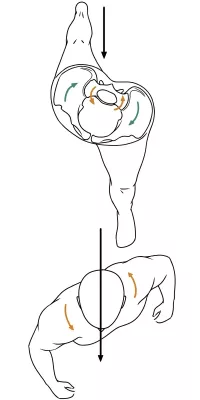
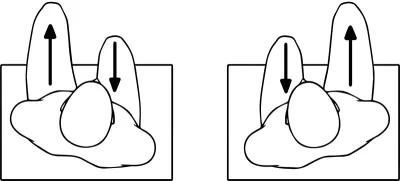
Your sacrum is part of your spine. And when you twist your spine, your sacrum twists too. Within the bony ring of the pelvis, the sacrum twists just a little—but enough that when the stiff, shock-absorbing sacroiliac joints (SIJs) are sensitized, the twisting forces of walking (Image 1), turning, or bending can trigger sensations of stiffness, discomfort, or pain.
Image 1. In walking, the two pelvic bones rotate (green arrows) around the sacrum, which twists between them at the SI joints due to the spine's transmission of torque from the contralateral arm swinging (orange). Image redrawn with permission from RL DonTigny, 2018.
Sources disagree about the precise amount of sacral movement the SIJs allow, and there is an even greater range of opinions about the clinical significance of SIJ movement.1 But most all sources agree that the function of whatever movement the SIJs allow is (a) shock absorption, (b) force attenuation, and (c) a potential source of nociception.
For More Learning
Watch "The Ilia & SI Joints" in the Advanced Myofascial Techniques series of workshops and recorded video courses.
Like other SIJ-related sensations, SIJ-related nociception can be felt either at the joints themselves, or referred to the low back, pelvis, pubic symphysis, gluteals, hip joints, etc.
In the Ilia Rotation Technique, we gently assess and mobilize the two large innominate (or hip bones) in relation to the sacrum. We test and address any sensitive or mobility differences by passively moving these bones in the horizontal plane, which mimics the slight twisting of the sacrum in walking or trunk rotation.
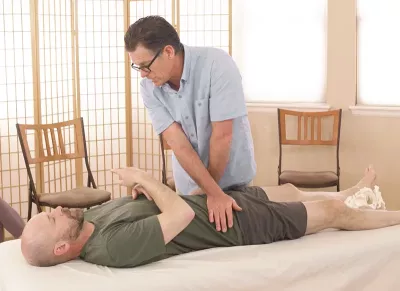
We also take time to help the client feel this potential motion in their own bodies (Image 2). This subtly but tangibly shifts sacral mobility, but, perhaps even more importantly, it also changes the subjective experience of walking and turning.
Image 2.
So, is the goal of the technique to straighten out, or de-rotate, the pelvic bones? No. Position-based descriptions such as "upslips," "torsions," "out-flares," and the like have not been reliably correlated with pain or dysfunction, in spite of being the dominant model many manual therapy disciplines use to assess and treat pelvic issues. Thus, in this approach, we're not trying to get the pelvic bones to move into any "ideal" or symmetrical static position.
"But," you might ask, "since the sacrum twists between a left and a right SIJ, what happens when the two joints aren't evenly mobile? If one side is stiffer, wouldn't that cause a slightly asymmetrical gait?" And, "Couldn't that left/right difference itself cause problems?" Again, the idea of asymmetry being the source of orthopedic issues or pain is supported by far more conventional wisdom than evidence. However, one study of SIJ pain in pregnancy did indeed show less pain in subjects who had more even left/right SIJ stiffness.2 In other words, at least in that study, the more evenly mobile the two SIJs were, the more comfortable the subjects were likely to be.
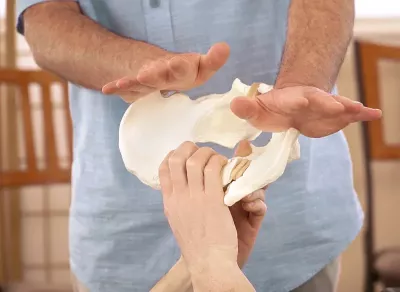
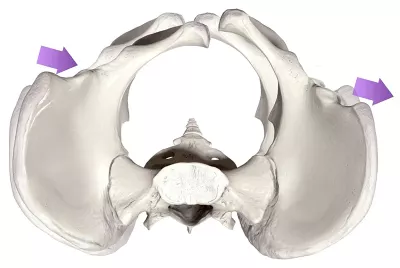
Image 3. The practitioner's hand position and direction of gentle pressure, which would encourage easier ilia rotation to the client's right.Image 4. The direction of gentle pressure. Image courtesy of Anatomy Standard, used by permission.
What's more, our focus in this technique is not on increasing range of motion; rather, it is on refining the evenness of the two sides' sensitivity and subtle mobility. This is based on research suggesting that the amount of movement at the SIJs doesn't correlate with pain: On average, people with less SIJ movement don't have pain any more or less often than people with a lot of SIJ movement,3 so it's hard to say that more (or less) SIJ movement would be reliably therapeutic.
Image 5. Self-care for the SI joint: "walking" the ischial tuberosities forward and back on a chair can help mobilize, hydrate, and desensitize the SI joints. Image redrawn with permission from RL DonTigny, 2018.
Pain, symmetry, and theories aside, in practice, our clients consistently report feeling freer and more comfortable after receiving the Ilia Rotation Technique described here. Whether this is due to more even SIJ motion or to proprioceptive changes is hard to say. But your clients will appreciate the relief and freedom they typically feel after this subtle but potent technique.
Check out the accompanying video, give this technique a try, and let me know how it goes.
Notes
1. For more about the different opinions on SIJ movement ranges and their clinical significance, check out Episode 3 of the Thinking Practitioner podcast, "Sacroiliac Joint Pain: Causes, Controversies, and Considerations," and "Working with the Ilia" in Massage & Bodywork, January/February 2013 issue. 2. L. Damen et al., "The Prognostic Value of Asymmetric Laxity of the Sacroiliac Joints in Pregnancy-Related Pelvic Pain," Spine 27, no. 24 (2002): 2,820-4. 3. DonTigny, Richard, "The DonTigny Dynamic Core Stabilization Program," accessed June 2022, www.researchgate.net/publication/328560079_The_DonTigny_Dynamic_Core_Stabilization_Program.
A Deeper Dive—Ilia Rotation Technique
Indications
Sensitivity or stiffness when walking, running, stepping, or twisting, especially when felt in the sacroiliac joints, low back, pelvis, pubic symphysis, gluteals, or hip joints.
Purpose
Refine proprioception, decrease sensitivity, and increase evenness of left/right horizontal plane (rotational) mobility at the sacroiliac joints.
Instructions
Starting with a very light touch at both ASISs, assess for left/right differences in the ilia's rotational mobility and SIJ sensitivity.
Use a crossed-arm position to assess lateral rotation (Image 2), or uncrossed arms (not pictured) to assess medial rotation. Compare each direction.
Ask for your client's report of sensitivity and mobility: "Which direction is more sensitive?" And/or, "Which direction is stiffer?"
Gently increase your assessment's pressure if differences are not felt with the initial very light levels of touch. There should be no discomfort from your pressure.
Come to an agreement about the direction of interest. Help your client feel what you do, or have your client help you feel what they do.
Use the same hand position to gently desensitize, de-threaten, and/or encourage mobility, typically in the more sensitive or difficult direction (Images 3 and 4).
If no left/right differences are found, you can repeat the technique in both directions.
Wait for a breath, then remove your hands. Wait for another breath and repeat the assessment.
Also repeat the mobilization phase, if needed, or use other techniques to address any other sensitivity or mobility restrictions found.
Have your client walk and sense into their movement as a way to help their brain register and integrate the proprioceptive and mobility shifts.
Note: Special thanks to Richard DonTigny, PT, and to Anatomy Standard for their kind assistance with this column's illustrations.
To understand tissue-tension barriers, MTs must be constantly present and mindful. Too light and we will not become efficient at creating the healing change that is needed.