
Going for Gold
A gold medal-winning massage may not be what you think. It’s not about fancy tools, flashy techniques, or pedigree. It’s about centering the bodywork on the client experience.
As massage therapists, our hands are one of our most valuable, powerful, and utilized tools. Our hands are our emissaries of touch as we press, pull, squeeze, discover, dissipate, and soothe. In every touch, we have the potential to convey and circulate kindness, care, trust, and hope. And with our hands, we can embody our capacity to give and receive by infusing our breath and mindful movements with every touch.
As touch therapists, hands are essential to not only our livelihoods, but also to our lifestyle. How we eat, drink, dress, wash, travel, text, and perform a multitude of other daily tasks relies on the performance and versatility of our hands. If you've ever gotten a paper cut or hangnail, you might recall how distractingly uncomfortable basic tasks are and how much of your day revolves around your hands.
Our hands are such a highly intelligent sense organ that they can perceive and communicate without words, interpret others' feelings, and act as superhighways of neurological awareness and relaxation.
Because our hands contain some of the highest proportion of sensory neurons compared to other body parts, they are highly sensitive to pain. Conversely, they are also a supersized gateway to the relaxation response. Indeed, our hands are more represented in our brain than any other single part of the body. Likewise, behavioral researchers are finding that "using our hands stimulates brain activity, promotes mental health, and relieves stress."1
And yet, we often take our hands for granted, not giving them the attention and care they deserve and need. As therapists, it's paramount that we lovingly tend to our hands, fingers, thumbs, and wrists to prevent injury and sustain a thriving practice. Here are some hand exercises to help you warm up before a session, awaken your senses, tune into your energy, activate your coordination, release tension, stretch your tools, and cool down post-session.
Touch is the first of the five senses to develop in utero and is often the last of our senses to diminish in old age. And, if we're lucky, our lives may be bookended by the loving touch of another's hands.
Touch can increase the release of oxytocin (our feel-good hormones), and holding hands has been shown to decrease levels of cortisol (our stress hormone). At the University of California, Berkeley, research conducted by Dacher Keltner, PhD, and his team found that humans can convey emotions through touch alone—more than half the time.2
It's amazing that science demonstrates emotions can be experienced and expressed by touch. Take a moment to consider that in a majority of cases, anyone from the general population can nonverbally and accurately interpret someone's emotions through touch. Now imagine what you, as an experienced practitioner of touch, could listen for and communicate with your hands. One way to fine-tune this aspect of your touch is to awaken your hands' healing energy.
Restore vitality in your body and activate the healing energy in your hands by contacting a potent acupressure point called Lao Gong or Pericardium 8 (PC8). This point is located in the center of your palm, where the tip of your middle finger touches your palm when you make a fist.
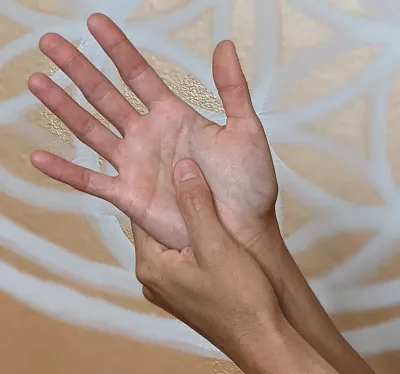
According to traditional Chinese medicine, Lao Gong (translated as "Laborer's Palace") is the eighth point on the pericardium meridian and is considered to be home to a minor chakra. Many energy healers use this point to sense or emit healing energy. Working with PC8 is vital to allowing the flow of qi to circulate through your hands and to spread to all the fingers. To get the energy and qi moving in your healing hands:
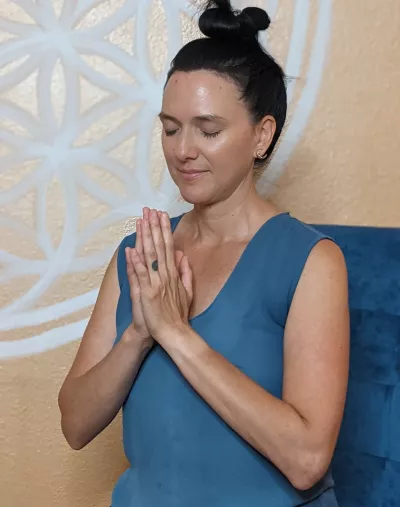
How do you experience energy in your hands? Can you sense light growing in your palms, and if so, does it have a color? Explore, experiment, notice.
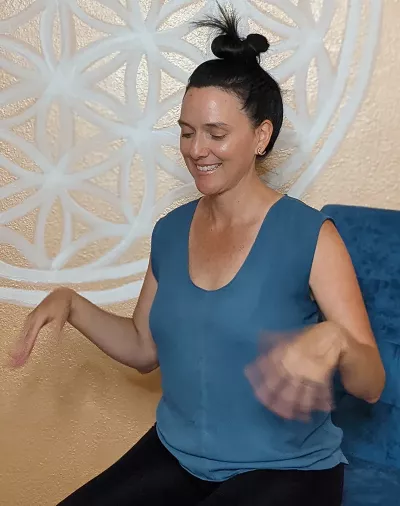
Generate more blood flow and synovial fluid circulation, and prepare your tools for hands-on healing. Start by sitting, standing, or walking around. Bend your elbows, and begin to vigorously shake your hands, wrists, and fingers for 20-30 seconds.
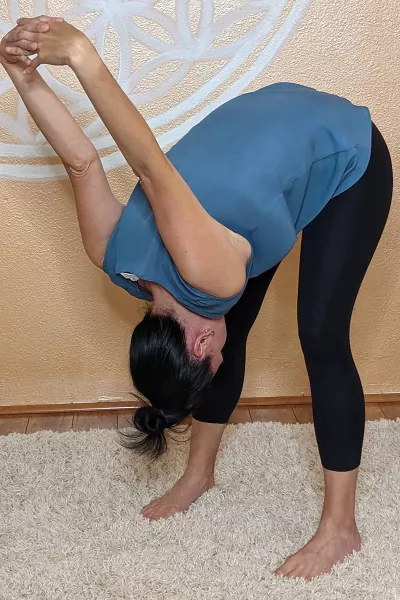
Start in a standing position and interlace your fingers behind your back. Stay here and enjoy a few deep breaths to open your chest and expand into your heart space. If you like, you can take this deeper with fingers still interlaced and begin to bend forward. To protect your spine, be sure to keep a bend in your knees so your belly or ribs are resting on your thighs. For more intensity, reach your interlaced fingers up to the ceiling or wall in front of you. This encourages the thoracic outlet to open, drains stored up tension from the spine, and gives a thorough head-to-toe activating stretch.
Activate, awaken, and warm up your hands and brain with this quick exercise. For 30 seconds:
Use this technique to start your day awakened and refreshed or to reenergize yourself in the middle of your day, as a way to drain away mental fatigue and refine your sensory awareness.
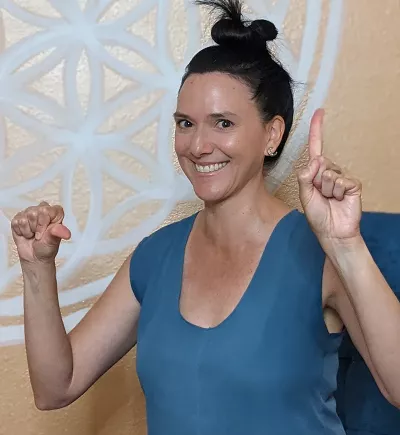
Did you know that one quarter of the brain's motor cortex, which is the area that controls all movement, is dedicated to moving our hand muscles? And because the left hemisphere of the brain controls the right hand and vice versa, we recommend people grow their ambidexterity by using both hands equally in everyday life. This will create an exponential impact on your brain, allowing for clearer thinking, better coordination, and lifelong performance enhancements while doing the things you love.
Do you work with both hands equally? Play with the coordination challenge below. You might be surprised how quickly you can upgrade your entire brain-body coordination.
These hand-brain coordination exercises help build connections in your brain that make it easier for you to think and move. Giving your nervous system new experiences keeps it healthy and actively growing throughout your life.
In a standing position, bend your elbows and bring your fingers into a soft fist, and then swiftly flick your fingers toward the ground as though you're shaking off water. Be sure to hear the sound of your fingernails flicking off the heel of your palms (especially the ring and pinkie fingers) and repeat a handful of times.
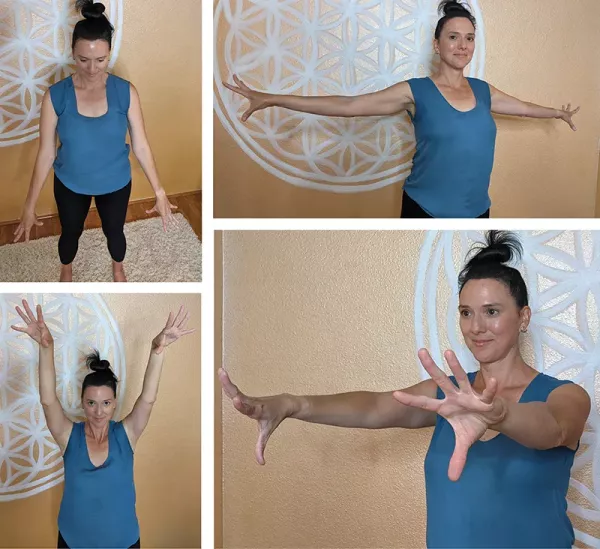
Repeat the same action on different planes of movement: Extend and flick fingers out in front of you, and then finger-flick laterally, superiorly, anteriorly, and then back down inferiorly. This is a great way to release stored energy and tension from the upper body. Some people report auto corrections in their elbow and/or carpals. Practice between or after a day's sessions.
This is an elegant healing move to open, stretch, and release accumulated tension from the jaw all the way to your fingertips. You can do this standing or sitting. Reach your arms out to the sides like wings. With the palms up, draw all your fingertips and thumbs together on each hand to make a "crane's beak."
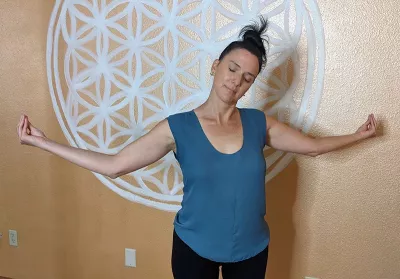
Now, externally rotate both arms so the creases of your elbows and your crane's beaks point up to the ceiling. Hold this position as you lower an ear to a shoulder and gently rock your head forward and back to find the perfect stretch for you. When you feel complete, repeat on the opposite side. Lower your arms, pause, and notice how you feel and where you feel it.
Once again extend your arms straight out, but this time, internally rotate your arms so the creases of your elbows and your crane's beaks point toward the floor. Gently add the lateral cervical flexion with the gentle rocking on each side. Bask in all the new awareness, blood, and energy circulating.
Studies show that preparing your body daily with dynamic stretches can prevent injury, increase blood flow to the muscles, and improve muscle power and strength.3 Dynamic stretching is movement based and uses active movements to create a stretch, as in a walking lunge. We can do the same for our hands and wrists.
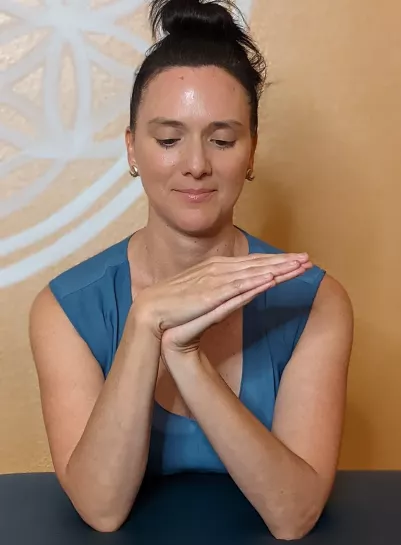
To perform this stretch:
Our hands are evolutionary marvels, hosting 29 major joints, 123 ligaments, 34 muscles, 48 nerve branches, and 30 arteries, and they are complex and flexible instruments evolved over 70 million years. Our hands are like an extension of our brain, and they are such a highly intelligent sense organ that they can perceive and communicate without words, interpret others' feelings, and act as superhighways of neurological awareness and relaxation. Successful therapists understand the power of their hands in giving and receiving, emitting and sensing, and energizing and healing. Nurture, train, strengthen, and take care of your hands; treat them like the invaluable professional tools they are.
1. High Mowing School, "The Hand to Brain Connection," accessed May 2021, http://www.highmowing.org/using-your-hands.
2. Dacher Keltner, "Hands On Research: The Science of Touch," Greater Good Magazine (September 29, 2010), https://greatergood.berkeley.edu/article/item/hands_on_research.
3. J. Matt McCrary, Bronwen J. Ackermann, and Mark Halaki, "A Systematic Review of the Effects of Upper Body Warm-Up on Performance and Injury," British Journal of Sports Medicine 49, no. 14 (July 2015): 935-42, https://doi.org/10.1136/bjsports-2014-094228.
A gold medal-winning massage may not be what you think. It’s not about fancy tools, flashy techniques, or pedigree. It’s about centering the bodywork on the client experience.
Energy work can be a divisive topic in the massage field, however, there are valuable potential benefits and insights to be gained through exploring and integrating energetic modalities in therapeutic practice.
Time perception is shaped by interoception and body state, which means hands-on work can directly influence how clients experience duration.
By recognizing the knee as a transmission point within the kinetic chain rather than a standalone joint, therapists can address the upstream and downstream restrictions that can cause knee stress and pain.