By Mary Murphy
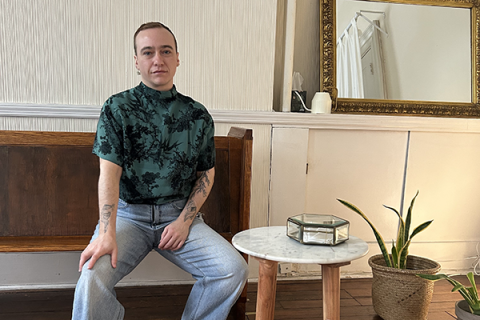
Abigail Pollock was one of the winners of ABMP’s Massage Is for EveryBody 2025 contest. We wanted to share more of Abigail’s story, which exemplifies the inclusive values of this campaign. Please join us in celebrating Abigail!
There are dozens of places massage is delivered in a more “traditional” way: private practices, franchise businesses, spas, physical therapy offices, clinics, etc. But massage takes place in more clinical environments too: hospitals, cancer centers, pediatric wards, and care homes. But financial or physical access to this type of care can sometimes be hard to find. Healwell is one nonprofit organization that, through partnerships, provides inpatient and outpatient massage therapy in a variety of settings.
Healwell is where Abigail Pollock (they/them), one of the 2025 Massage Is for EveryBody essay winners, learned about the importance of access to inpatient/outpatient massage. “I first learned about Healwell as a student in massage school in 2018,” Pollock says. “I witnessed the way they were setting standards in our field and felt I had found my hoped-for community. It became a professional goal of mine to work with them.”
In December 2024, their dream came true—Pollock joined the Healwell team. “Now, I am the clinical lead of the program at the Johns Hopkins Howard County Medical Center, where we work in partnership with the Claudia Mayer/Tina Broccolino Cancer Resource Center and their grant-funded integrative health program. Through the program, clients are awarded free massage therapy sessions—and have the option for paid sessions, which are open to care partners and the wider chronic illness community.”
Grant-funded and nonprofit programs like these are essential to provide equitable access to clients who may need it. “In 2025, I was able to partner with the BoStrong Foundation to provide a year of oncology massage to a client of mine who was awarded a wellness grant,” Pollock says. “This grant supported me to provide regular in-home sessions while my client went through cancer recurrence and treatment following [a] stem cell transplant, which would have been out of reach otherwise.”
But Pollock was left wondering how programs like these could be sustainable. What sort of model could be put in place to support not just the well-being of clients, but the providers of that care as well?
“This [recent] experience opened my mind to funding possibilities that sustainably address the needs of the practitioner as well as the client,” Pollock says. “Many current models of financial access, such as sliding scale, create losses that are swallowed by massage therapists. I have seen providers lose their businesses out of a desire to make their work accessible, which ultimately represents a loss for the clients and community.”
Luckily, Pollock has a background in grant writing and fundraising in the nonprofit sector. “I hope to be able to use this in the future to help connect integrative health practitioners with grants and other funding possibilities.” In other words, Pollock wants to be part of the solution and is using their experience at Healwell to get there.
“I have learned so much from every environment [I’ve worked in]—and I think the range is one of the factors that has made me strong in my work and able to support many diverse needs,” Pollock says. “Spas really taught me the art of hospitality, of making someone feel welcome and worthy of being cared for. Clinical settings honed my communication skills and ability to articulate what I do, both to clients and to providers in other fields, and helped me make sure my technical foundation was in line with best practices. Working in clients’ homes [taught me] so much in the finesse of interrelating soft skills and boundaries. And running my own studio was the test to see if I could pull it all together.”
What makes massage so impactful in Pollock’s field of work? “There are few opportunities in the world of medical care, and really the modern world in general, to spend an hour of undivided, concentrated attention on another human. Or to be the recipient of that level of attention,” Pollock says. “For many of us, this is a level of deep presence and transparency that may be scarce.” That is what Pollock is striving to give their clients.
“I think one of the most exciting aspects of massage therapy and body-based practices is creating a supported space for people to practice deepening their awareness of themselves,” Pollock says. “Education is the intangible value that a client carries with them well beyond the session. Although our physical time together is limited, the education will continue to influence their daily decisions. It’s an important piece of accessibility to me, that my massage therapy practice can be a well of resources, support, referrals, and listening. Ultimately, I want my clients to know everything I know and more.”
The biggest takeaway? Never underestimate the power of connection and community. No one is doing this work alone—dozens of nonprofits, MTs, educators, clinical care teams, and industry leaders are doing it together. “I am constantly witnessing my clients practicing greater autonomy, sovereignty, choice, and accountability because of our work together,” Pollock says. “I had a client who, years after surgery, finally touched his own scars for the first time. It’s so impressive and fills me with joy.”